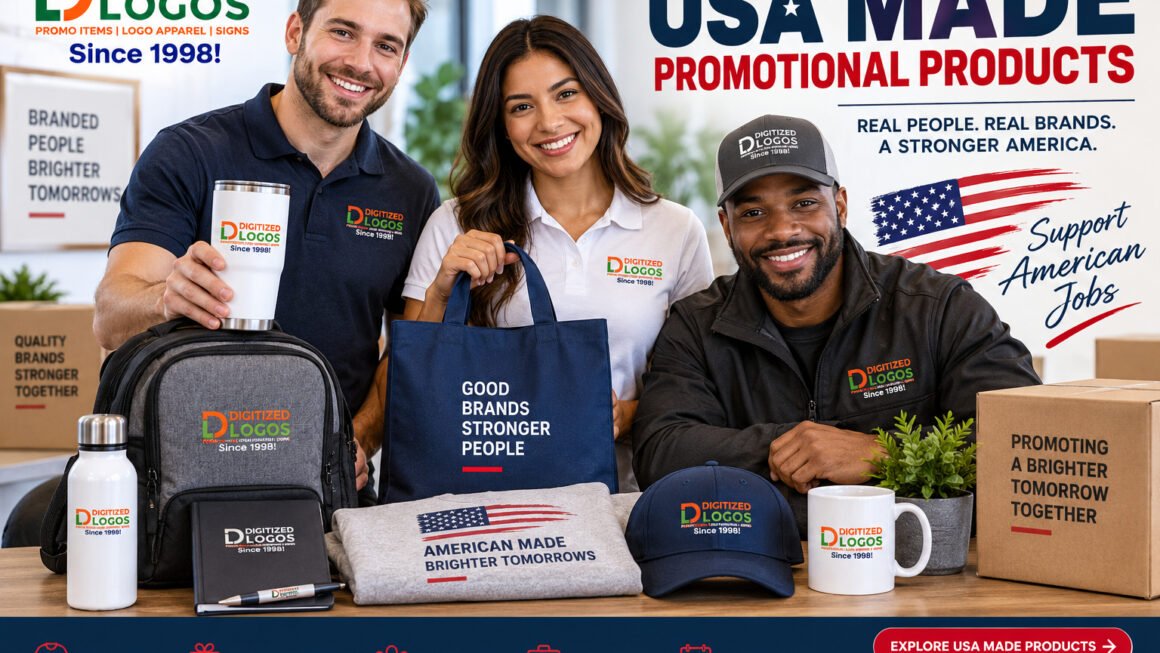
USA Made Promotional Products for Business Branding
USA made promotional products give businesses a practical way to strengthen brand visibility while prioritizing domestic sourcing, dependable quality, and more predictable supply chains. From employee apparel and onboarding kits to trade show giveaways and corporate gifts, American-made merchandise can support both everyday brand programs and time-sensitive campaigns.
For organizations comparing products, pricing, customization options, and fulfillment support, Digitized Logos provides branded apparel and promotional product solutions for businesses across the United States, including Maryland, Virginia, and Washington DC. Buyers can explore promotional products at https://products.digitizedlogos.com/ and build a merchandise mix around their audience, budget, timeline, and branding requirements.
Quick Answer: What Are USA Made Promotional Products?
Short Answer: USA made promotional products are branded merchandise manufactured or substantially produced in the United States and customized for business, employee, event, gifting, or marketing programs. American made promotional products can include drinkware, bags, apparel, office items, recognition gifts, event merchandise, and other branded goods.
For business buyers, domestic sourcing can be valuable when product origin, supply-chain visibility, quality expectations, or procurement requirements matter. The right option depends on the specific product, available inventory, decoration method, quantity, budget, and required delivery date.
Why Businesses Choose USA Made Promotional Products
Promotional merchandise is more effective when it has a clear job to do. A product may need to attract attention at a trade show, welcome a new employee, thank a client, support an internal campaign, or keep a brand visible long after an event ends.
Domestic products can add another consideration to that strategy. Companies may choose American-made merchandise because they want stronger sourcing transparency, domestic manufacturing support, easier procurement alignment, or potentially shorter supply-chain distances for qualifying products.
- Corporate gifting: Create thoughtful branded gifts for customers, partners, executives, and employees.
- Employee onboarding: Build coordinated kits with apparel, drinkware, notebooks, bags, and workplace essentials.
- Trade show marketing: Prepare useful giveaways and branded merchandise that continue generating impressions after an event.
- Recognition programs: Support milestones, anniversaries, safety achievements, and employee appreciation.
- Merchandise programs: Maintain consistent branded products for multiple offices, departments, events, or campaigns.
American Made Promotional Products vs. Imported Products
Short Answer: Neither sourcing model automatically fits every campaign. American made promotional products can be especially useful when domestic origin and supply-chain considerations are priorities, while imported products may provide broader choices at certain price points or for highly specialized merchandise.
The better purchasing decision comes from evaluating the complete program rather than comparing unit price alone. Product availability, decoration, freight, packaging, quantity, delivery requirements, and replacement risk can all affect the final cost and business value.
For example, an imported giveaway with a lower initial unit cost may be appropriate for a large campaign with a long planning window. A domestic option may make more sense when the organization has specific sourcing objectives or needs a product with a more manageable production and replenishment strategy.
How to Choose USA Made Promotional Products
A successful merchandise program starts with the business objective and works backward to the product. Choosing an item simply because it looks interesting can lead to unused inventory, inconsistent branding, or unnecessary spending.
- Define the outcome. Decide whether the merchandise should generate awareness, support an event, recognize employees, welcome new hires, thank customers, or strengthen an ongoing merchandise program.
- Identify the recipient. Consider who will receive the product, how they will use it, and what level of perceived value is appropriate.
- Confirm domestic-origin requirements. If USA-made sourcing is mandatory, establish the applicable procurement criteria before selecting products.
- Set the working budget. Include the product, decoration, setup, packaging, freight, and fulfillment rather than evaluating blank-item pricing alone.
- Select the customization method. Match the artwork and material to embroidery, screen printing, sublimation, engraving, transfer printing, or another suitable decoration process.
- Verify quantities and timing. Confirm minimum order quantities, inventory, proofing, production, shipping, and event deadlines before approving the order.
- Plan distribution. Determine whether merchandise will ship to one office, an event venue, multiple locations, or individual recipients.
Customization Options for Branded Merchandise
Customization is more than placing a logo on a product. The decoration technique needs to work with the item’s material, shape, intended use, artwork complexity, and expected wear.
Embroidery can provide a dimensional, professional appearance on polos, jackets, caps, and other textile products. Screen printing is commonly suited to apparel and larger quantities, while full-color printing can support detailed artwork and gradients. Dye sublimation can be particularly effective when designs require vibrant color and extensive coverage on compatible polyester-based products.
Laser engraving can create a refined permanent mark on compatible metal, wood, and other materials. Transfers and digital printing provide additional flexibility when artwork includes multiple colors or fine details.
Practical operational insight: Artwork should be evaluated before production, not merely forwarded to a decorator. Fine lines, small lettering, gradients, imprint dimensions, garment construction, seams, and product curvature can all affect how a logo appears on the finished item.
USA Made Promotional Products for Employee Onboarding
Short Answer: An onboarding kit works best when every item serves a practical purpose and presents the employer consistently. A coordinated combination of branded apparel, drinkware, notebooks, bags, or workplace accessories can turn a routine first-day package into a stronger employee experience.
Consider a company hiring 100 employees over several months. Instead of ordering unrelated merchandise every time a new group starts, it could establish a standard kit with approved artwork, defined product specifications, and a repeatable fulfillment process.
If each kit contains four useful branded items, that program creates 400 planned brand touchpoints while simplifying purchasing for HR and operations. The more important benefit is consistency: new employees receive the same intentional brand experience regardless of start date or department.
Trade Show Giveaways and Event Merchandise
Trade show merchandise should support the event strategy rather than compete with it. The best giveaway is not necessarily the cheapest product or the item with the largest imprint area. It is the product that the intended attendee is likely to keep and use.
For a 1,000-attendee conference, for example, a company might order 500 general giveaways rather than assuming every visitor needs an item. It could then reserve 50 higher-value branded gifts for qualified prospects, customers, speakers, or scheduled meetings.
This tiered approach can improve budget allocation. Instead of spending the same amount on every interaction, merchandise value is aligned with the purpose of the engagement.
Businesses preparing for events can browse branded promotional products at https://products.digitizedlogos.com/ and compare items based on audience, quantity, branding potential, and campaign objectives.
Corporate Gifting With American Made Promotional Products
Corporate gifting usually has a different objective from mass promotional distribution. A gift may need to communicate appreciation, reinforce an important relationship, celebrate a milestone, or create a memorable customer experience.
That often makes perceived quality more important than simply maximizing quantity. Premium drinkware, useful office products, curated merchandise sets, branded apparel, and presentation-ready gifts can create stronger impressions when matched appropriately to the recipient.
American made promotional products may also support corporate sourcing policies or brand narratives centered on domestic manufacturing. Buyers should still verify origin requirements product by product because manufacturing, components, assembly, decoration, and packaging can involve different locations.
Behind the Scenes: How a Promotional Product Order Gets Produced
A professional merchandise order involves more steps than selecting an item and uploading a logo. Behind the scenes, product specifications, inventory, artwork, decoration requirements, proof approval, production capacity, shipping, and final delivery all need to align.
After a product is selected, artwork is prepared for the intended decoration method. An embroidery design may require digitizing, while print production may require vector artwork, color specifications, bleed, or other production-ready files.
A proof is typically reviewed before full production. Once approved, the merchandise enters the decoration workflow, passes through applicable quality checks, and is packed for shipment or distribution.
Practical operational insight: Event date and in-hands date should never be treated as the same deadline. Building a buffer between delivery and the actual event provides time to inspect merchandise, organize kits, distribute apparel, or resolve unexpected shipping issues.
Buyer Considerations: Cost, Minimums, Turnaround and Quality
Short Answer: The real cost of promotional merchandise includes more than the blank product. Business buyers should evaluate decoration, setup, quantity, packaging, freight, fulfillment, production time, quality consistency, and the financial impact of a missed deadline.
How Much Do USA Made Promotional Products Cost?
Pricing varies considerably by product category, materials, quantity, decoration method, packaging, and shipping requirements. A simple high-volume giveaway and a premium executive gift serve different purposes, so comparing them purely by unit price can be misleading.
Consider a hypothetical $5,000 event merchandise budget. Spending the entire amount on 2,500 inexpensive items means approximately $2 per item before any additional costs. Allocating the same budget across 800 useful giveaways and 100 higher-value prospect gifts may produce fewer total pieces but create a more intentional engagement strategy.
What About Minimum Order Quantities?
Minimum quantities vary by manufacturer, item, and decoration process. Some products are practical for smaller executive or employee orders, while others become economical only at larger quantities.
Organizations should ask about minimums early, particularly when merchandise must be distributed across several departments or locations.
How Long Does Production Take?
Turnaround depends on inventory, customization, proof approval, production capacity, quantity, shipping destination, and seasonal demand. Rush requirements can further narrow the available product selection.
A business with a fixed conference date should therefore start with the required in-hands date and work backward. This reduces the risk of choosing a product first and discovering later that it cannot meet the deadline.
How Do You Maintain Quality Consistency?
Consistency becomes increasingly important when branded merchandise is reordered throughout the year. Approved artwork, standardized decoration specifications, product references, brand colors, and documented placement requirements help reduce variation between production runs.
Digitized Logos manages sourcing, customization, and fulfillment, helping organizations coordinate these operational details rather than treating each merchandise purchase as an isolated transaction. Buyers evaluating a program can review promotional product options at https://products.digitizedlogos.com/.
How to Evaluate ROI From Promotional Merchandise
Promotional-product ROI should be measured against the purpose of the campaign. Not every item is designed to produce an immediate sale, so measuring only direct revenue can undervalue merchandise used for retention, recruiting, employee engagement, or long-term brand visibility.
For lead-generation campaigns, useful measures can include cost per qualified conversation, meetings booked, QR-code visits, offer redemptions, and opportunities influenced. For employee programs, organizations may track participation, kit delivery success, adoption, feedback, and administrative efficiency.
A simple event calculation illustrates the difference. If a company spends $4,000 on merchandise and the campaign contributes to 40 qualified conversations, the merchandise investment equals $100 per qualified conversation before considering other event costs. If eight of those conversations develop into meaningful sales opportunities, the company can compare merchandise spending with pipeline influenced rather than relying on giveaway volume alone.
Scaling a Corporate Merchandise Program
Ordering merchandise for one event is relatively straightforward. Managing products across recruiting, sales, HR, customer success, conferences, regional offices, and executive gifting requires a more structured approach.
Scalable merchandise programs establish approved products, artwork standards, ordering rules, inventory expectations, replenishment triggers, and fulfillment procedures. This reduces one-off purchasing and helps prevent different departments from producing inconsistent versions of the brand.
For organizations operating across Maryland, Virginia, Washington DC, and other parts of the United States, centralized merchandise planning can also improve visibility into spending and demand. The goal is not simply to order more products. It is to make branded merchandise easier to control as the organization grows.
Common Promotional Product Sourcing Mistakes
- Starting with the cheapest item: Low unit cost has limited value when recipients do not keep or use the product.
- Waiting until the event is close: Short timelines can reduce product, customization, and shipping choices.
- Ignoring total landed cost: Setup, decoration, packaging, freight, and fulfillment can materially affect the final budget.
- Using unsuitable artwork: A logo that works on a website may require adjustments for embroidery, engraving, or a small imprint area.
- Ordering without a distribution plan: Merchandise can become unused inventory when nobody defines how, when, and where it will be distributed.
- Assuming every domestic claim means the same thing: Buyers with formal sourcing requirements should verify the applicable origin criteria for each product.
Promotional Merchandise Trends for Business Buyers
Business merchandise programs increasingly emphasize usefulness, personalization, coordinated brand experiences, and more intentional product selection. Rather than purchasing large quantities of disconnected giveaways, organizations can build smaller collections around specific audiences and moments.
That shift supports merchandise ecosystems rather than isolated orders. A company might maintain separate but visually coordinated selections for employee onboarding, sales events, customer gifting, recruiting, recognition, and executive meetings.
Domestic sourcing can fit naturally into that strategy when origin is important to the organization’s procurement priorities or brand story. The result is a merchandise program built around business requirements instead of novelty alone.
Why Work With Digitized Logos?
Digitized Logos provides branded apparel and promotional product solutions for organizations that need more than a catalog of products. The company supports sourcing, customization, and fulfillment so businesses can coordinate product selection with brand standards, quantities, timelines, distribution needs, and campaign objectives.
Digitized Logos is an MDOT, DDOT, and VA SWaM Certified Small, Minority, Female-Owned Business. Its regional presence supports organizations in Maryland, Virginia, and Washington DC while serving broader United States business merchandise requirements.
For procurement teams, marketing departments, HR teams, event planners, associations, government contractors, and corporate buyers, this approach can reduce the operational friction involved in managing branded merchandise across multiple initiatives.
Key Takeaways
- USA made promotional products can support domestic-sourcing priorities while delivering useful branded merchandise for employees, customers, events, and corporate programs.
- Evaluate total program cost, not unit price alone, including customization, freight, packaging, fulfillment, and deadline risk.
- Choose products according to audience and business outcome before deciding on decoration, quantity, and distribution.
- Standardized artwork, product specifications, and fulfillment processes help merchandise programs scale while maintaining brand consistency.
- ROI is strongest when merchandise is connected to measurable goals such as qualified conversations, employee experience, customer engagement, event readiness, or pipeline influence.
Frequently Asked Questions About USA Made Promotional Products
What qualifies as a USA made promotional product?
A USA made promotional product is generally merchandise manufactured or substantially produced in the United States, but specific origin requirements can vary. Businesses with formal procurement rules should verify the manufacturing, component, assembly, and decoration details of individual products before relying on a domestic-origin designation.
Are American made promotional products more expensive?
American made promotional products can have different pricing from imported alternatives depending on materials, manufacturing, quantity, decoration, and product category. Buyers should compare total landed cost and business value, including freight, fulfillment, quality, production timing, and the potential cost of delays, rather than unit price alone.
Can USA made promotional products be customized with our logo?
Yes. Many USA made promotional products can be customized using methods such as screen printing, embroidery, engraving, transfers, or digital printing. The appropriate process depends on the product material, artwork, quantity, imprint area, desired appearance, and durability requirements of the campaign.
What are the best American made promotional products for corporate programs?
The best products depend on the recipient and business objective. Useful drinkware, branded apparel, bags, office products, recognition gifts, and event merchandise can work well. Start with how recipients will use the item, then evaluate sourcing requirements, customization, budget, quantities, and delivery timing.
How early should businesses order promotional products for an event?
Businesses should begin planning as early as practical because inventory, proofing, customization, production, and shipping all require time. Fixed-date events should also include a delivery buffer. Starting earlier generally provides more product choices and reduces the operational risk associated with rush production and shipping.
Build a More Reliable Branded Merchandise Program
The right USA made promotional products can do more than display a logo. They can support employee experiences, strengthen customer relationships, improve event readiness, reinforce brand visibility, and help organizations create more consistent merchandise programs.
Digitized Logos can help businesses evaluate American made promotional products alongside branded apparel, corporate gifts, trade show merchandise, onboarding kits, and ongoing corporate swag programs. With support for sourcing, customization, flexible ordering, turnaround planning, and fulfillment, organizations can build merchandise around real business outcomes rather than simply ordering products.
Call 301-963-3553 or visit https://products.digitizedlogos.com/ to explore promotional products and start planning your next branded merchandise program.
#USAMadePromotionalProducts #AmericanMadePromotionalProducts #PromotionalProducts #BrandedMerchandise #CorporateSwag #CorporateGifts #BrandedApparel #EmployeeOnboarding #TradeShowGiveaways #DigitizedLogos