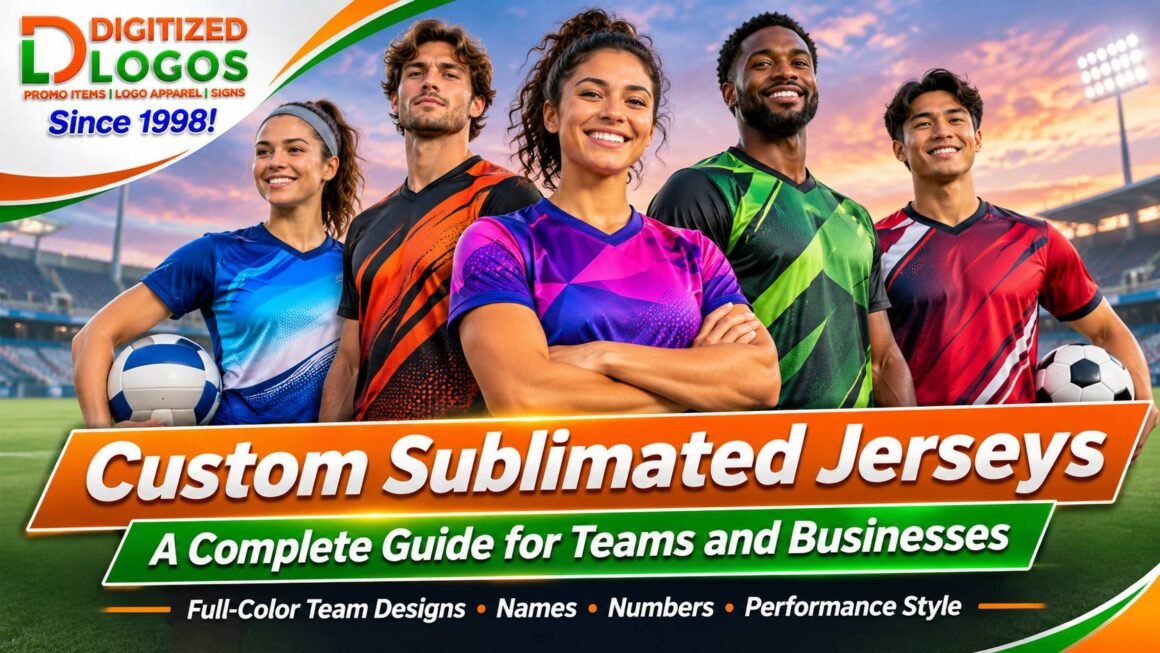
Team apparel should do more than display a logo. It should represent a shared identity, fit comfortably, and look consistent across every player or participant. For sports organizations, schools, corporate teams, and event organizers, custom sublimated jerseys offer a practical way to combine personalized designs with functional athletic apparel.
Unlike traditional printing methods that apply ink or graphics to the surface of a garment, dye sublimation transfers color into compatible polyester fibers. This allows detailed artwork, team colors, player names, and numbers to become part of the fabric rather than forming a separate printed layer.
However, selecting the right jersey involves more than choosing an attractive design. Fabric construction, sizing, artwork preparation, production requirements, and ordering quantities can influence the final result. This guide explains what buyers should evaluate before investing in custom team jerseys.
What Are Custom Sublimated Jerseys?
Custom sublimated jerseys are athletic or promotional garments decorated using dye sublimation printing. During production, specialized dyes are transferred into polyester fabric using controlled heat and pressure. The process allows manufacturers to reproduce detailed designs without creating a thick surface print.
Sublimation is particularly useful for jerseys that incorporate multiple colors, gradients, intricate patterns, player numbers, and personalized names.
Depending on the available garment construction and manufacturing process, designs may cover the front, back, sleeves, and other printable fabric areas.
The result is a customized garment that maintains the underlying fabric’s texture while displaying detailed graphics.
Why Choose Custom Sublimated Jerseys?
The primary advantage of sublimation is its ability to combine detailed full-color decoration with lightweight polyester apparel. This makes it suitable for athletic uniforms and branded garments that need distinctive visual designs.
1. Extensive Design Flexibility
Sublimation supports detailed artwork, complex color combinations, gradients, and large graphics. Teams can incorporate mascots, sponsor artwork, geometric patterns, and other visual elements without relying on multiple separate decoration layers.
2. Comfortable Printed Areas
Because sublimation dye penetrates the polyester fibers, it does not create the raised surface associated with some vinyl transfers or thick printed graphics. This helps preserve the original feel of the fabric.
Actual comfort still depends on garment construction, material weight, fit, ventilation, and intended activity.
3. Resistance to Print Cracking and Peeling
Fully sublimated graphics do not form a separate adhesive film or ink layer that can crack or peel in the same manner as certain surface decorations.
Nevertheless, fabric abrasion, improper washing, excessive heat, and prolonged environmental exposure can affect the appearance and service life of the garment.
4. Individual Player Personalization
Names, numbers, and other player-specific details can be incorporated into the artwork before printing. This provides flexibility when producing uniforms for teams with multiple members.
Buyers should confirm whether individual personalization affects unit pricing, production schedules, or minimum quantities.
5. Consistent Team Presentation
A coordinated jersey design helps establish a recognizable appearance across players, staff, and event participants. This can be particularly valuable when teams participate in tournaments, public events, or activities involving sponsors.
How Does Dye Sublimation Jersey Printing Work?
Dye sublimation uses specialized inks that respond to heat. During transfer, the dyes enter compatible polyester material, producing graphics that are integrated into the fabric rather than simply attached to its surface.
The specific workflow depends on whether the supplier decorates completed garments or prints fabric panels before assembly.
- Artwork development: The team logo, colors, patterns, names, and numbers are arranged within the jersey design.
- Template preparation: Artwork is adapted to the garment’s printable areas, dimensions, and production specifications.
- Printing: The design is printed using compatible sublimation inks and transfer materials.
- Heat transfer: Controlled heat and pressure transfer the dyes into the polyester fabric.
- Garment assembly: When production involves printed fabric panels, those panels are cut and sewn into finished jerseys.
- Quality inspection: Finished garments are checked for artwork placement, visible defects, sizing, and other approved specifications.
One important production consideration is seam alignment. A design that looks continuous on a flat digital template may not connect perfectly after separate fabric panels are sewn together.
Buyers should identify critical graphics, sponsor logos, and lettering that must remain fully visible. Placing important information too close to seams, collars, or underarm areas can create avoidable production problems.
Best Materials for Sublimated Team Jerseys
Polyester is the preferred material for conventional dye sublimation because its fiber structure is compatible with the transfer process. Cotton does not accept conventional sublimation dyes in the same manner.
Not every polyester jersey performs identically. Fabric structure, thickness, stretch, and ventilation affect how the finished garment feels during use.
Lightweight Polyester
Lightweight polyester fabrics are often selected for activewear because they can provide a comfortable balance between garment weight and mobility. Buyers should review the actual fabric sample rather than assuming every lightweight material offers the same durability or opacity.
Polyester Mesh
Mesh constructions may provide additional airflow in selected areas of a jersey. The degree of ventilation depends on the mesh structure and garment design.
Stretch Polyester Blends
Some athletic garments combine polyester with elastane or similar stretch fibers to provide additional flexibility. Sublimation suitability depends on the fabric composition and production requirements.
For activities involving frequent movement, the jersey’s cut, stretch recovery, and seam construction deserve as much attention as the printed design.
Personalized Full Color Team Jerseys: Design Options
Personalized full color team jerseys allow organizations to create apparel that reflects their team identity rather than relying entirely on standard stock colors.
Available customization features depend on the garment and supplier, but common design elements include:
- Team logos: Primary and secondary team branding.
- Player names: Individual identification on the back or another designated area.
- Player numbers: Large numbers designed for visibility during activities.
- Team colors: Color combinations consistent with an organization’s established identity.
- Sponsor logos: Approved partner or event sponsor branding.
- Patterns: Geometric shapes, gradients, stripes, and other visual treatments.
- Event details: Tournament names, campaign artwork, or commemorative graphics.
Effective jersey design balances visual impact with readability. A complex background may look attractive on a screen but make player numbers difficult to identify from a distance.
For competitive sports, confirm any applicable league or tournament requirements before approving the design. Some organizations regulate number dimensions, placement, uniform colors, and sponsor branding.
Who Uses Custom Sublimated Jerseys?
Although sublimated jerseys are closely associated with sports, their applications extend to organizations that need coordinated, full-color apparel.
Sports Teams and Athletic Clubs
Basketball, soccer, baseball, softball, volleyball, and other athletic programs can use customized jerseys to establish a unified team appearance.
The appropriate style depends on the activity, including sleeve construction, garment length, mobility requirements, and preferred fit.
Schools and Universities
Educational institutions may use custom jerseys for athletic programs, recreational competitions, student organizations, and campus tournaments.
For programs ordering across multiple teams, consistent logo files, standardized colors, and centralized size records can simplify repeat purchases.
Corporate Teams and Employee Events
Businesses participating in charity games, company sports leagues, wellness activities, or community events can use jerseys to create a coordinated employee appearance.
For example, a hypothetical technology company organizing an annual employee tournament could develop a common jersey design while assigning different player numbers and names to participants.
This approach allows the organization to maintain consistent branding while accommodating individual employees.
Charity Tournaments and Fundraising Events
Nonprofits and event organizers may use branded jerseys for volunteer groups, fundraising teams, and sponsored competitions.
Organizers should confirm sponsorship placement and artwork approvals early, particularly when several organizations contribute logos.
Esports and Gaming Communities
Esports teams may choose sublimated jerseys to display detailed team graphics, player handles, and sponsor branding.
Since esports apparel is often worn during competitions, broadcasts, and promotional appearances, visual contrast and logo placement can be important design considerations.
Custom Sublimated Jerseys vs. Other Printing Methods
The best decoration method depends on garment material, design complexity, quantity, and intended use.
Dye Sublimation vs. Screen Printing
Screen printing generally places ink onto the fabric surface. It can be a practical option for certain designs and larger production runs, particularly when the artwork uses a limited number of colors.
Dye sublimation is often better suited to detailed, multicolor artwork covering substantial areas of compatible polyester fabric.
Dye Sublimation vs. Heat Transfer Vinyl
Heat transfer vinyl involves applying cut or printed material to the garment using heat and pressure. It can work well for selected names, numbers, and smaller graphics.
Unlike vinyl, fully sublimated graphics do not form a separate film on the jersey. However, vinyl may be more suitable when decorating fabrics that cannot be sublimated conventionally.
Dye Sublimation vs. Embroidery
Embroidery creates designs using stitched thread. It is commonly used for smaller logos and branding on suitable garments.
Sublimation is generally more appropriate when the objective is lightweight, large-area, full-color artwork. Embroidery may be preferable for applications where a textured stitched appearance is desired.
What Affects Custom Sublimated Jersey Pricing?
The cost of a custom jersey depends on several purchasing and production variables. No single unit price applies to every jersey style, fabric, quantity, or customization requirement.
Common factors include:
- Number of jerseys required.
- Fabric composition and garment construction.
- Available jersey styles and sizing options.
- Design preparation and artwork complexity.
- Individual player names and numbers.
- Minimum production quantities.
- Sample or prototype requirements.
- Shipping destinations and delivery requirements.
- Additional setup or artwork services.
Before comparing quotations, ensure that each supplier is pricing comparable garments and services.
A lower quoted unit price may not reflect the final amount if artwork preparation, individual personalization, freight, or other services are charged separately.
How to Order Custom Sublimated Jerseys
A structured ordering process reduces the risk of sizing errors, incorrect player information, and unexpected artwork changes.
- Define the intended use: Determine the sport, event, or organizational activity for which the jerseys are required.
- Select the garment: Review available fabrics, sizing, fits, collars, and sleeve styles.
- Confirm quantities: Prepare the number of jerseys required for each size and design variation.
- Organize artwork: Gather approved team logos, colors, sponsor graphics, and other required elements.
- Prepare personalization details: Check the spelling of every player name and confirm the corresponding jersey number and size.
- Request a proof: Review the proposed design and verify graphic placement before authorizing production.
- Confirm production terms: Review costs, minimum quantities, proof approvals, production schedules, and shipping arrangements.
- Approve the final specifications: Ensure the supplier has the correct artwork and complete order information.
For complex orders, a shared roster containing each participant’s name, number, size, and garment style can prevent confusion during production.
Common Mistakes to Avoid When Buying Custom Jerseys
Submitting Low-Resolution Artwork
Small images taken from websites or screenshots may not provide sufficient detail for large-format reproduction. Vector artwork is often preferred for logos because it can be resized without the same pixelation problems associated with low-resolution raster files.
Ignoring Size Charts
A medium jersey from one manufacturer may fit differently from a medium produced by another. Buyers should evaluate the actual size chart and, when appropriate, request a sample.
Approving Colors Only on a Screen
Colors displayed on monitors can differ from printed fabric due to screen settings, textile characteristics, and printing conditions. Organizations with strict brand standards should discuss color-matching expectations and available sample approval procedures.
Overlooking Reorder Requirements
Teams may need replacement jerseys when players join, leave, or change sizes. Before placing the initial order, ask whether the supplier can retain the approved design and accommodate future quantities.
Waiting Until the Event Date Approaches
Custom jersey production involves artwork approval, manufacturing, inspection, and shipping. Buyers should confirm the supplier’s schedule before committing to a tournament or event deadline.
Managing Jersey Orders for Multiple Teams or Locations
Organizations purchasing jerseys for several departments, sports teams, or locations can benefit from a standardized ordering process.
Consider a hypothetical company coordinating a recreational tournament across three office locations. Each location requires a different team color, but every jersey must display the same company logo and tournament branding.
The company could simplify coordination by maintaining an approved artwork package, standardized garment specifications, and separate player rosters for each location.
This creates a clearer production process and helps reduce inconsistencies between orders.
For recurring programs, maintaining approved artwork versions and historical size information can also support future replenishment.
How to Care for Sublimated Jerseys
Proper garment care helps preserve the appearance and condition of customized athletic apparel.
- Follow the manufacturer’s garment care label.
- Wash using a mild detergent and an appropriate temperature.
- Turn jerseys inside out when recommended.
- Avoid bleach unless specifically permitted by the care instructions.
- Limit exposure to excessive drying temperatures.
- Avoid ironing directly over additional heat-applied decorations.
- Store garments clean and dry between uses.
Although the sublimated graphics are integrated into the fabric, the garment itself remains subject to normal wear, abrasion, stretching, and improper laundering.
How to Choose a Custom Jersey Supplier
Supplier selection should involve more than comparing product photographs. Buyers need clear information about customization capabilities, garment quality, order requirements, and fulfillment processes.
Before choosing a supplier, consider these questions:
- Which polyester fabrics and garment styles are available?
- Can the supplier accommodate individual names and numbers?
- Are there minimum quantities for each design or size?
- What artwork formats are preferred?
- Will a digital proof be available before production?
- Can physical samples be requested?
- How are production errors or discrepancies addressed?
- Can the same approved design be reordered later?
- Are shipping charges and production requirements clearly explained?
Clear communication during the quotation and artwork stages is particularly valuable for organizations managing large rosters, multiple sponsors, or important event deadlines.
Custom Sublimated Jerseys from Digitized Logos
Digitized Logos provides customized branded apparel and promotional product solutions for businesses, sports organizations, schools, and event programs.
Organizations exploring custom sublimated jerseys can evaluate how full-color artwork, coordinated team designs, and individual personalization fit their apparel requirements.
For businesses coordinating merchandise across departments or events, it is useful to discuss garment selection, artwork, sizing, and fulfillment expectations before approving an order.
Available jersey styles, minimum quantities, customization details, and production schedules should be confirmed for the specific product being considered.
Frequently Asked Questions About Custom Sublimated Jerseys
Are sublimated jerseys suitable for competitive sports?
Yes. Sublimated polyester jerseys can be suitable for competitive sports when their fabric, construction, fit, and design meet the requirements of the activity. Buyers should also verify applicable league rules concerning uniform colors, player numbers, and other required specifications.
Can every jersey have a different player name and number?
Individual names and numbers can be incorporated into sublimation artwork, making personalized team uniforms possible. However, buyers should verify whether the selected supplier permits different personalization details within one production order and whether additional charges or quantity requirements apply.
Do sublimated jersey designs crack or peel?
Graphics produced entirely through dye sublimation do not create the separate surface layer found with some other decoration techniques, so they are not subject to the same type of cracking or peeling. The fabric can still experience fading, abrasion, and other wear depending on use and care.
What is the minimum order quantity for custom sublimated jerseys?
Minimum quantities vary by supplier, garment, production method, and customization requirements. Some products may require larger quantities than others. Buyers should confirm the specific minimum before planning a team purchase, particularly when ordering replacement jerseys or individual sizes.
How long does it take to produce custom sublimated jerseys?
Production time depends on artwork readiness, proof approval, order quantity, manufacturing capacity, and shipping requirements. Highly personalized or complex orders may require additional coordination. Buyers should request a confirmed production schedule and account for transit time when planning around events.
Key Takeaways for Custom Jersey Buyers
- Sublimation supports detailed, full-color designs on compatible polyester fabrics without creating a separate printed surface layer.
- Successful jersey selection requires attention to garment construction, fit, sizing, and intended activity.
- Accurate artwork, player rosters, and approved proofs are essential for avoiding customization errors.
- Pricing and minimum quantities should be confirmed for the exact product and order requirements.
- Organizations planning repeat purchases should discuss artwork retention, consistency, and reorder procedures before production.
Bring Your Team Design to Life with Custom Sublimated Jerseys
Custom sublimated jerseys provide a flexible approach to creating coordinated athletic and promotional apparel. Their ability to accommodate detailed graphics, personalized names, and team-specific designs makes them worth considering for sports programs, corporate activities, and organized events.
The most successful orders begin with clear requirements. Choosing the appropriate material, preparing accurate artwork, verifying sizes, and confirming production details can help organizations make informed purchasing decisions.
Digitized Logos can help businesses and organizations explore branded apparel options aligned with their design and purchasing needs.
To discuss your jersey requirements, contact Digitized Logos at 301-963-3553 or email Info@DigitizedLogos.com. You can also explore available apparel and promotional merchandise options through the Digitized Logos product catalog.