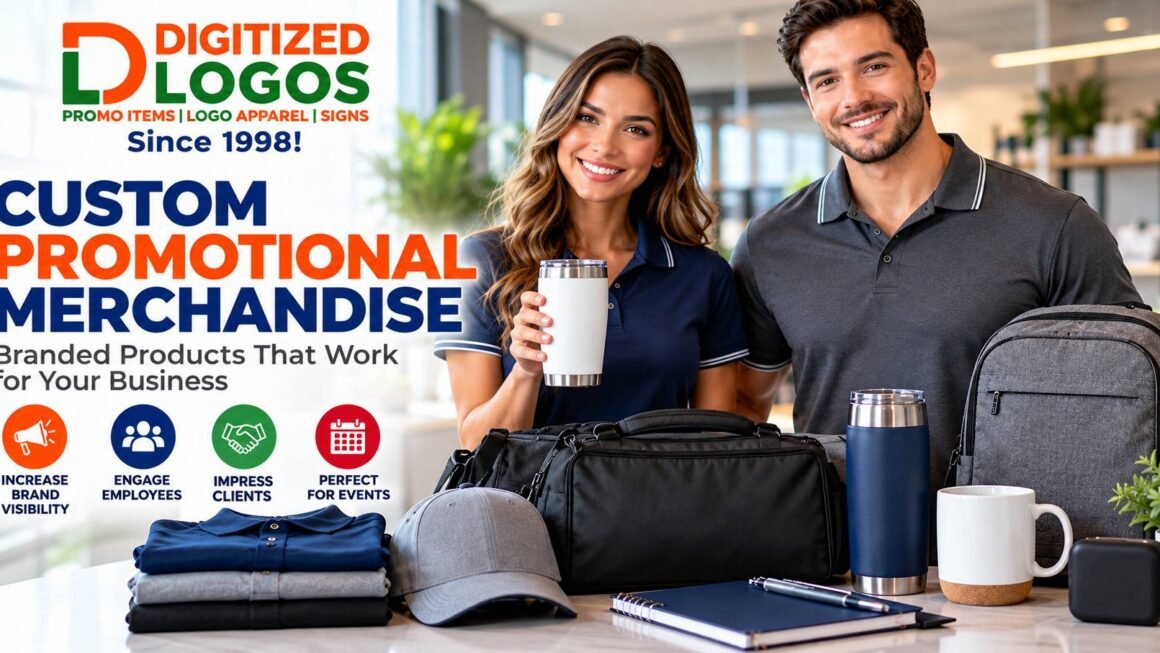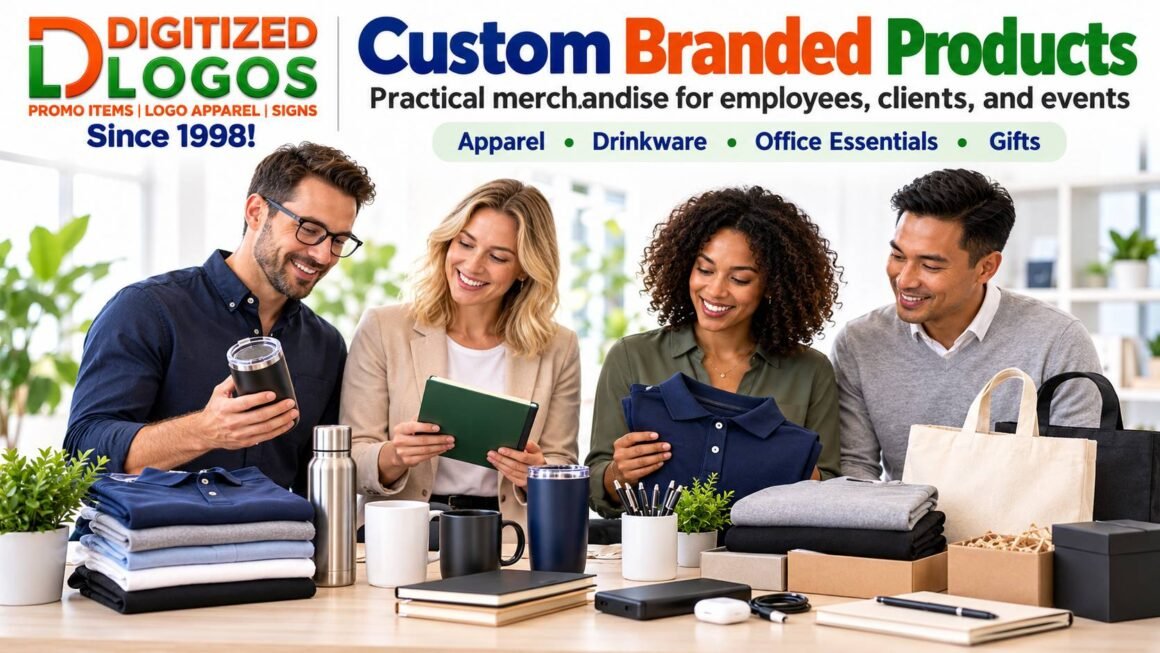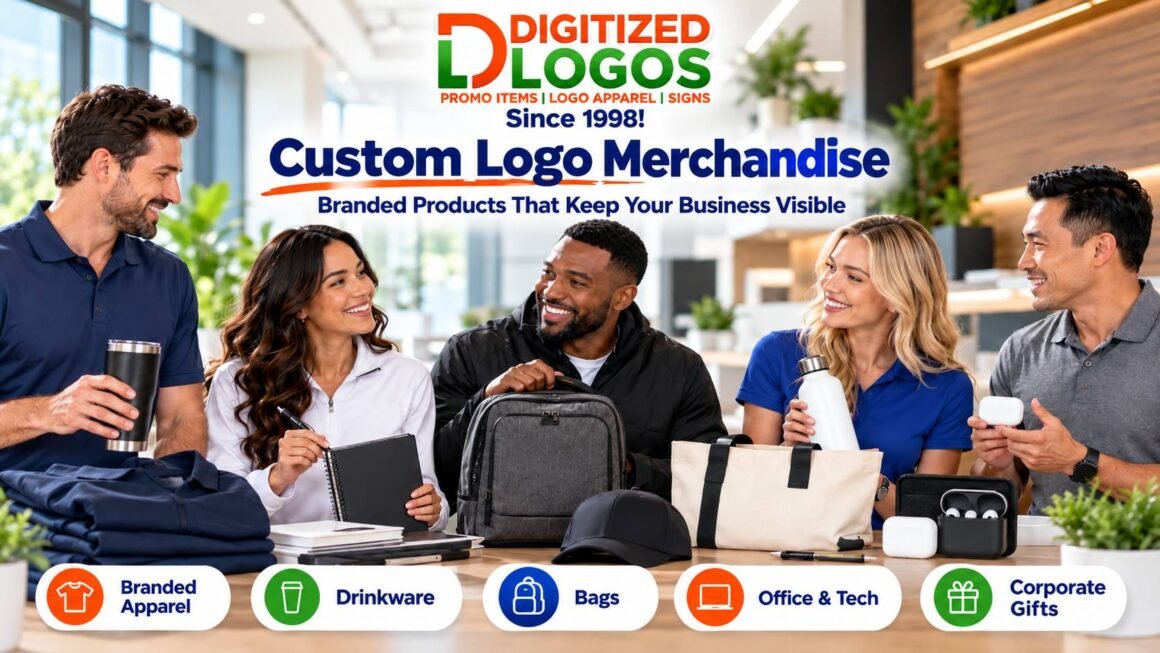
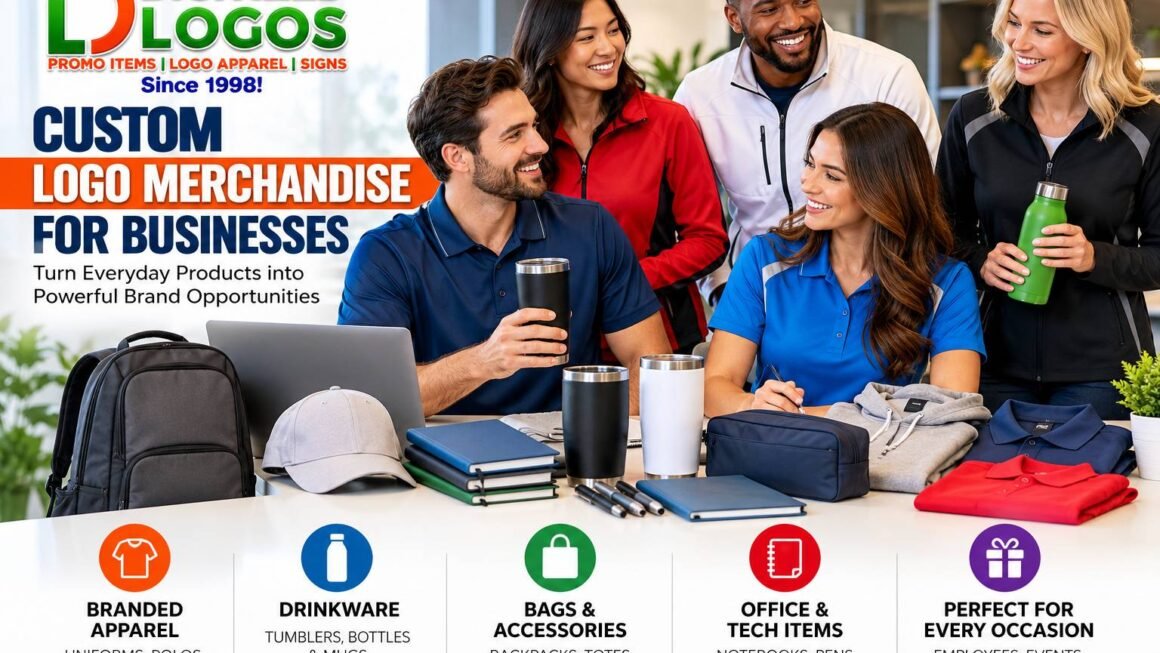
Logo merchandise for businesses helps companies turn everyday products into useful reminders of their brand. From employee apparel and client gifts to trade show giveaways and corporate merchandise programs, branded products can support brand recognition, strengthen professional presentation, and create more consistent customer experiences.
However, successful merchandise programs require more than printing a logo on an item. Businesses must consider product usefulness, decoration quality, materials, cost, order quantities, and distribution. Choosing the right logo merchandise for businesses starts with understanding who will use the products and what the company wants to accomplish.
Digitized Logos provides custom promotional products and branded apparel solutions for businesses planning employee programs, corporate events, customer appreciation campaigns, and ongoing merchandise initiatives. This guide explains how purchasing teams can select, customize, and manage branded products while avoiding common ordering problems.
What Is Logo Merchandise for Businesses?
Logo merchandise for businesses consists of physical products customized with a company’s name, logo, message, or other approved brand artwork. These products are commonly used for employee identification, promotional marketing, corporate gifting, customer engagement, and company events.
Unlike traditional advertisements, useful branded products can remain in circulation after their initial distribution. A company jacket may be worn regularly, a reusable water bottle may accompany someone to work, and a branded notebook may stay on a desk for months. Actual exposure depends on whether recipients choose to keep and use the merchandise.
Common categories include:
- Branded apparel: Polo shirts, T-shirts, jackets, hoodies, performance shirts, and uniforms.
- Drinkware: Tumblers, water bottles, travel mugs, and reusable cups.
- Office merchandise: Notebooks, pens, journals, folders, and desk accessories.
- Technology accessories: Charging cables, phone accessories, mouse pads, and compatible electronic products.
- Travel and everyday accessories: Backpacks, luggage tags, umbrellas, and personal organizers.
- Event merchandise: Lanyards, badges, reusable bags, and conference giveaways.
The best choice depends on the intended recipient, available budget, customization requirements, and the setting in which the product will be used.
Why Businesses Invest in Custom Logo Merchandise
Businesses purchase branded merchandise for several reasons. Some programs focus on external marketing, while others support employees, improve brand consistency, or simplify corporate purchasing.
1. Strengthening Everyday Brand Visibility
A promotional product has the potential to display a company logo repeatedly whenever the recipient uses it. Unlike a single event advertisement, merchandise may remain visible during ordinary activities.
For example, an employee wearing a branded polo at a customer location represents the company’s visual identity. A client using a branded travel mug may encounter the business name during a daily routine.
Visibility alone does not guarantee new sales. Product usefulness, audience relevance, logo readability, and the context of use all influence the value of that exposure.
2. Creating a Consistent Employee Appearance
Branded apparel helps businesses establish a recognizable appearance across teams and locations. This can be especially useful for customer-facing employees, service technicians, event representatives, and sales teams.
Coordinated uniforms can make employee identification easier and reinforce a professional presentation. Businesses should consider comfort, sizing, durability, and job requirements alongside visual appearance.
3. Supporting Employee Onboarding and Recognition
New-hire welcome packages can introduce employees to company branding while supplying useful items for their workday.
A typical onboarding package might combine an embroidered polo, a notebook, and a reusable bottle. Employee appreciation programs may instead emphasize upgraded apparel, travel accessories, or practical personal gifts.
The merchandise should match the organization’s culture and employee needs rather than simply include the greatest possible number of items.
4. Improving Corporate Events and Trade Show Programs
Branded merchandise can support event engagement when products are appropriate for the audience and easy to distribute.
A compact technology accessory may be more practical for traveling conference attendees than a bulky giveaway. For a recruitment event, wearable merchandise or useful office supplies may have greater relevance.
Businesses should also consider booth storage, packaging, shipping, and the number of expected recipients before ordering.
5. Supporting Customer Appreciation and Business Relationships
Corporate gifts can acknowledge customers, partners, and employees during meaningful business occasions.
Appropriate gifts depend on the recipient and relationship. An executive appreciation package may justify a different product selection and budget than a large customer giveaway.
Organizations in regulated industries or government-related purchasing environments should review applicable gift policies before distributing merchandise.
How to Choose the Right Logo Merchandise for Businesses
The most useful approach is to match the merchandise to a specific business objective. A product suitable for a trade show may not be the best option for field employees or a customer appreciation campaign.
Before choosing logo merchandise for businesses, purchasing teams should evaluate the intended audience, use case, product quality, and operational requirements.
Step 1: Define the Purpose of the Merchandise
Start with the business problem the merchandise should address. Is the company trying to create a consistent employee appearance, welcome new hires, thank clients, or distribute promotional products at an event?
A clear objective helps determine the appropriate product category, quantity, quality level, and customization method.
Step 2: Understand the Recipients
Merchandise should fit the habits and practical needs of its intended users.
Office employees may value drinkware, notebooks, and technology accessories. Field service personnel may need performance apparel, weather-appropriate jackets, or durable everyday accessories. Frequent travelers may prefer compact products that are easy to carry.
Choosing products based on actual recipient needs can reduce the risk of purchasing merchandise that is rarely used.
Step 3: Evaluate Materials and Product Quality
Two products that appear similar in a catalog may perform differently in everyday use.
For apparel, review fabric composition, garment weight, fit, washability, and sizing availability. For drinkware, examine material construction, lid design, cleaning requirements, and intended use. For bags, consider stitching, closures, capacity, and carrying comfort.
Samples can help purchasing teams evaluate quality before committing to larger orders, particularly when products will be distributed to employees or important clients.
Step 4: Choose the Appropriate Branding Method
The decoration technique affects how a logo looks, feels, and performs on the finished product.
Embroidery, screen printing, heat transfer, dye sublimation, engraving, and other decoration methods have different material requirements and design limitations. The ideal method depends on the product, artwork, quantity, and desired appearance.
Step 5: Establish a Realistic Total Budget
Compare more than the advertised unit price. Artwork preparation, decoration, setup charges, shipping, packaging, fulfillment, and other applicable costs may influence the final purchase amount.
Companies distributing products to multiple destinations should also account for individual shipment costs and possible inventory storage.
Step 6: Confirm Production and Delivery Requirements
Provide the supplier with the required delivery date, destination, quantity, artwork, and product specifications.
Production schedules may depend on product availability, decoration complexity, proof approval, and shipping arrangements. Businesses should request confirmation of the applicable schedule rather than assuming every product has the same turnaround time.
Best Types of Branded Merchandise With Logo Customization
Different merchandise categories offer distinct advantages. The following comparisons can help businesses narrow their selection.
Custom Apparel and Corporate Uniforms
Branded apparel is a practical choice when businesses want employees or event teams to present a consistent identity. Popular options include polos, performance shirts, jackets, hoodies, and T-shirts.
Apparel purchasing requires attention to size ranges, fit preferences, fabric performance, care instructions, and logo placement. A design that works well on a T-shirt may need adjustments for a structured polo or jacket.
Companies ordering apparel for multiple departments may benefit from standardizing approved garment styles and brand artwork.
Branded Drinkware
Reusable bottles, tumblers, and mugs are common choices for employee gifts, events, and client appreciation programs.
Product selection should account for capacity, material, portability, lid construction, and decoration area. A large logo may not reproduce effectively on every curved or textured surface.
Businesses should evaluate samples where appearance, functionality, or perceived gift quality is particularly important.
Office and Desk Merchandise
Notebooks, pens, desk organizers, and related office supplies are useful options for meetings, conferences, employee programs, and client communications.
These products are often straightforward to distribute, although writing quality, material construction, printing area, and product durability can vary significantly.
Technology and Mobile Accessories
Technology accessories can be relevant to professional audiences, particularly where recipients regularly use laptops and mobile devices.
Buyers should verify compatibility, product specifications, electrical safety considerations where applicable, and warranty terms. Avoid selecting electronic merchandise based only on appearance or price.
Travel and Outdoor Merchandise
Backpacks, umbrellas, travel organizers, and other everyday accessories may be appropriate for employees who commute, travel, or work outside a traditional office.
These products often have substantial branding areas, but material quality, portability, and intended use should guide the final decision.
Which Logo Decoration Method Should You Choose?
The correct decoration method depends on the surface being branded, the artwork design, the desired finish, and production requirements.
Embroidery
Embroidery uses stitched thread to reproduce artwork on compatible textiles. It is commonly selected for polo shirts, caps, jackets, and other corporate apparel.
Detailed logos may require simplification because small text, thin lines, and gradients do not always translate cleanly into stitches. Embroidery files also require preparation appropriate to the garment and design.
Screen Printing
Screen printing transfers ink through prepared screens onto compatible surfaces, commonly apparel. It can be effective for bold graphics and repeated designs.
Design complexity, number of colors, placement, and production quantity can affect setup and pricing. Buyers should confirm how artwork colors will be reproduced.
Heat Transfer Decoration
Heat transfer methods apply prepared graphics to compatible materials using heat and pressure. Different transfer technologies support different artwork types and applications.
Fabric compatibility, placement, laundering requirements, and production specifications should be confirmed before ordering.
Dye Sublimation
Dye sublimation uses heat to transfer dye into compatible materials, commonly polyester fabrics or specially coated products. It is especially useful for full-color graphics and certain all-over apparel designs.
For suitable garments, sublimation can support designs extending across large fabric panels. However, construction seams, cut patterns, garment fit, and the printable material all influence the finished appearance.
Traditional dye sublimation is not interchangeable with printing directly onto every fabric type. Buyers should confirm material compatibility before selecting the method.
Laser Engraving
Laser engraving creates permanent or lasting surface markings, depending on the material and product construction. It is often used on compatible metal, wood, and selected other products.
The visible result depends on the underlying material and surface finish. Engraving does not automatically reproduce the original colors of a company logo.
Why Artwork Preparation Matters More Than Many Buyers Expect
One of the most common reasons branded merchandise requires additional production review is artwork that does not match the product or decoration method.
A logo may look sharp on a computer screen but become difficult to reproduce when reduced to a small embroidery area or printed onto a curved surface.
Professional artwork preparation typically involves checking several details:
- File format: Scalable vector artwork is often preferred for logos because it can be resized without the pixelation associated with low-resolution images.
- Minimum detail size: Fine lines and small text may disappear or become unreadable with certain decoration methods.
- Color requirements: Digital artwork colors may differ from physical ink, thread, or engraved finishes.
- Placement: Logo position must account for seams, pockets, zippers, buttons, and available decoration areas.
- Product dimensions: The same artwork dimensions may look different on a jacket, cap, tumbler, or notebook.
- Proof approval: A digital or physical proof can help buyers identify placement and design concerns before production.
For example, a detailed multicolor logo may be suitable for printing on a smooth surface but require adjustments for embroidery. A supplier should explain those production limitations before proceeding.
Buyers should retain approved artwork files and decoration specifications for future reorders. This can make merchandise programs easier to maintain over time.
How Much Does Custom Logo Merchandise Cost?
The price of custom logo merchandise depends on the product, order quantity, decoration method, artwork requirements, and fulfillment arrangements. There is no single price that accurately represents every branded merchandise order.
Cost factors commonly include:
- Base product price and material quality.
- Number of items ordered.
- Decoration method and number of imprint locations.
- Number of colors or complexity of the artwork.
- Applicable setup and preparation charges.
- Packaging and individual fulfillment requirements.
- Shipping destinations and delivery requirements.
Higher quantities can reduce per-unit costs for some products and decoration methods, but discounts are not universal. Buyers should request pricing based on actual order specifications.
Understanding Total Program Cost
Consider a hypothetical business ordering 200 branded employee shirts at an assumed product-and-decoration cost of $20 each.
The initial merchandise cost would be $4,000 before any additional applicable charges. If shipping, individual packaging, or distribution is required, the total program cost increases accordingly.
This example illustrates the calculation, not actual Digitized Logos pricing.
For recurring programs, purchasing teams should also consider replacement garments, additional employees, reorders, and any storage or distribution costs.
Minimum Order Quantities and Flexible Purchasing
Minimum order quantities, commonly called MOQs, vary by product and production method.
Some merchandise can be customized in smaller quantities, while other products require larger orders because of manufacturing processes, setup requirements, or supplier policies.
Businesses should confirm the applicable minimum before selecting a product, particularly when planning executive gifts, small department programs, or individual employee orders.
For ongoing merchandise programs, it may also be worth evaluating whether a company store or managed ordering process can simplify recurring purchases. Available features, minimums, setup charges, and fulfillment arrangements should be verified for the specific program.
Realistic Business Applications for Corporate Merchandise
Example 1: A Multi-Location Service Company
Consider a hypothetical HVAC company operating several service branches. The company wants employees to look professional while making its brand recognizable during customer visits.
A practical merchandise program might include approved performance polos for technicians, branded jackets for cooler weather, and embroidered apparel for office personnel.
The purchasing team would establish standard logo placement, garment colors, size options, and reorder specifications. This could help reduce visual inconsistencies when different branches order replacement apparel.
Example 2: A Business Exhibiting at a Trade Show
Imagine a software company preparing for a national industry conference. Its primary goal is to leave qualified visitors with useful branded products after conversations at its booth.
Instead of ordering several unrelated giveaways, the marketing team could choose one practical item for general distribution and a separate higher-value gift for scheduled business meetings.
The team would then determine quantities, artwork approvals, packaging requirements, and shipping arrangements based on the event schedule.
Both scenarios are illustrative examples, not descriptions of actual Digitized Logos customers.
Managing Merchandise Programs Across Multiple Locations
Companies with several offices, departments, or field teams face different purchasing challenges than organizations placing a single promotional order.
Without consistent specifications, individual locations may purchase different apparel colors, use outdated logos, or select products with varying quality.
A structured merchandise program can address these issues through centralized product selection, approved decoration standards, and defined ordering procedures.
Standardize Products and Artwork
Maintain a documented list of approved products, brand colors, imprint locations, and artwork versions. This gives purchasing teams a consistent starting point for future orders.
Plan for New Employees and Replacements
Employee merchandise requirements change throughout the year. Businesses may need to accommodate new hires, size exchanges, damaged uniforms, and changing staffing levels.
Ordering processes should account for these routine needs rather than treating every purchase as an entirely new project.
Evaluate Corporate Merchandise Stores
An online company store can provide employees or authorized purchasers with a centralized selection of approved merchandise.
Depending on the provider and program design, company stores may support individual ordering, approved product catalogs, personalized merchandise, and shipment coordination.
Businesses should review store costs, inventory arrangements, ordering controls, fulfillment options, and ongoing administration before implementation.
How to Evaluate a Branded Merchandise Supplier
Finding a supplier involves more than comparing product catalogs. Businesses should evaluate how clearly the provider handles artwork, sourcing, production requirements, and order communication.
Before placing an order, ask the supplier:
- Which products are appropriate for our intended audience and budget?
- What decoration methods are available for the selected materials?
- What artwork formats and specifications are required?
- Can we review a digital proof or physical sample before production?
- What minimum order quantities apply?
- What charges are included in the quotation?
- What production and delivery schedule can be confirmed?
- How are product quality concerns or order discrepancies handled?
- Can approved products and artwork be maintained for future reorders?
- What fulfillment options are available for multiple locations?
Clear answers help purchasing teams compare suppliers on operational suitability rather than unit price alone.
Digitized Logos provides branded merchandise with logo customization options across promotional product and apparel categories. Businesses can explore products based on their intended use and discuss customization requirements before finalizing a purchasing decision.
Common Mistakes to Avoid When Ordering Branded Merchandise
Choosing the Lowest Unit Price Without Reviewing Quality
A cheaper item may not represent better value if its construction, usability, or appearance does not meet recipient expectations. Product quality should be considered alongside purchase price.
Using Artwork That Is Unsuitable for the Product
Highly detailed logos, tiny lettering, and complicated gradients may not reproduce effectively with every decoration method. Review artwork compatibility before approving production.
Ignoring Size and Fit Requirements
Apparel orders can become difficult to distribute when size ranges or fit expectations are not considered. Review size charts and garment specifications, and consider samples for important programs.
Ordering Too Late
Product availability, proof approvals, production schedules, and shipping can affect delivery. Begin planning early enough to accommodate the supplier’s confirmed requirements.
Failing to Plan for Distribution
Receiving hundreds of branded items at one location is different from sending individual packages to employees nationwide. Fulfillment should be included in the initial purchasing plan.
Changing Products Without Updating Brand Standards
When businesses switch garment styles or merchandise categories, logo size, placement, and decoration methods may need to be reconsidered. Approved brand artwork should remain consistent even when production specifications change.
How Can Businesses Measure the Value of Logo Merchandise?
Measuring merchandise value starts with defining the intended outcome. A uniform program, trade show campaign, and employee recognition initiative should not necessarily use the same success metrics.
Potential measures include:
- Employee programs: Distribution completion, employee feedback, replacement frequency, and garment usability.
- Trade shows: Merchandise distributed, qualified conversations, leads collected, and subsequent follow-up activity.
- Customer gifts: Recipient feedback, campaign participation, and relationship-management objectives.
- Company stores: Ordering accuracy, administrative workload, fulfillment performance, and product consistency.
- Promotional campaigns: Trackable responses or conversions where the campaign includes an appropriate measurement mechanism.
Merchandise impressions and sales outcomes are difficult to attribute precisely without a defined measurement process. Companies should avoid assuming that every distributed item produces a measurable return.
A useful evaluation considers total program spending, recipient response, product usage, and whether the merchandise achieved its original business purpose.
Frequently Asked Questions About Logo Merchandise for Businesses
What is the best logo merchandise for a business?
The best merchandise depends on the audience and intended use. Branded apparel can work well for employee programs, while drinkware, notebooks, and practical accessories may suit customer gifts or events. Buyers should prioritize usefulness, appropriate quality, branding visibility, and total cost rather than selecting a product solely because it is popular.
Can businesses order logo merchandise in small quantities?
Some customized products are available in smaller quantities, but minimum order requirements vary by item, decoration method, and supplier. Businesses planning limited gift programs or small employee orders should verify minimum quantities and setup charges before choosing merchandise. Small orders may have different per-unit costs than larger production runs.
What file format is best for printing a company logo on merchandise?
Vector artwork, such as properly prepared AI, EPS, or PDF files, is commonly preferred because it supports accurate resizing. Some printing methods also accept suitable high-resolution raster files. Embroidery requires a production-ready stitch file prepared for the design. The correct format should always be confirmed with the supplier.
How long does it take to produce custom logo merchandise?
Production time varies by product availability, decoration method, order quantity, artwork approval, and shipping arrangements. Some items require additional preparation or special production processes. Businesses working toward an event or employee rollout should request a confirmed schedule based on the exact product and delivery requirements before committing to a deadline.
What is the difference between promotional products and corporate merchandise?
Promotional products are commonly used to market a business, event, or campaign. Corporate merchandise is a broader term that can include employee apparel, recognition gifts, uniforms, company store products, and promotional giveaways. The categories overlap because many customized products can serve both marketing and internal business purposes.
Key Takeaways for Business Buyers
- Choose merchandise based on recipient needs and clearly defined business objectives.
- Evaluate product quality, artwork compatibility, and decoration methods before committing to production.
- Compare total program costs, including any applicable setup, shipping, and fulfillment expenses.
- Use approved artwork and product standards to improve consistency across departments and locations.
- Measure outcomes according to the purpose of the merchandise rather than assuming that product distribution automatically generates sales.
Explore Logo Merchandise for Your Business With Digitized Logos
The right merchandise program starts with practical products, clear branding requirements, and a purchasing process that fits the organization.
Whether your business needs employee uniforms, corporate gifts, event giveaways, or ongoing merchandise solutions, thoughtful product selection and production planning can help create a consistent and useful branded experience.
Digitized Logos offers promotional products and branded apparel options for organizations seeking customized merchandise. Businesses can explore product categories and discuss their artwork, quantities, intended use, and purchasing requirements.
Explore logo merchandise for businesses through Digitized Logos and identify products suited to your next corporate program.
Call: 301-963-3553
Email: info@DigitizedLogos.com
Website: products.digitizedlogos.com