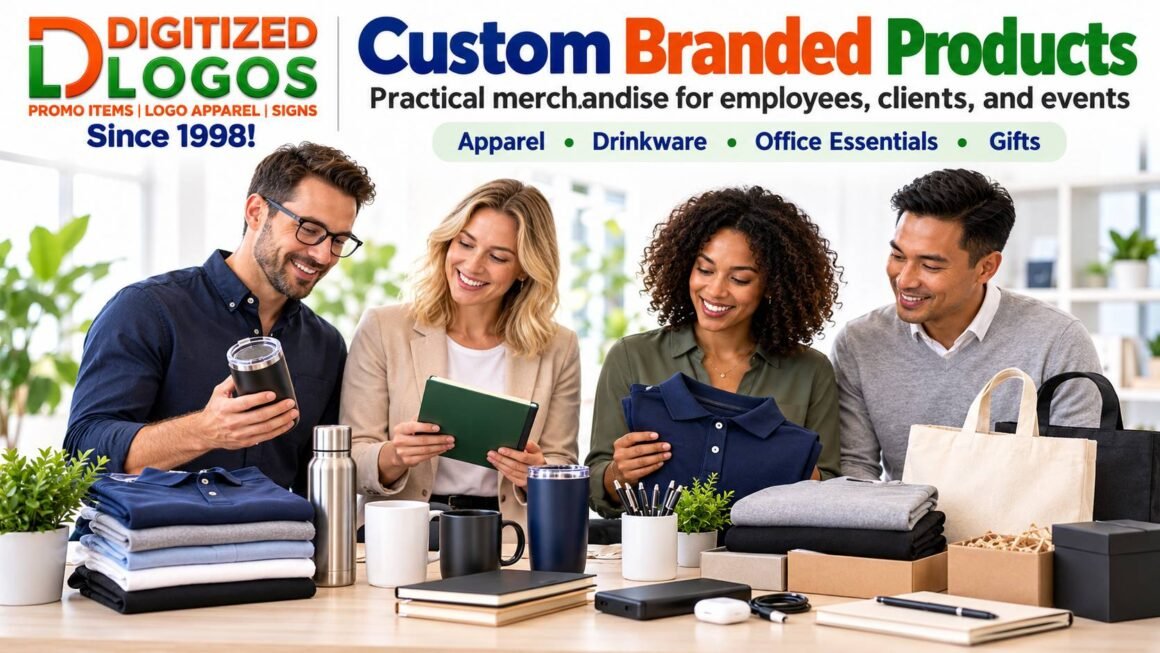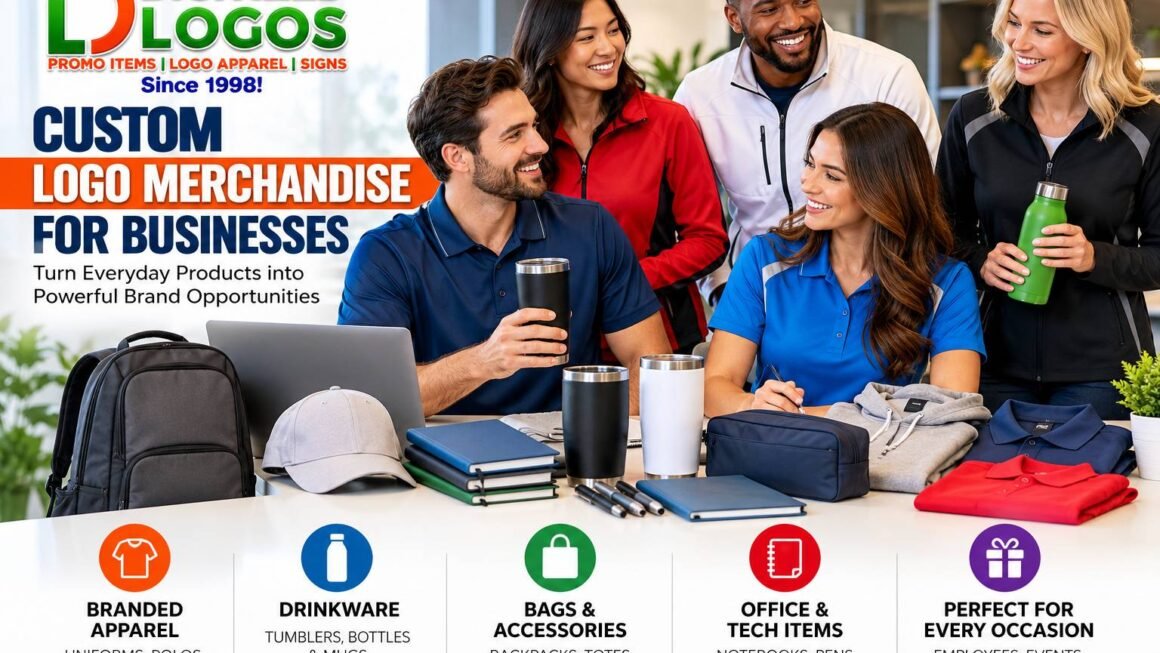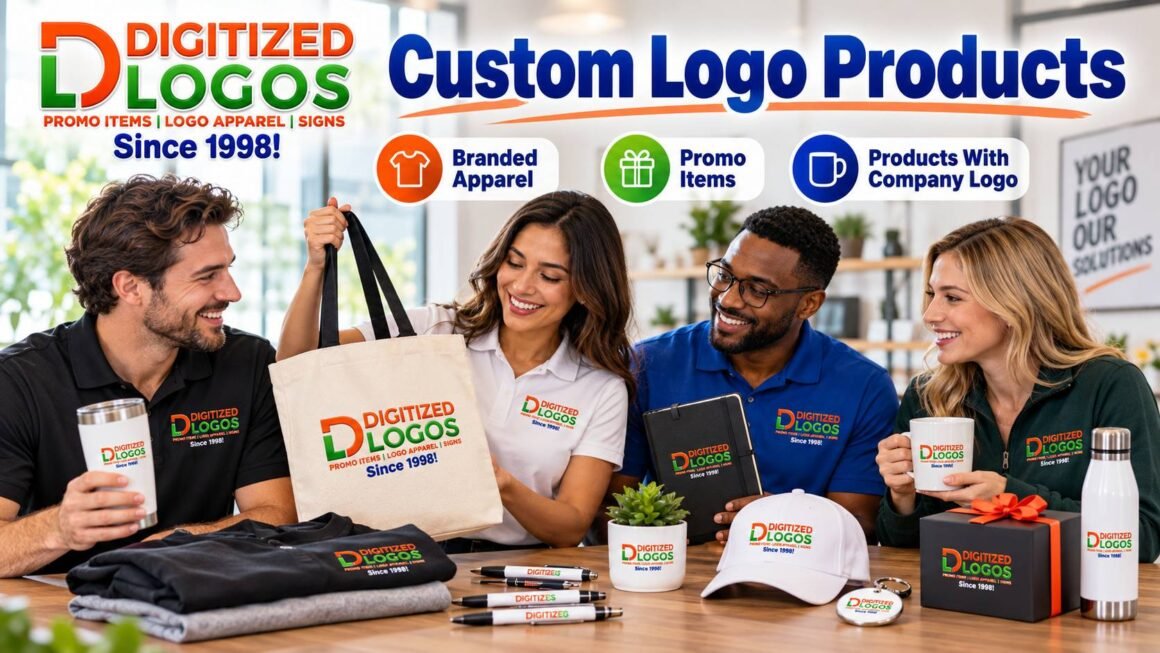
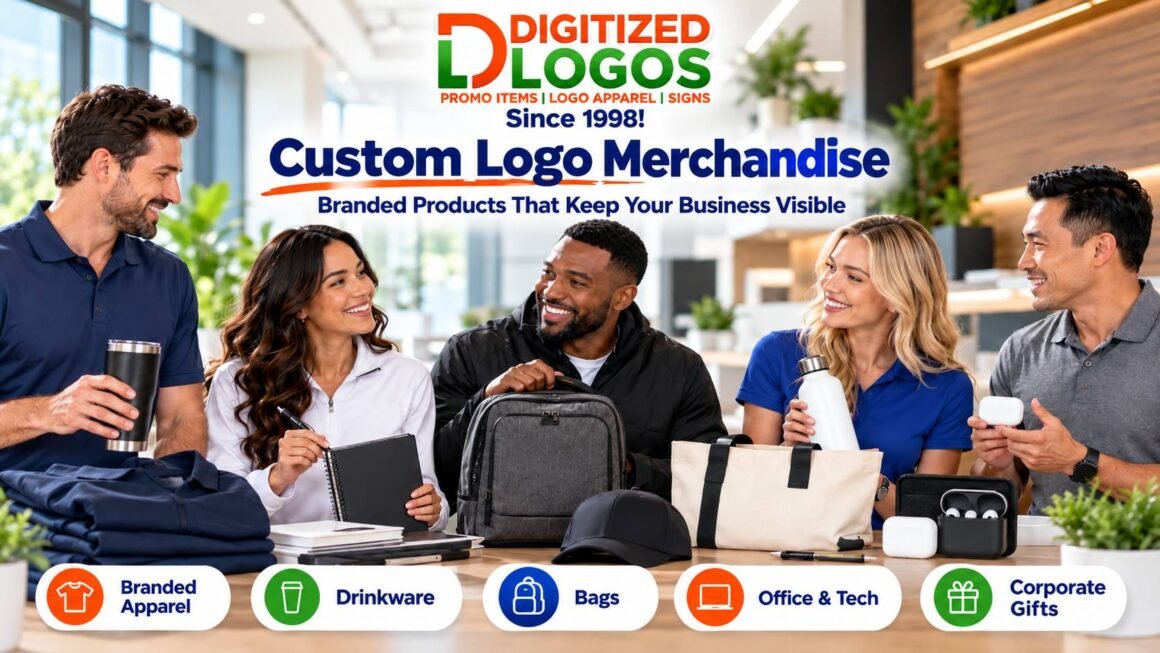
Custom logo merchandise gives businesses a practical way to put their brand on products employees, customers, and event attendees can use in everyday life. From branded polo shirts and jackets to drinkware, bags, notebooks, and technology accessories, the right merchandise can reinforce brand recognition while serving a useful purpose.
For businesses planning employee programs, trade shows, customer appreciation gifts, corporate events, or ongoing promotional campaigns, choosing custom logo merchandise involves more than selecting an item and adding a logo. Product quality, artwork placement, decoration methods, order quantities, and distribution all influence the final result.
Digitized Logos provides promotional products and branded apparel solutions for businesses looking to create merchandise that reflects their brand identity. Understanding how to choose, customize, and manage these products can help purchasing teams make more informed decisions and build a consistent brand experience.
Quick Answer: What Is Custom Logo Merchandise?
Custom logo merchandise consists of products personalized with a company’s logo, colors, messaging, or other brand elements. Businesses use these products for employee uniforms, onboarding kits, corporate gifts, trade show giveaways, customer appreciation, and marketing campaigns.
Effective merchandise combines practical usefulness, appropriate product quality, clear branding, and a distribution plan that matches the intended audience. The best choice depends on the purpose of the program, the available budget, the desired brand presentation, and how recipients will use the products.
Why Businesses Invest in Branded Merchandise
Branded merchandise connects a company’s visual identity with physical products that people can keep, wear, or use. Unlike a digital advertisement that disappears from view when a user scrolls past it, a useful branded item may remain in someone’s routine for months or years, depending on its quality and frequency of use.
The business value depends on the product and the way it is distributed. A well-designed employee jacket may support a consistent professional appearance, while a practical event giveaway may help attendees remember the organization that provided it.
- Brand recognition: Consistent logo placement and brand colors make a company’s identity more recognizable across different products and interactions.
- Employee engagement: Branded apparel, welcome kits, and useful accessories can help employees feel connected to their organization.
- Customer relationships: Thoughtfully selected gifts provide a tangible way to acknowledge customers, partners, and business milestones.
- Event marketing: Merchandise can extend a brand’s presence beyond a trade show booth, conference, or corporate event.
- Professional consistency: Coordinated apparel and accessories help businesses maintain a recognizable appearance across teams and locations.
These benefits are not automatic. Merchandise that feels inexpensive, carries an unclear logo, or has little relevance to its recipient may deliver less value than a carefully selected product designed around a specific business objective.
Popular Types of Company Logo Merchandise
The most suitable products depend on who will receive them, where they will be used, and what the business wants to accomplish. A product selected for a field employee may have different requirements from one intended for a conference attendee or executive client.
1. Branded Apparel and Corporate Clothing
Branded apparel includes polo shirts, T-shirts, jackets, sweatshirts, performance shirts, and other garments customized with a company logo or design. Businesses use these products for employee uniforms, team events, corporate gifting, promotional campaigns, and customer-facing roles.
Product selection should account for comfort, fabric, fit, durability, and the environment in which the garment will be worn. A lightweight performance shirt may suit an outdoor event, while a structured polo or embroidered jacket may better match a customer-facing business environment.
Decoration also affects the finished garment. Embroidery can provide a textured, professional appearance for suitable logos and fabrics. Screen printing can work well for many larger apparel orders, while dye sublimation is particularly useful for compatible polyester fabrics when a design calls for full-color graphics, gradients, patterns, or extensive coverage.
2. Drinkware and Everyday Accessories
Water bottles, travel mugs, tumblers, and drinkware accessories are common choices for employee gifts, customer appreciation, and event merchandise. Their practical value makes them worth considering when recipients are likely to use them regularly.
Before ordering, evaluate material, capacity, lid construction, insulation requirements, cleaning instructions, and the available branding area. A logo that looks clear on a large bottle may require a simplified treatment on a narrow or curved surface.
3. Bags and Travel Products
Tote bags, backpacks, laptop bags, duffel bags, and travel accessories serve different audiences and purchasing needs. Trade show organizers may prefer lightweight bags that attendees can carry comfortably, while businesses preparing employee welcome kits may prioritize durable backpacks or work bags.
Check stitching, handles, zippers, compartments, material, and expected load before making a selection. The size and placement of the branding should complement the bag’s construction rather than interfere with pockets, seams, or functional features.
4. Office and Technology Merchandise
Notebooks, pens, desk accessories, charging accessories, and other technology-related products can suit office environments, conferences, onboarding kits, and customer gifts. These products are particularly useful when the intended audience regularly works at a desk or travels for business.
For technology accessories, confirm compatibility, safety information, functionality, and applicable product specifications before purchasing. For stationery and desk products, consider writing quality, material, finish, and how the logo will appear against the product’s surface.
5. Corporate Gifts and Premium Merchandise
Premium merchandise is appropriate when a business wants its gift to reflect a particular relationship, milestone, or level of appreciation. Depending on the audience and budget, options may include quality outerwear, executive bags, premium drinkware, coordinated gift sets, or carefully assembled merchandise kits.
The value of a corporate gift comes from its relevance and presentation, not simply its price. A well-chosen product that fits the recipient’s needs can be more meaningful than a more expensive item with limited practical use.
How to Choose the Right Custom Logo Merchandise
Product selection should begin with the business objective, not a catalog of available items. A clear objective helps narrow the options and prevents spending money on merchandise that does not fit the intended audience.
- Define the purpose. Decide whether the merchandise is intended for employee uniforms, onboarding, customer gifts, trade shows, internal recognition, or another specific use.
- Identify the recipients. Consider their roles, preferences, work environments, and likely product usage. Products intended for field teams may need different durability and performance characteristics from executive gifts.
- Set the budget. Account for the product, decoration, packaging, shipping, distribution, and any applicable setup or fulfillment charges. Compare the total program cost rather than the item price alone.
- Evaluate product quality. Review materials, construction, sizing, functionality, and care requirements. When the order is significant or the product is unfamiliar, request a sample or production-representative proof where available.
- Choose the decoration method. Match the branding technique to the product material, artwork, desired appearance, and expected use.
- Confirm artwork and specifications. Approve the logo, colors, placement, dimensions, product variants, and any other relevant production details before authorizing the order.
- Plan distribution and replenishment. Determine how merchandise will reach recipients, where inventory will be stored if needed, and how future orders will maintain consistency.
This process is useful for both one-time purchases and recurring merchandise programs. It also gives purchasing teams a consistent framework for evaluating products and communicating requirements to a supplier.
Customization Methods: Choosing the Right Decoration
The decoration method determines how the logo or design is applied to a product. The appropriate technique depends on the material, surface shape, artwork complexity, production requirements, and the appearance the business wants to achieve.
Embroidery
Embroidery uses thread to reproduce a design on compatible materials, particularly apparel, caps, bags, and selected accessories. It creates a raised, textured finish that can work well for company logos on polos, jackets, and uniforms.
Very small lettering, fine details, and complex gradients may need to be simplified for embroidery. Artwork preparation typically involves digitizing the design into stitch instructions, so the quality of the digitized file and the characteristics of the fabric affect the final result.
Screen Printing
Screen printing applies ink through a prepared screen and is commonly used for T-shirts, sweatshirts, and other suitable products. It can be an effective choice for bold graphics and repeat orders, depending on the number of colors, artwork, garment material, and production quantity.
When comparing quotes, confirm the number of print colors, print locations, setup charges, and any limitations affecting the selected garment. These details can influence both cost and the appearance of the finished design.
Dye Sublimation
Dye sublimation uses heat to transfer dye into compatible materials, typically polyester fabrics or specially coated surfaces. On suitable polyester apparel, the process can produce detailed, full-color designs with extensive coverage without the same raised ink feel associated with some other decoration methods.
This technique is useful for performance apparel, custom jerseys, and products requiring complex graphics or edge-to-edge designs. Material compatibility matters: traditional dye sublimation is not a universal solution for every fabric or product surface, and the final color can be influenced by the base material.
Other Product Branding Methods
Depending on the product, customization may also involve laser engraving, pad printing, digital printing, heat-applied transfers, or other application methods. Each technique has different requirements for material compatibility, artwork, durability, and placement.
When comparing options, ask the supplier to explain why a particular method is appropriate for the product rather than assuming one decoration technique will work equally well across an entire merchandise collection.
How Artwork and Product Specifications Affect Quality
A product can be well made and still look unprofessional if the branding is poorly prepared. Artwork quality, logo proportions, color reproduction, and placement should be reviewed before production begins.
- Use appropriate artwork files. Vector artwork is often preferable for logos because it can be resized without the same loss of sharpness associated with enlarging a low-resolution image. The required file format depends on the decoration process.
- Confirm color expectations. Brand colors can appear different across fabrics, inks, threads, coatings, and digital displays. Ask how color matching will be handled when consistency is important.
- Check logo readability. Small text, thin lines, intricate symbols, and closely spaced elements may not reproduce clearly at every size.
- Review placement carefully. Positioning should account for seams, pockets, zippers, curved surfaces, and the way a garment or product is used.
- Approve a representative proof. Review the actual product specifications and available artwork or production proofs. A digital mockup helps communicate intent, but it may not reproduce the exact texture, color, or finished appearance of the physical product.
These checks are especially valuable when a business is ordering multiple products or distributing merchandise across several locations. Small inconsistencies in logo scale, placement, or color can become more noticeable when products are displayed together.
What Does Custom Logo Merchandise Cost?
The cost of custom merchandise depends on the product, quantity, decoration method, artwork requirements, packaging, shipping, and fulfillment arrangements. There is no single price that applies to every order, so a meaningful comparison requires a clear specification for the products being quoted.
Common cost considerations include:
- Product selection: Material, construction, features, and brand can significantly affect the base price.
- Order quantity: Unit pricing may change at different quantities, depending on supplier pricing and production requirements.
- Decoration: Stitch count, print colors, design complexity, decoration locations, and setup requirements may affect the total.
- Packaging: Individual packaging, gift boxes, inserts, and coordinated kits can add to program costs.
- Distribution: Shipping to one location differs from shipping individually to employees or customers at multiple addresses.
- Inventory and reorders: Storage, replenishment, product changes, and maintaining consistent specifications can affect the longer-term cost of a merchandise program.
For a practical comparison, request quotes using the same product specifications, quantity, decoration locations, and delivery requirements. Ask suppliers to identify setup charges, shipping, applicable taxes, and other additional costs so the comparison reflects the complete purchase.
A lower unit price is not necessarily the better business decision if the product is unsuitable, difficult to distribute, or likely to require early replacement. Evaluate the expected usefulness and quality of the merchandise alongside the total cost.
Minimum Order Quantities and Production Timelines
Minimum order quantities and production timelines vary by product, supplier, decoration method, inventory status, and order complexity. Some products may be available in small quantities, while others may require larger production runs or additional setup.
Before placing an order, confirm the minimum quantity, product availability, artwork approval requirements, production schedule, shipping arrangements, and the date the merchandise needs to be in hand. A quoted production period should not automatically be treated as the complete time from initial inquiry to delivery.
For event merchandise, work backward from the event date and allow time for product selection, artwork revisions, approvals, production, transit, and receiving. Building in a reasonable contingency is particularly useful when multiple products or locations are involved.
For recurring programs, discuss how the supplier will handle future orders, discontinued products, changing sizes, and substitutions. Confirming these conditions in advance can reduce the risk of inconsistent merchandise or unexpected delays.
Managing a Company-Wide Merchandise Program
A recurring merchandise program requires more planning than a one-time promotional order. Companies purchasing for several departments, locations, or employee groups need a reliable process for product selection, approvals, inventory, distribution, and replenishment.
One option is to establish a standardized product collection containing approved apparel, accessories, and gifts. A defined collection can help teams make consistent choices without requiring every department to start the selection process from scratch.
Businesses with ongoing purchasing needs may also benefit from a curated company merchandise store. Depending on the store’s capabilities and the agreed arrangement, an online store can provide a central place to browse approved products and help coordinate ordering across teams.
Before implementing a program, determine who can place orders, who approves spending, which products are authorized, and how brand standards will be maintained. Clarify how sizes, stock availability, shipping, and reorders will be handled, particularly when employees work in different locations.
Digitized Logos offers promotional product solutions and curated online store options for businesses exploring ways to organize branded merchandise. The appropriate arrangement depends on the company’s purchasing structure, product requirements, and fulfillment needs.
Realistic Examples of Custom Merchandise in Business
Example 1: A Hospitality Group Preparing for Employee Onboarding
Consider a hypothetical hospitality group hiring employees across several properties. The company wants a consistent appearance for customer-facing staff and a useful welcome package for new team members.
The purchasing team could evaluate branded polos or jackets for suitable roles, along with drinkware and notebooks for onboarding kits. Before ordering, the team would confirm garment sizing, fabric suitability, logo placement, quantities by location, and the process for replenishing items as new employees join.
The practical advantage is a more organized purchasing process and a consistent visual identity across participating properties. Actual cost savings or employee engagement outcomes would depend on how the program is implemented and measured.
Example 2: A Construction Company Preparing for a Trade Show
Consider a hypothetical construction company exhibiting at an industry trade show. The company wants its staff to look coordinated and wants to give visitors merchandise that is useful beyond the event.
The company might compare branded performance shirts for booth staff, durable tote bags for attendees, and reusable drinkware for selected customer gifts. Product choices would account for event conditions, the intended audience, carrying convenience, branding visibility, and the available budget.
To manage production risk, the team would approve artwork early, confirm quantities, verify delivery arrangements, and establish a receiving checklist before the merchandise ships. This helps connect the marketing plan to the practical requirements of running the event.
Common Mistakes to Avoid When Ordering Branded Merchandise
Many merchandise problems can be prevented by resolving specifications and operational details before production begins.
- Choosing products based only on price. An inexpensive item may not offer the quality, usefulness, or brand presentation the business needs.
- Ignoring the recipient. Merchandise should suit the audience, its working environment, and the reason for the purchase.
- Using the wrong decoration method. A branding technique that works well on one material may be unsuitable for another.
- Approving artwork without checking dimensions. A logo can look balanced on a screen but appear too small, too large, or poorly positioned on the finished product.
- Overlooking sizing and product variants. Apparel programs require careful planning for size ranges, quantities, and any gender-specific or fit-related options.
- Ordering too close to an event. Insufficient time for approvals, production, and shipping can leave little room to resolve problems.
- Failing to plan reorders. Recurring programs need clear product specifications and a process for managing availability changes.
- Underestimating fulfillment requirements. Individually packed employee kits or deliveries to multiple locations require more coordination than a single bulk shipment.
A clear written specification is one of the simplest ways to reduce misunderstandings. It should identify the product, color, quantity, sizes where applicable, decoration method, logo placement, packaging, shipping requirements, and approval process.
How to Evaluate a Promotional Merchandise Supplier
Selecting a supplier involves more than comparing catalog prices. A suitable partner should be able to explain the available options, identify relevant product limitations, clarify customization requirements, and communicate the steps needed to complete the order.
When evaluating suppliers, consider the following questions:
- Can the supplier recommend products suited to the intended audience and budget?
- Can the supplier explain decoration methods and artwork requirements?
- Are product specifications, pricing, setup charges, and shipping costs clearly documented?
- Can the supplier support the quantities and product mix required for the program?
- How are artwork proofs, product substitutions, and approvals handled?
- What options are available for repeat orders, company merchandise stores, or multi-location fulfillment?
- How does the supplier communicate product availability and schedule changes?
For businesses purchasing several categories of merchandise, coordinating product selection and branding through a single point of contact may simplify communication. However, buyers should still verify the supplier’s capabilities for each product category, decoration method, and fulfillment requirement.
Digitized Logos provides access to promotional products, branded apparel, customization options, and business merchandise solutions. Buyers can explore the available catalog and discuss their requirements to identify products appropriate for their intended use.
Frequently Asked Questions About Custom Logo Merchandise
What are the best custom logo merchandise products for businesses?
The best products depend on the audience and purpose. Branded apparel can support employee uniforms and events, while drinkware, bags, notebooks, and technology accessories may suit customer gifts or trade show giveaways. Prioritize usefulness, quality, branding suitability, and total cost rather than selecting products solely because they are popular.
Can a company customize merchandise with its exact logo and brand colors?
Many promotional products can be customized with a company logo and brand colors, subject to the product and decoration method. Provide suitable artwork files and confirm color expectations, logo dimensions, and placement before production. Exact color reproduction may vary across materials and processes, so review the available proofing options when brand consistency is important.
Is dye sublimation better than embroidery for branded apparel?
Neither method is universally better. Embroidery is useful for textured logos on suitable garments, while dye sublimation can produce detailed, full-color graphics on compatible polyester fabrics. The right choice depends on the design, material, garment construction, desired appearance, and intended use. Confirm compatibility and production requirements before choosing a method.
How far in advance should a business order promotional merchandise?
Order timing depends on product availability, customization, quantity, artwork approvals, production, and shipping. For an event, work backward from the required delivery date and allow time for revisions and receiving. Confirm the actual schedule with the supplier rather than assuming all products follow the same production timeline.
How can a business maintain consistent branding across multiple locations?
Establish approved logos, brand colors, product specifications, decoration placements, and ordering procedures. Maintain a central reference for approved products and document any changes. For recurring purchases, discuss reordering, discontinued products, substitutions, and fulfillment arrangements with the supplier to help preserve consistency across locations.
Key Takeaways
- Choose merchandise based on the recipient, business objective, intended use, and available budget.
- Match the decoration method to the product material, artwork complexity, and desired appearance.
- Review artwork, product specifications, quantities, and delivery requirements before approving production.
- Compare total purchasing costs, including decoration, packaging, shipping, and fulfillment, rather than relying on unit price alone.
- For recurring programs, establish approved products and clear processes for ordering, distribution, and reordering.
Explore Custom Logo Merchandise with Digitized Logos
Effective branded merchandise starts with a clear understanding of your audience, your brand, and the purpose of the purchase. Whether you are preparing employee apparel, planning a trade show, developing corporate gifts, or organizing an ongoing merchandise program, thoughtful product selection and careful production planning can help you make a more informed investment.
Digitized Logos helps businesses explore custom logo merchandise, promotional products, branded apparel, and related merchandise solutions. You can browse product options, discuss customization requirements, and evaluate merchandise that fits your business objectives.
To explore company logo merchandise for your organization, visit the Digitized Logos product catalog, call 301-963-3553, or email info@DigitizedLogos.com. Share your intended use, approximate quantity, budget, branding requirements, and delivery needs to help identify suitable options for your program.