Branded Apparel and Custom Uniforms That Build a Stronger Business Identity
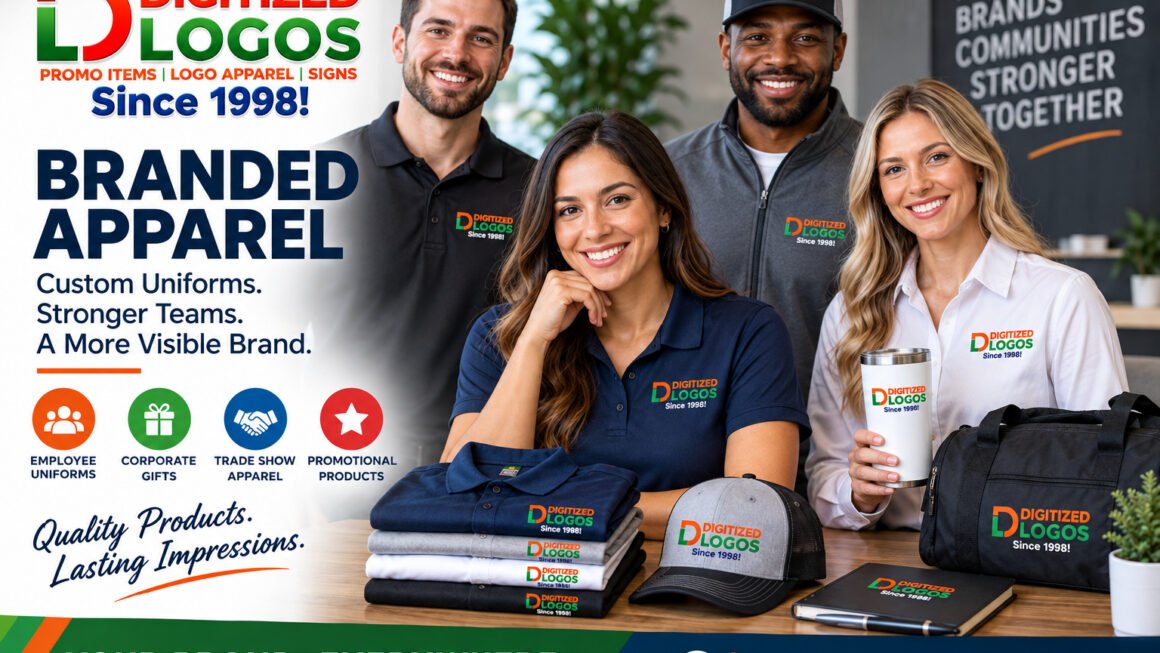
Branded apparel does more than put a logo on a shirt. When thoughtfully sourced, designed, produced, and distributed, it turns employees, event teams, sales representatives, and customer-facing staff into consistent extensions of your brand.
Digitized Logos provides branded apparel and promotional product solutions for organizations that need professional customization, reliable sourcing, and scalable fulfillment. Businesses can explore branded apparel, corporate merchandise, and promotional products at https://products.digitizedlogos.com/.
Quick Answer: What Is Branded Apparel?
Short Answer: Branded apparel is clothing customized with a company’s logo, colors, messaging, or visual identity for employees, customers, events, promotions, and merchandise programs. It includes custom uniforms, polos, T-shirts, jackets, performance wear, hats, and other garments designed to create consistent brand visibility.
For business buyers, the real value comes from consistency. The right apparel program gives teams an approved selection of garments and decoration methods instead of relying on employees or individual departments to source items independently.
Why Branded Apparel Matters to Modern Businesses
A uniform or branded polo can generate repeated exposure throughout its useful life. Unlike a one-time advertisement, apparel continues representing the organization whenever it is worn at a workplace, conference, customer meeting, community event, jobsite, or trade show.
The benefits extend beyond impressions. A structured apparel program can simplify purchasing, improve employee presentation, support onboarding, reduce inconsistent logo usage, and make it easier for multiple offices or departments to order approved merchandise.
For organizations operating across Maryland, Virginia, Washington DC, and elsewhere in the United States, centralized merchandise management can be particularly valuable when teams, events, and distribution locations are spread across multiple markets.
Branded Apparel vs. Custom Uniforms: What Is the Difference?
Branded apparel is the broader category. It can include employee clothing, corporate gifts, event apparel, customer merchandise, executive apparel, promotional shirts, outerwear, hats, and team gear.
Custom uniforms are usually more operational. They are selected for employees who need a consistent appearance or garments suited to specific working conditions. Uniform programs may involve polos, button-down shirts, jackets, work shirts, safety-oriented garments, hospitality apparel, or performance clothing.
The distinction matters during sourcing. A shirt intended for a one-day event may be evaluated primarily on appearance, budget, and delivery date. A uniform worn every week needs stronger consideration of durability, laundering, comfort, replacement availability, sizing, and decoration longevity.
Where Businesses Use Branded Apparel
Use Case: Companies use branded clothing anywhere people represent the organization. That makes apparel relevant across employee engagement, marketing, recruiting, customer experience, corporate gifting, and event programs.
- Employee uniforms: Create a recognizable and professional customer-facing appearance.
- New-hire onboarding: Add branded shirts, polos, jackets, or hats to onboarding kits.
- Trade shows: Give booth teams a coordinated look while supporting brand recognition across the venue.
- Corporate events: Outfit employees, volunteers, speakers, and event staff.
- Sales teams: Provide professional apparel for customer meetings, conferences, and field visits.
- Corporate gifting: Use premium apparel as an employee, client, or partner gift.
- Merchandise programs: Maintain approved branded merchandise for ongoing departmental or company-wide ordering.
Apparel can also be coordinated with promotional products, trade show giveaways, branded gifts, corporate swag, and merchandise programs. Buyers planning both apparel and promotional merchandise can review options at https://products.digitizedlogos.com/.
How to Build a Branded Apparel Program Step by Step
A successful program starts with the business requirement rather than the garment catalog. Clarifying who will wear the products, where they will be used, and how frequently they will be reordered prevents expensive mismatches between appearance and performance.
- Define the use case. Determine whether the apparel is for uniforms, events, onboarding, customer gifts, sales teams, field employees, or a broader merchandise program.
- Establish brand standards. Confirm approved logos, colors, placement requirements, messaging, and any restrictions on how the brand identity can appear.
- Select appropriate garments. Evaluate material, fit, sizing, durability, climate, workplace conditions, wash frequency, and expected wear.
- Choose the decoration method. Match embroidery, screen printing, dye sublimation, heat-applied graphics, or another process to the garment and artwork.
- Confirm quantities and size distribution. Build the order around actual wearer requirements rather than relying on arbitrary size assumptions.
- Review artwork and proofs. Verify logo proportions, placement, colors, spelling, and garment specifications before production.
- Plan distribution. Decide whether merchandise will ship to one office, multiple locations, events, or individual recipients.
- Create a replenishment strategy. For ongoing programs, establish approved products and reorder procedures so future purchases remain consistent.
Choosing the Right Garments for Your Team
There is no universally correct corporate shirt. Product selection should reflect how the garment will actually be used.
Polos and Professional Shirts
Polos work well for sales teams, conferences, hospitality environments, office staff, and customer-facing employees. Consider fabric weight, moisture management, wrinkle resistance, collar construction, fit options, and whether embroidery will sit cleanly on the fabric.
T-Shirts and Event Apparel
T-shirts are useful for employee programs, community events, campaigns, giveaways, and casual workplaces. Buyers should consider fabric feel, color availability, print area, sizing range, and whether the garment needs to perform for one event or withstand repeated wear.
Outerwear
Jackets, vests, quarter-zips, and other layers can provide high perceived value because recipients often keep and wear them longer. Outerwear is particularly useful for field teams, employee recognition, executive gifts, and seasonal programs.
Performance Apparel
Moisture-wicking and performance fabrics can be appropriate for outdoor events, active teams, warm environments, golf programs, and physically demanding work. Decoration compatibility should be checked because different technical fabrics respond differently to embroidery, heat, and printing processes.
Which Customization Method Should You Choose?
Short Answer: Embroidery is commonly chosen for polished logos on polos, jackets, and hats. Screen printing works well for many larger-volume graphic applications, while dye sublimation is particularly useful for full-color, highly customized polyester apparel where the design becomes part of the fabric.
The best method depends on artwork complexity, garment material, quantity, intended appearance, durability requirements, budget, and production schedule.
Embroidery
Embroidery creates a dimensional stitched finish and is frequently used for corporate polos, jackets, button-down shirts, caps, and uniforms. Small lettering and highly detailed artwork may need adjustment so the design remains readable when converted into stitches.
Screen Printing
Screen printing is often practical for T-shirts and larger production runs. Cost efficiency depends partly on order quantity, number of print locations, artwork, and the number of colors required.
Dye Sublimation
Dye sublimation allows extensive full-color design coverage on compatible polyester materials. It is useful when businesses want patterns, gradients, photographic elements, or graphics that extend beyond the limitations of a conventional left-chest logo.
Heat-Applied Decoration
Heat transfer methods can support detailed graphics, names, numbers, and certain shorter-run applications. Garment construction and fabric compatibility should be evaluated before selecting the process.
Behind the Scenes: Why Apparel Production Requires More Than Uploading a Logo
Professional customization involves several decisions that customers rarely see. Artwork may need to be prepared for embroidery, printing, or sublimation; decoration dimensions must suit each garment; logo placement has to account for seams, pockets, plackets, and fabric behavior; and production specifications must remain consistent across sizes.
This is one reason sampling and proof approval matter. A design that looks balanced on a digital screen may need adjustments when applied to an actual polo, jacket, cap, or performance shirt.
Operational insight: Buyers should approve placement dimensions, not merely the appearance of a digital proof. A logo can look visually correct in an enlarged proof while being too large or too small on the finished garment.
Operational insight: Size collection should happen before final quantities are committed whenever apparel is intended for specific employees. Guessing the size distribution can create excess inventory in some sizes while leaving essential team members without usable garments.
What Does Branded Apparel Cost?
Short Answer: Branded apparel pricing depends on garment quality, quantity, decoration method, artwork complexity, number of decoration locations, sizes, packaging, shipping, and turnaround requirements. The lowest unit price is not necessarily the lowest total program cost.
A basic event shirt and a premium embroidered performance polo solve different business problems, so comparing them strictly by unit price can be misleading. Buyers should evaluate expected wear, presentation, useful life, and distribution costs alongside the initial purchase price.
How to Think About ROI
Apparel ROI is not limited to advertising impressions. Organizations can also gain value through employee engagement, professional presentation, standardized procurement, event readiness, recruiting, customer experience, and longer-term brand exposure.
Consider a hypothetical 150-person company issuing two branded garments per employee. That creates 300 pieces in active circulation. If each garment is worn twice per month for 12 months, the program generates approximately 7,200 employee-wear occasions before considering exposure at conferences, customer visits, commuting, or community events.
The example does not assign a monetary value to each exposure. It illustrates why useful apparel can continue delivering visibility long after distribution, especially when recipients actually want to wear it.
Real-World Example: Multi-Location Employee Uniform Program
Imagine a service organization with 100 employees across Maryland, Virginia, and Washington DC. Managers at individual locations have historically purchased their own shirts, resulting in inconsistent garment colors, logo sizes, and quality.
A centralized custom uniforms program could establish two approved polos, one outerwear option, standardized decoration specifications, and a defined reorder process. Instead of repeatedly choosing products from scratch, locations order from an approved assortment, improving consistency while reducing administrative friction.
Real-World Example: Trade Show Apparel and Giveaways
Consider a company sending 20 employees to a three-day industry conference. Rather than treating shirts, booth giveaways, and customer gifts as unrelated purchases, the organization can build one coordinated merchandise program.
Staff might receive three branded shirts for consistent daily presentation while prospects receive complementary promotional products. Higher-value branded gifts can be reserved for scheduled customer meetings. This creates a more intentional brand experience than distributing disconnected items without a merchandise strategy.
Buyer Considerations Before Ordering Custom Uniforms
Business buyers should evaluate apparel as an operational purchase, especially when products will be reordered throughout the year. Ask how easily the original garment, color, decoration specifications, and size range can be reproduced later.
Important considerations include fabric durability, fit consistency, decoration quality, color availability, minimum quantities, sample availability, reorder requirements, production schedules, inventory strategy, packaging, and shipping destinations.
For regulated workplaces or specialized industries, functional requirements should be identified before selecting garments. Branding should complement the job requirement rather than compromise it.
Decision Support: Cost, Turnaround, Minimums, and Fulfillment
How Should Buyers Evaluate Cost?
Compare total program value rather than unit price alone. A cheaper garment that employees avoid wearing, shrinks quickly, or cannot be reliably reordered may create more replacement and administrative costs than a better-suited option.
What Affects Turnaround Time?
Product availability, artwork preparation, proof approval, decoration complexity, quantity, production capacity, shipping destination, and seasonal demand can all affect schedules. Event-driven orders should include contingency time instead of treating the event date as the production deadline.
Are Minimum Quantities Always Required?
Minimum quantities vary by garment, supplier, decoration process, and production method. Buyers requiring small initial quantities or frequent replenishment should discuss those requirements before selecting a product.
How Flexible Is Customization?
Customization can range from a simple embroidered logo to highly detailed, full-color apparel. The appropriate level depends on brand standards, garment construction, budget, production method, and the environment in which the apparel will be worn.
How Does Fulfillment Work?
Orders may be shipped in bulk to one destination or distributed across offices, events, or recipients depending on program requirements. Fulfillment planning should happen before production because individual packing, multiple destinations, deadlines, and recipient-level distribution can materially change logistics.
Digitized Logos manages sourcing, customization, and fulfillment, helping business buyers coordinate these variables rather than treating them as disconnected purchasing steps. Organizations evaluating apparel and related merchandise can explore available options at https://products.digitizedlogos.com/.
Common Branded Apparel Mistakes to Avoid
- Choosing solely by price: Low-cost garments can become expensive if poor fit or durability reduces actual usage.
- Skipping samples: Fabric weight, fit, texture, and color can look different in person than on a screen.
- Ignoring decoration compatibility: Not every logo or printing technique works equally well on every fabric.
- Ordering without confirmed sizes: Guessing can produce unnecessary inventory and shortages.
- Waiting until the event is close: Compressed timelines reduce flexibility if inventory or artwork changes are needed.
- Ignoring reorders: A product that cannot be replenished consistently can undermine a long-term uniform program.
How to Scale a Corporate Merchandise Program
Once organizations move beyond occasional orders, branded merchandise becomes a procurement and brand-management function. The objective changes from buying individual products to creating a repeatable system.
A scalable program may combine employee apparel, custom uniforms, onboarding kits, trade show giveaways, corporate gifting, recognition items, and departmental merchandise under consistent brand standards.
Standardizing core items can also reduce decision fatigue. Instead of asking managers to select a new polo for every order, a business can maintain approved products and decoration specifications while allowing controlled flexibility for special events or campaigns.
Branded Apparel Trends for Business Merchandise Programs
Corporate buyers increasingly focus on usefulness rather than simply maximizing the number of items distributed. Comfortable apparel, versatile outerwear, performance fabrics, elevated retail-inspired silhouettes, and products employees voluntarily wear can generate stronger long-term value.
Another important trend is program integration. Apparel is increasingly planned alongside onboarding kits, promotional products, event merchandise, employee recognition, and corporate gifting rather than being managed as a standalone purchase.
Full-color customization also gives organizations more creative flexibility. Instead of limiting every garment to a small chest logo, appropriate production methods can incorporate patterns, brand graphics, gradients, and campaign-specific visual systems.
How to Choose a Branded Apparel Vendor
Short Answer: Choose a vendor based on product sourcing capability, decoration expertise, proofing processes, quality control, fulfillment support, communication, scalability, and ability to maintain brand consistency, not simply the lowest quoted unit price.
Ask prospective vendors how they handle artwork, substitutions, unavailable inventory, samples, proofs, quality issues, split shipments, repeat orders, and event deadlines. These questions reveal how the supplier performs when an order becomes operationally complex.
Digitized Logos provides branded apparel and promotional product solutions and manages sourcing, customization, and fulfillment. The company is an MDOT, DDOT, and VA SWaM Certified Small, Minority, Female-Owned Business, supporting organizations seeking both merchandise capabilities and supplier-diversity alignment.
Key Takeaways
- Branded apparel is a business system, not simply logo placement. Product selection, decoration, sizing, fulfillment, and replenishment all influence results.
- Custom uniforms should be selected for real working conditions. Comfort, durability, laundering, fit, and reorder availability matter alongside appearance.
- ROI extends beyond impressions. Professional presentation, employee engagement, procurement consistency, and repeated use contribute to program value.
- Early planning reduces risk. Confirming artwork, inventory, sizes, deadlines, and distribution requirements before production helps prevent avoidable problems.
- Scalable programs create consistency. Approved products and repeatable specifications make it easier to support employees, events, onboarding, gifting, and corporate swag across multiple locations.
Frequently Asked Questions About Branded Apparel
What types of branded apparel can businesses customize?
Businesses can customize polos, T-shirts, button-down shirts, jackets, vests, performance wear, hats, work shirts, and other garments. The right products depend on whether they are being used for employee uniforms, trade shows, onboarding, corporate gifting, field teams, customer-facing staff, or ongoing merchandise programs.
How far in advance should I order custom uniforms?
Order as early as practical, particularly when apparel is tied to an event or employee launch. Lead times vary according to inventory, quantity, decoration method, artwork approval, production capacity, and shipping. Building contingency time into the schedule provides more flexibility if products or specifications need adjustment.
Is embroidery or printing better for branded apparel?
Neither method is universally better. Embroidery often suits polos, jackets, hats, and professional uniforms, while printing can work well for graphic T-shirts and promotional apparel. Dye sublimation is useful for compatible full-color performance garments. The best method depends on fabric, artwork, quantity, appearance, and intended use.
Can branded apparel be combined with promotional products?
Yes. Many businesses coordinate apparel with promotional products, onboarding kits, corporate gifts, trade show giveaways, and employee merchandise. Managing these products as one broader merchandise program can improve visual consistency, simplify purchasing, and create a more coordinated brand experience across employees, customers, and events.
How can companies maintain consistency across repeat apparel orders?
Document approved garments, product colors, logo files, decoration dimensions, placement, thread or print specifications, and sizing requirements. Using consistent specifications and a defined reorder process reduces variation between departments and locations while making future purchasing faster and easier to manage.
Build a Branded Apparel Program That Is Ready When Your Business Needs It
The best branded apparel programs balance appearance with practical execution. Garment quality, customization, employee comfort, brand consistency, production schedules, and fulfillment all need to work together, whether you are ordering custom uniforms for employees or merchandise for a national event program.
Digitized Logos can help businesses coordinate apparel, promotional products, corporate merchandise, sourcing, customization, and fulfillment. For organizations in Maryland, Virginia, Washington DC, and across the United States, a structured merchandise program can provide greater consistency while making future orders easier to manage.
Improve brand visibility, simplify ordering, maintain merchandise consistency, and prepare your team for upcoming events. Call 301-963-3553 or visit https://products.digitizedlogos.com/ to explore branded apparel and corporate merchandise options with customization and fulfillment support.
#BrandedApparel #CustomUniforms #CorporateMerchandise #PromotionalProducts #CorporateSwag #EmployeeApparel #BrandedMerchandise #TradeShowMarketing #CorporateGifts