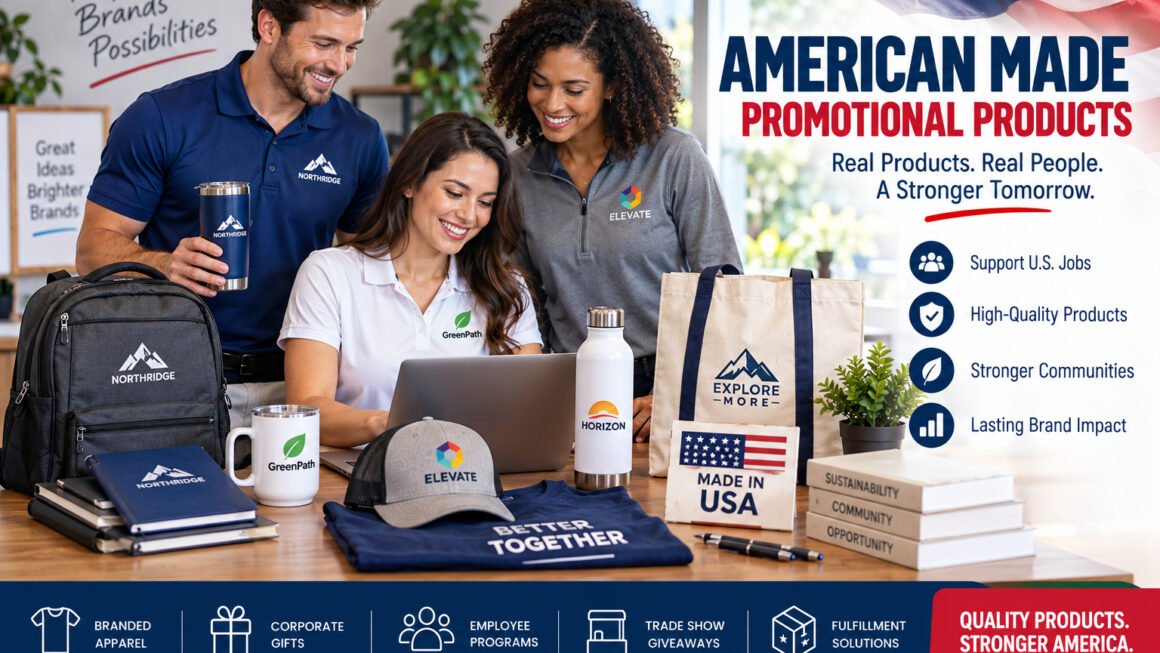
American Made Promotional Products: Smarter Branded Merchandise for Businesses
American made promotional products give businesses a practical way to combine brand visibility with domestic sourcing, quality-focused purchasing, and memorable customer or employee experiences. From corporate gifts and branded apparel to trade show merchandise and onboarding kits, domestically made products can support marketing, procurement, employee engagement, and corporate merchandise programs.
For organizations searching for USA made promotional products, the purchasing decision involves more than finding an item with space for a logo. Product origin, decoration capabilities, minimum quantities, inventory, production schedules, fulfillment, and total delivered cost all influence whether a merchandise program succeeds. Digitized Logos helps businesses navigate these considerations through https://products.digitizedlogos.com/.
Quick Answer: Why Choose American Made Promotional Products?
Short Answer: American made promotional products are branded merchandise manufactured in the United States and customized for business marketing, corporate gifting, employee engagement, events, and organizational programs. They are especially relevant when domestic sourcing, supply-chain transparency, brand quality, or American manufacturing is important to the buyer.
Businesses should verify product origin rather than assuming that merchandise customized or shipped from a U.S. facility was also manufactured domestically. This distinction is particularly important when American-made sourcing is part of a procurement requirement or campaign message.
What Are American Made Promotional Products?
American made promotional products are products manufactured in the United States that can be decorated with a company’s logo, message, campaign artwork, or visual identity. Depending on available domestic inventory and manufacturing capabilities, options can include drinkware, bags, apparel, office merchandise, event items, recognition products, gifts, and other branded merchandise.
These products can be used for one-time campaigns or incorporated into ongoing corporate merchandise programs. The objective is not simply to distribute something carrying a logo. Effective merchandise should connect the brand with a useful, relevant experience.
American Made vs USA Decorated: An Important Difference
Short Answer: A promotional product can be printed, embroidered, engraved, or packaged in the United States without necessarily being manufactured in the United States. Businesses requiring USA made logo items should verify the origin of the underlying product before ordering.
This distinction matters because the promotional-products supply chain includes manufacturing, importing, warehousing, decoration, packaging, and distribution. These activities may happen in different locations.
When domestic origin is a purchasing requirement, buyers should establish that requirement before requesting product recommendations. It is much easier to build an appropriate assortment from verified options than to select merchandise first and investigate origin immediately before production.
Why Businesses Are Choosing USA Made Logo Items
Domestic sourcing can serve several business objectives simultaneously. For some organizations, it aligns with procurement priorities. For others, American-made merchandise provides a relevant story for customers, employees, community programs, conferences, or corporate initiatives.
The business case can include:
- Domestic sourcing priorities: Products can align with organizational purchasing policies or campaign objectives centered on U.S. manufacturing.
- Brand positioning: American-made merchandise can reinforce a message around domestic business, craftsmanship, community, or sourcing transparency when relevant.
- Corporate gifting: Carefully selected products can create more intentional customer, employee, and partner gifts.
- Employee engagement: Branded merchandise can support onboarding, recognition, milestones, meetings, and internal events.
- Event marketing: Useful products can extend brand exposure beyond the conference or trade show floor.
- Merchandise consistency: Planned sourcing can help organizations standardize products and branding across departments and locations.
Where American Made Promotional Products Work Best
Short Answer: American made promotional merchandise can be used for trade shows, corporate gifts, employee onboarding, recognition programs, customer appreciation, recruiting, community initiatives, sales meetings, company events, and ongoing branded merchandise programs.
The best application depends on the audience and desired business outcome. Merchandise for 2,000 conference attendees should not necessarily follow the same product strategy as gifts for 50 high-value customers.
Trade Shows and Conferences
Trade show giveaways work best when they support the event strategy rather than becoming an isolated purchase. General visitors may receive practical, scalable merchandise while qualified prospects or scheduled customers receive a higher-value item.
This tiered approach helps businesses allocate promotional budgets according to audience value instead of giving every attendee the same product. Organizations planning an upcoming conference can explore promotional products at https://products.digitizedlogos.com/ based on quantity, audience, branding, and event requirements.
Employee Onboarding Kits
Branded onboarding merchandise helps translate an employer’s visual identity into a physical employee experience. Apparel, drinkware, bags, notebooks, desk products, and other useful items can be combined into a coordinated welcome package.
For distributed organizations, fulfillment is as important as product selection. Shipping 250 kits to one headquarters is operationally different from delivering individual kits to 250 employee addresses.
Corporate Gifts and Customer Appreciation
Corporate gifting benefits from relevance and perceived value. Rather than selecting products solely because they have a large imprint area, businesses should consider how recipients will actually use the item.
A useful product that remains in an office, vehicle, home, or travel routine can create repeated brand exposure without requiring the merchandise to feel like an advertisement.
Employee Recognition and Milestones
Branded merchandise can support work anniversaries, safety achievements, performance milestones, employee appreciation, company celebrations, and internal recognition programs. Higher-value products can be reserved for major milestones while scalable items support larger employee populations.
How to Build an American Made Merchandise Program
A reliable merchandise program starts with business requirements before product selection. This prevents teams from spending time comparing products that do not fit their quantity, sourcing, budget, or deadline.
- Define the business objective. Determine whether the merchandise is intended for awareness, employee engagement, gifting, recognition, recruiting, events, or another measurable purpose.
- Define the audience. Identify recipients and estimate quantities before selecting product categories.
- Establish domestic sourcing requirements. Specify whether American manufacturing is mandatory or simply preferred.
- Create a realistic delivered budget. Include merchandise, decoration, setup, packaging, freight, and fulfillment.
- Select appropriate products. Evaluate usefulness, perceived value, branding potential, available inventory, and audience relevance.
- Choose the decoration process. Match the product and artwork with screen printing, embroidery, sublimation, engraving, transfers, or another appropriate method.
- Review proofs carefully. Verify logo placement, dimensions, colors, spelling, orientation, and product configuration.
- Plan fulfillment. Decide whether merchandise will ship in bulk, to multiple offices, directly to recipients, or to an event location.
Choosing the Right Customization Method
Customization affects both appearance and performance. A decoration technique that works beautifully on a performance shirt may not be appropriate for a metal drinkware product, structured cap, or executive gift.
Embroidery
Embroidery provides a dimensional and professional appearance for polos, jackets, caps, bags, and other textiles. Artwork complexity and size should be evaluated carefully because very small lettering and intricate details may not translate cleanly into thread.
Screen Printing
Screen printing is widely used for apparel and selected textile products. It can work particularly well for graphics with clearly defined colors and is often practical when businesses need consistent decoration across larger quantities.
Dye Sublimation
Dye sublimation can create vivid, detailed graphics on compatible materials. It is particularly useful for performance apparel and merchandise where full-color designs, gradients, patterns, or larger decorated areas are important to the creative concept.
Laser Engraving
Laser engraving can create a refined appearance on compatible metal, coated, wood, and other products. It is frequently considered for premium drinkware, recognition merchandise, corporate gifts, and products intended for longer-term use.
Behind the Scenes of a Promotional Product Order
After a product is selected, several operational steps still have to align. Inventory is confirmed, artwork is prepared, decoration specifications are established, proofs are generated, approval is received, production is scheduled, merchandise is decorated, quality is checked, and the completed order enters the shipping or fulfillment process.
Practical operational insight: The production completion date is not the same as the required delivery date. Freight time, event receiving schedules, individual shipment processing, and possible carrier delays should be considered when establishing the production timeline.
Another operational insight: Available inventory can change while a quote is being evaluated. For deadline-sensitive orders, early approval can preserve more flexibility in product color, quantity, decoration, and shipping options.
American Made vs Imported Promotional Products
Domestic and imported promotional merchandise can serve different purchasing requirements. Instead of assuming one sourcing strategy fits every campaign, buyers should evaluate product origin alongside budget, selection, customization, inventory, quantity, and deadline.
American-made products may be particularly relevant when domestic manufacturing is an organizational priority or part of the campaign story. Imported merchandise can offer additional product categories, configurations, materials, colors, and price points.
The appropriate choice depends on the actual program. For buyers specifically requesting USA made promotional products, origin should be treated as a core sourcing requirement rather than something verified after the merchandise has already been selected.
Buyer Considerations Before Requesting a Quote
Short Answer: Before requesting pricing for USA made logo items, buyers should know their quantity, budget, required delivery date, shipping destinations, preferred products, artwork requirements, and whether domestic manufacturing is mandatory. Providing these details makes product recommendations and pricing substantially more useful.
- What is the exact or estimated quantity?
- Who will receive the merchandise?
- Is USA manufacturing required?
- What is the target budget per recipient or program?
- When must the completed products arrive?
- Where will they be delivered?
- How many logo locations are required?
- Does the artwork require full color?
- Will products need individual packaging or kitting?
- Could the program require replenishment later?
Cost and ROI of American Made Promotional Products
Promotional-product cost should be evaluated against the intended business result rather than viewed only as a price per unit. A $2 giveaway and a $40 corporate gift solve very different problems.
Consider a hypothetical company with a $7,500 conference merchandise budget and 1,500 expected visitors. Spending the budget uniformly would provide $5 per attendee before other program costs. But if only 300 visitors represent priority prospects, the company could instead allocate part of its budget toward higher-value merchandise for those contacts while using a more scalable item for general traffic.
That segmentation can make the merchandise strategy more closely reflect customer value and sales objectives.
How Should Businesses Measure Promotional Product ROI?
There is no single ROI metric appropriate for every merchandise program. Event merchandise can be connected to booth visits, qualified leads, appointments, or follow-up engagement. Employee programs can be evaluated around participation, consistency, or experience. Corporate gifting can be tied to customer engagement, account development, or relationship-building objectives.
A second hypothetical example illustrates the difference. A company spends $3,000 providing premium merchandise to 60 strategic customers, or $50 per recipient. If those customers represent significant existing or potential revenue, cost per recipient is more informative than comparing the campaign with a mass-market giveaway costing a few dollars.
Decision Support: Reducing Risk Before You Order
Business buyers typically need clarity around cost, minimum quantities, customization, turnaround, quality, and logistics before approving merchandise. These issues should be resolved during sourcing rather than after production begins.
Cost
Request pricing that reflects the complete configuration whenever possible. Product price alone may not represent decoration, setup, packaging, freight, kitting, or individual fulfillment.
Minimum Quantities
Minimum order quantities vary by product and customization method. If the first option requires more units than needed, a different product or decoration technique may provide a better operational fit.
Turnaround
Production schedules depend on inventory, artwork, quantity, decoration, proof approval, and production capacity. Businesses working toward fixed event dates should communicate their required in-hands date before finalizing the product.
Customization Flexibility
Not every product supports every decoration technique. Buyers requiring exact placements, multiple imprint areas, intricate artwork, full-color graphics, personalization, or special packaging should communicate those requirements during sourcing.
Quality Consistency
Brand consistency depends on more than the logo file. Product color, logo proportions, decoration size, positioning, thread or ink treatment, and packaging can all influence how the final merchandise represents the organization.
Fulfillment Logistics
A 500-unit order shipped to one location is relatively straightforward. The same 500 units divided among employees, customers, offices, or events can require address management, labeling, kitting, tracking, and inventory coordination.
Digitized Logos manages sourcing, customization, and fulfillment, allowing buyers to approach merchandise as a coordinated business program rather than a series of disconnected product orders. Buyers can review available promotional merchandise at https://products.digitizedlogos.com/.
How Corporate Merchandise Programs Scale
Organizations that purchase branded merchandise repeatedly can gain operational efficiency by establishing approved products, logo treatments, decoration standards, budget ranges, and ordering procedures. Instead of sourcing a completely new collection for every request, teams can build a controlled merchandise system.
This approach is particularly useful when marketing, human resources, recruiting, sales, procurement, and regional offices all purchase branded products. Central standards help reduce inconsistent logos, mismatched colors, duplicate sourcing, unnecessary inventory, and last-minute purchasing.
Programs can still retain flexibility. Core products can remain standardized while seasonal merchandise, event collections, customer gifts, and campaign-specific products rotate according to need.
Regional Branded Merchandise Support
Businesses and organizations across Maryland, Virginia, Washington DC, and the broader United States use promotional products for conferences, recruiting, employee programs, public outreach, customer engagement, corporate gifting, and organizational events.
Digitized Logos provides branded apparel and promotional product solutions and manages sourcing, customization, and fulfillment. The company is an MDOT, DDOT, and VA SWaM Certified Small, Minority, Female-Owned Business, providing an additional consideration for organizations with supplier-diversity purchasing objectives.
Common Promotional Product Buying Mistakes
One of the most expensive mistakes is starting too late. Tight timelines reduce the number of products, colors, decoration methods, and shipping options available to the buyer.
Another is selecting merchandise entirely on unit cost. A product only generates meaningful brand value when it reaches the right recipient and is useful enough to keep.
Businesses also make mistakes when they assume decoration location determines manufacturing origin. If USA-made status matters, verify the underlying product’s origin specifically.
Finally, buyers frequently underestimate fulfillment. Kitting 1,000 employee packages or shipping merchandise to dozens of locations requires a different operational plan from delivering several cartons to one corporate office.
How to Select an American Made Promotional Products Partner
Short Answer: Evaluate a promotional products provider on sourcing knowledge, product availability, customization capabilities, artwork support, production coordination, communication, quality control, fulfillment, and deadline management. For American-made programs, the provider should also help buyers identify products that match their stated domestic-origin requirements.
A strong merchandise partner should understand the reason behind the order. Knowing whether products are intended for a trade show, onboarding program, executive gift, recruiting campaign, employee recognition initiative, or customer event changes what should be recommended.
The goal is to reduce uncertainty between product selection and final delivery while maintaining a consistent representation of the organization’s brand.
Frequently Asked Questions
What qualifies as an American made promotional product?
An American made promotional product is merchandise manufactured in the United States and customized for branding or organizational use. Buyers should verify the stated origin of each product when domestic manufacturing is required. Printing, embroidery, engraving, packaging, or shipping from a U.S. facility does not automatically establish where the underlying product was manufactured.
What types of USA made logo items can businesses order?
Available USA made logo items can span multiple promotional categories depending on current manufacturers and inventory. Businesses may find apparel, drinkware, bags, office products, event merchandise, recognition items, gifts, and other products. Availability, colors, minimum quantities, decoration options, and manufacturing origin should be confirmed for the specific item being considered.
Are American made promotional products suitable for trade shows?
Yes. American-made merchandise can support trade shows, conferences, exhibitions, recruiting events, and corporate meetings. Buyers should select products according to audience value, expected attendance, booth strategy, budget, portability, and usefulness. Tiering merchandise between general attendees and priority prospects can also help allocate the event budget more strategically.
How long do customized promotional products take to produce?
Turnaround varies according to product availability, quantity, decoration method, artwork readiness, proof approval, production capacity, and shipping destination. Buyers should provide the required in-hands date as early as possible. This allows sourcing and production decisions to be planned backward from the actual delivery deadline rather than the event date alone.
Can Digitized Logos support recurring corporate merchandise programs?
Digitized Logos provides branded apparel and promotional product solutions and manages sourcing, customization, and fulfillment. These capabilities can support recurring needs such as employee onboarding, events, corporate gifting, recognition, trade show marketing, and branded merchandise programs where organizations need greater consistency across products, branding, ordering, and distribution.
Key Takeaways
- Verify origin: USA manufacturing and USA decoration are different considerations when sourcing promotional merchandise.
- Buy for the audience: Product usefulness and recipient relevance can matter more than choosing the lowest unit price.
- Plan the complete cost: Decoration, setup, packaging, freight, and fulfillment should be considered alongside merchandise pricing.
- Work backward from delivery: Inventory, proofing, production, and transportation all affect event readiness.
- Think beyond individual orders: Standardized merchandise programs can improve brand consistency and simplify recurring purchasing.
Build an American Made Branded Merchandise Program
American made promotional products can turn routine merchandise purchasing into a more intentional branding strategy. When sourcing, customization, product selection, timing, and fulfillment are coordinated around a defined business objective, branded products can support customer relationships, employee engagement, event marketing, corporate gifting, recruiting, and long-term brand visibility.
Digitized Logos helps organizations source and customize promotional merchandise while coordinating the operational details required to get products where they need to be. Businesses seeking USA made promotional products can build a program around their audience, quantities, budget, branding requirements, and deadline.
Call Digitized Logos at 301-963-3553 or visit https://products.digitizedlogos.com/ to explore American made promotional products and USA made logo items for your next event, employee program, corporate gift, or branded merchandise initiative.
#AmericanMadePromotionalProducts #USAMadePromotionalProducts #USAMadeLogoItems #BrandedMerchandise #PromotionalProducts #CorporateSwag #CorporateGifts #BrandedApparel #TradeShowMarketing #DigitizedLogos