Sublimated Apparel: Turn Employees Into Walking Billboards
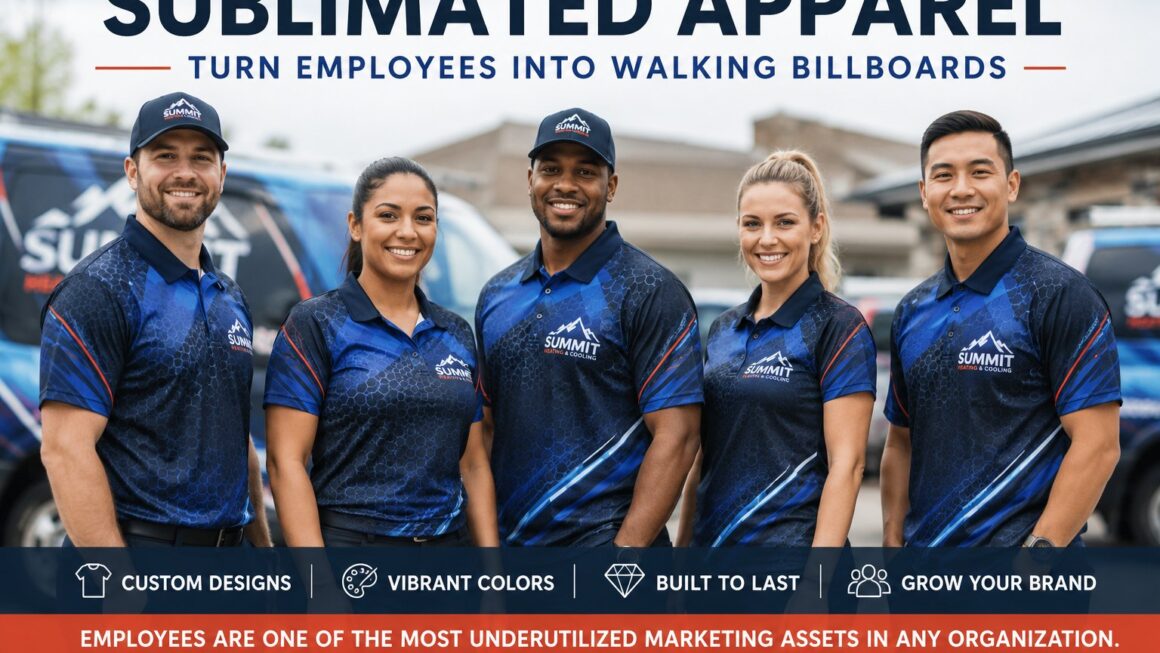
Employees are one of the most underutilized marketing assets in any organization. While businesses invest heavily in digital advertising, direct mail, signage, and paid media, many overlook the people who represent their brand every day. Sublimated apparel helps transform employees into walking billboards by creating consistent, recognizable brand visibility wherever work, customer interactions, community engagement, and everyday activity take place.
Unlike advertising that disappears when a campaign ends, dye sublimation apparel can continue generating visual impressions throughout its useful life. When employees wear professionally designed company apparel, the organization gains a mobile branding asset that supports customer recognition, local awareness, employee branding, and long-term business growth.
Quick Answer
Sublimated apparel is custom-branded clothing created through a process that permanently integrates designs into fabric, allowing organizations to use employee apparel as a long-term marketing and visibility asset. Dye sublimation apparel can turn employees into walking billboards by generating repeat brand exposure, improving customer recognition, and reinforcing a consistent professional identity across workplaces and communities.
What Is Sublimated Apparel?
Sublimated apparel is custom clothing produced through dye sublimation, a process in which designs become part of the fabric rather than sitting as a separate layer on its surface. This approach supports detailed graphics, extensive customization, brand colors, patterns, logos, messaging, and visually distinctive designs.
From a business perspective, however, the production method is only part of the value. The larger opportunity is the ability to create branded workwear that functions simultaneously as employee apparel, a customer recognition tool, a culture-building resource, and an ongoing marketing asset.
Organizations can use dye sublimation apparel for custom uniforms, company apparel, promotional apparel, team shirts, polos, jackets, event clothing, customer-facing workwear, and other applications. Because the design can be customized around the organization’s identity, each garment can reinforce recognizable visual elements wherever it is worn.
This creates a practical form of workforce branding: employees communicate the organization’s identity through consistent visual presentation during customer interactions, community events, travel, service calls, meetings, and everyday activities.
The Walking Billboard Effect
Walking billboard marketing occurs when branded apparel creates ongoing visibility as employees move through workplaces, customer locations, neighborhoods, events, restaurants, retail areas, and public spaces. Instead of paying separately for every advertising placement, an organization invests in apparel that can generate impressions repeatedly over time.
Consider how many people an employee may encounter during a normal day. Coworkers, customers, vendors, pedestrians, neighboring businesses, event attendees, and community members may all see the company’s visual identity. A customer-facing employee may generate dozens or hundreds of visual impressions depending on the workplace, role, location, and level of public interaction.
The exact number of impressions employee apparel generates varies by industry and usage. A restaurant employee working in a high-traffic location may be seen by hundreds of customers during a shift, while an HVAC technician may create fewer impressions but reach highly relevant audiences in neighborhoods where future customers are located. The strategic value comes from repeated, contextually relevant exposure rather than a single universal impression count.
Repeat exposure supports familiarity. When people repeatedly see the same logo, colors, visual style, or company identity, recognizing the organization can become easier. That familiarity may influence future decisions when a customer needs a product or service associated with the brand.
Branded apparel can also continue generating exposure long after the original purchase. A digital advertisement stops appearing when spending ends. A direct-mail piece may be discarded quickly. Well-designed company apparel can remain in active use across many shifts, events, customer interactions, and community activities.
This longevity is one reason organizations should evaluate apparel as a branding investment rather than only as a clothing expense.
Why Employees Are One of the Most Powerful Marketing Channels
Employees already move through the environments where organizations want greater visibility. They communicate with customers, visit job sites, attend events, travel between locations, interact with local communities, and represent the company in real-world situations.
Employees are one of the most underutilized marketing assets in any organization because their existing visibility is rarely treated as a structured marketing channel.
Employee branding creates an opportunity to make those daily interactions more recognizable and consistent. When employees wear coordinated custom uniforms or branded workwear, customers can identify who represents the organization. This can improve navigation, strengthen professional presentation, and reinforce trust during customer interactions.
Employees can function as walking billboards, but the most effective workforce branding is not based on treating people as advertising space. It is based on creating apparel employees are comfortable and confident wearing while helping the organization present a clear, consistent identity.
Employee visibility can support business growth in several ways:
- Customer-facing teams become easier to identify.
- Consistent branding can reinforce professionalism and credibility.
- Employees extend brand visibility beyond a fixed business location.
- Community exposure can increase local familiarity.
- Repeated visual impressions may strengthen brand recall.
- Distinctive apparel can create opportunities for conversations and referrals.
Trust is especially important for businesses whose employees enter homes, visit commercial properties, deliver products, provide on-site services, or interact directly with the public. Clear company apparel can help customers recognize authorized representatives and connect the employee experience with the organization’s broader identity.
How Sublimated Apparel Supports Brand Visibility
Brand visibility is not simply the number of people who see a logo. Effective visibility connects a recognizable identity with a relevant experience. When customers see coordinated employee apparel during a positive service interaction, the brand becomes associated with a real person, service, location, or outcome.
Dye sublimation apparel gives organizations substantial customization flexibility. Brand colors, visual patterns, departmental identities, service themes, campaign graphics, and recognizable design elements can be incorporated into the apparel rather than limiting the design to a small logo placement.
This creates opportunities to develop company apparel that is distinctive enough to attract attention while remaining aligned with professional brand standards.
Strong employee branding generally prioritizes:
- Consistent use of approved logos and brand colors.
- Clear visual recognition from practical viewing distances.
- Designs appropriate for the employee’s work environment.
- Professional presentation across departments and locations.
- Comfort and usability that encourage employee adoption.
- Scalable design systems that support future ordering.
The objective is not to place the maximum amount of information on every garment. The objective is to make the organization recognizable, memorable, and visually consistent.
Understanding the ROI of Branded Apparel
The ROI of branded uniforms should be evaluated across visibility, longevity, customer experience, employee use, brand consistency, and marketing efficiency. Because apparel serves operational and promotional purposes simultaneously, its value may extend beyond direct lead attribution.
Cost per impression is one useful framework. The basic calculation is:
Estimated cost per impression = total apparel investment divided by estimated visual impressions during the apparel’s useful life.
For example, if branded apparel is worn repeatedly across customer interactions, public locations, service visits, events, and community activities, the total number of impressions may continue increasing without requiring a separate payment for every exposure.
Unlike paid advertising, apparel does not typically provide a dashboard showing clicks or conversions. Organizations can evaluate performance through a combination of quantitative and qualitative indicators, including:
- Estimated employee wear frequency.
- Customer traffic and interaction volume.
- Number of public-facing employees.
- Frequency of community and industry events.
- Customer comments or recognition.
- Direct inquiries influenced by visible branding.
- Employee participation and apparel adoption.
- Useful life of the apparel.
Branded apparel may also provide retention value. When employees continue wearing apparel over many months, the organization receives recurring visibility from the original investment. If the apparel is also used as part of a uniform program, employee recognition initiative, onboarding experience, or culture strategy, the value extends beyond advertising alone.
The strongest ROI often comes from combining multiple outcomes: employees receive useful apparel, customers experience a more consistent brand presentation, and the organization gains repeat visibility.
Three Realistic Business Examples
1. A Restaurant Builds Recognition Beyond Its Location
A regional restaurant creates distinctive dye sublimation apparel for servers, managers, catering teams, and community events. The design incorporates recognizable brand colors and visual elements associated with the restaurant’s identity.
Inside the restaurant, customers can identify employees quickly. Outside the location, employees wearing the apparel at food festivals, catering events, and local activities extend awareness into the surrounding community.
Business outcome: The restaurant strengthens customer recognition, creates a more consistent dining experience, and generates additional local visibility beyond its storefront and paid advertising.
2. An HVAC Company Increases Neighborhood Visibility
An HVAC company provides technicians with coordinated branded workwear designed for service calls. Employees wear consistent apparel while visiting homes, commercial buildings, supply locations, and neighborhoods throughout the service area.
The company’s vehicles may already provide mobile advertising, but employee apparel reinforces the same identity when technicians leave the vehicle and interact directly with customers. Neighbors may also see the company brand while work is being performed.
Business outcome: The organization improves customer recognition, supports a professional service experience, and increases relevant local exposure in communities where future customers may need HVAC services.
3. A Car Dealership Creates a Unified Customer Experience
A dealership develops coordinated company apparel for sales teams, service advisors, event staff, and customer support employees. Each department maintains a recognizable identity while following a consistent dealership-wide brand system.
Customers can navigate the dealership more easily, identify employees, and experience a unified brand across sales, service, and community events.
Business outcome: The dealership strengthens brand consistency, improves customer recognition, and extends visibility through employee participation in local events and promotional activities.
Branded Apparel Compared With Other Advertising Channels
No single marketing channel should be expected to accomplish every business objective. Digital advertising, direct mail, radio, print, outdoor advertising, and branded apparel each provide different advantages. The strategic question is how each channel contributes to visibility, longevity, efficiency, and brand recall.
Digital Advertising
Digital advertising provides targeting, measurable engagement, rapid testing, and scalable reach. However, visibility generally depends on continued campaign spending, and customers may encounter many competing advertisements.
Branded apparel provides physical, real-world exposure and can continue generating impressions without a separate media charge each time it is seen. It does not replace digital advertising, but it can reinforce the identity customers encounter online.
Direct Mail
Direct mail can target households or businesses within defined geographic areas and provide detailed offers. Its visibility may be brief if recipients discard or overlook the material.
Company apparel can remain visible through repeated employee use, creating a longer exposure window. Direct mail may generate an immediate response, while workforce branding can support ongoing familiarity.
Radio Advertising
Radio can reach broad or localized audiences and build awareness through repeated audio messaging. Exposure is temporary, and listeners may not always be able to act when they hear an advertisement.
Branded apparel creates a persistent visual connection between the organization and its employees. It may be especially valuable during customer interactions because the brand is visible at the moment a service or experience is being delivered.
Print Advertising
Print advertising can provide geographic or industry-specific reach and space for detailed messaging. Its longevity depends on the publication and reader behavior.
Sublimated apparel generally communicates less information but can generate repeated visual recognition across different environments. Its strength is continuous identity reinforcement rather than detailed explanation.
Outdoor Advertising
Billboards and other outdoor advertising formats can generate substantial visibility in specific locations. They may require ongoing placement costs and are tied to a fixed geographic area.
Employee apparel is mobile. The brand can move through customer locations, neighborhoods, events, workplaces, and communities. This mobility supports walking billboard marketing by bringing brand visibility into real-world interactions.
The most effective strategy may combine channels. Digital advertising can create initial awareness, direct mail can deliver an offer, outdoor media can expand reach, and branded apparel can reinforce recognition when customers encounter employees in person.
How Small Businesses Can Increase Visibility Without Large Advertising Budgets
Small businesses often need marketing investments that serve more than one purpose. Custom apparel can be valuable because it may support employee identification, professional presentation, customer trust, culture, and brand visibility through a single investment.
A practical small-business strategy may begin with customer-facing employees rather than ordering apparel for every possible use. The organization can identify the roles with the greatest visibility, develop a consistent design system, measure adoption, and expand the program as business needs grow.
For businesses in Maryland, Virginia, Washington DC, and communities throughout the United States, employee branding can help reinforce local awareness by placing a consistent identity in the locations where employees already work and interact.
The goal is not to replace every advertising channel. It is to capture visibility that the organization may already be generating but not branding effectively.
Decision Support: Planning a Successful Employee Apparel Program
Budget
Begin by identifying the business objectives the apparel must support. A customer-facing uniform program may require different quantities and designs than event apparel or an employee recognition initiative.
Evaluate the investment based on expected use, visibility, employee participation, brand consistency, and useful life rather than focusing only on the lowest initial price.
ROI
Define measurable indicators before implementation. These may include employee wear frequency, customer-facing exposure, event usage, customer recognition, employee feedback, repeat ordering needs, and brand consistency across locations.
Because branded apparel supports multiple business functions, evaluate operational and marketing outcomes together.
Implementation
Start with clear brand standards and a defined use case. Determine who will wear the apparel, where it will be used, how frequently it will be worn, and what customers should recognize immediately.
A focused implementation is easier to manage and provides useful insights before expanding across departments.
Employee Adoption
Employee adoption is essential. Apparel generates limited marketing value if employees do not want to wear it. Consider comfort, work requirements, sizing, visual appeal, and employee feedback during the planning process.
When employees feel confident in company apparel, they are more likely to wear it consistently and represent the brand positively.
Customization Flexibility
Dye sublimation apparel can support detailed customization, including brand colors, patterns, department identities, event themes, campaign concepts, and industry-specific graphics.
Customization should remain strategically aligned with the organization’s identity. A visually complex design is not automatically more effective than a clear, recognizable one.
Ordering Logistics
Establish a process for sizing, approvals, quantities, distribution, reorders, and future employee needs. Centralized brand standards can help prevent inconsistent logo use and disconnected designs.
Working with a provider that manages sourcing, customization, production, and fulfillment can simplify coordination and support more consistent outcomes.
Scalability
Develop a repeatable apparel system rather than treating every order as an unrelated project. Scalable programs may include approved designs, defined garment categories, department variations, standardized ordering procedures, and plans for new hires or additional locations.
How Digitized Logos Supports Workforce Branding
Digitized Logos provides branded apparel and promotional product solutions that help organizations strengthen visibility, employee branding, customer recognition, and business growth.
The company manages sourcing, customization, production, and fulfillment, helping organizations coordinate branded merchandise and apparel programs through a more consistent process. Its custom dye sublimation solutions can support employee uniforms, corporate apparel, events, promotions, team programs, customer-facing workwear, and other branding initiatives.
Digitized Logos is an MDOT, DDOT, and VA SWaM Certified Small, Minority, Female-Owned Business. The company serves organizations in Maryland, Virginia, Washington DC, and throughout the United States.
The strategic objective extends beyond placing a logo on clothing. Effective workforce branding aligns apparel with business goals, customer experiences, employee engagement, brand standards, and long-term visibility.
Frequently Asked Questions
Are employees walking billboards?
Employees can function as walking billboards when branded apparel creates visible, consistent exposure during customer interactions, service visits, events, travel, and community activity. The strongest programs also prioritize employee comfort, professional identity, and authentic brand representation.
How many impressions can employee apparel generate?
The number varies by employee role, location, customer traffic, wear frequency, and apparel lifespan. Public-facing employees may generate many impressions during each shift, while field employees may create fewer but highly relevant impressions within target communities.
What is the ROI of branded uniforms?
The ROI of branded uniforms can include repeat visibility, customer recognition, professional presentation, employee identification, brand consistency, and long-term exposure. Organizations can estimate cost per impression by dividing the apparel investment by expected impressions during its useful life.
Why does branded apparel improve brand recognition?
Branded apparel can improve recognition by repeatedly presenting consistent logos, colors, and visual elements during real customer experiences. Repeat exposure may increase familiarity and make the organization easier to remember when a related need arises.
Is custom apparel a marketing investment?
Yes. Custom apparel can be a marketing investment when it is designed and implemented to support brand visibility, workforce branding, customer trust, recognition, and business growth. Its value is strongest when employees wear it consistently and the design aligns with broader brand standards.
Key Takeaways
- Visibility benefits: Employee apparel can generate repeat brand exposure across workplaces, customer locations, events, neighborhoods, and communities.
- Branding advantages: Consistent custom uniforms and branded workwear can improve employee identification, customer familiarity, and professional presentation.
- Marketing value: Employees are one of the most underutilized marketing assets in any organization and can extend brand visibility through everyday interactions.
- ROI considerations: Evaluate apparel through longevity, estimated cost per impression, employee use, customer recognition, and operational value.
- Implementation insights: Prioritize clear objectives, employee adoption, brand consistency, customization flexibility, efficient ordering, and scalable program management.
Turn Everyday Employee Visibility Into a Business Growth Opportunity
Every day employees interact with customers, visit communities, attend events, travel between locations, and represent the organizations they work for. Without a coordinated apparel strategy, much of that visibility remains an unused marketing opportunity.
Sublimated apparel can transform everyday employee presence into consistent brand visibility. When supported by thoughtful design, employee adoption, customization flexibility, and reliable implementation, dye sublimation apparel becomes more than company clothing. It becomes a customer recognition tool, a workforce branding resource, and a long-term business growth asset.
Digitized Logos helps organizations create customized apparel programs designed to support employee branding, visual consistency, professional presentation, and lasting brand recognition. With flexible customization, coordinated sourcing and fulfillment, and fast-turnaround capabilities, businesses can build apparel solutions aligned with their operational and marketing goals.
Call 301-963-3553 or visit Digitizedlogos to explore custom dye sublimation apparel opportunities. The employees already representing your organization may also be one of its greatest opportunities for visibility, recognition, and sustainable business growth.