Trade Show Giveaways That Drive Leads, Engagement, and Brand ROI
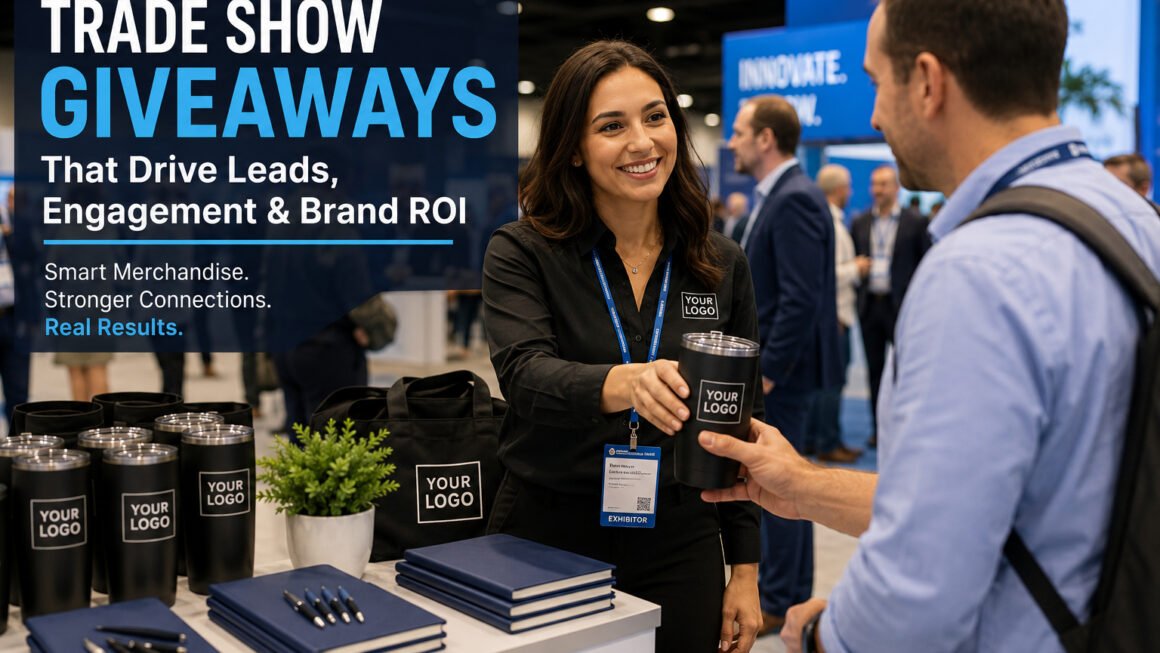
Trade Show Giveaways work best when they do more than fill a tote bag. The right branded merchandise attracts attention, creates a reason to engage, reinforces your company identity, and keeps your brand visible long after attendees leave the exhibit hall.
For Event Managers, marketing teams, sales leaders, associations, and corporate buyers, the challenge is not simply choosing promotional products. It is building a coordinated merchandise program that arrives on time, looks consistent, supports the event objective, and gives recipients something they will actually keep. Digitized Logos provides branded apparel, promotional products, and corporate merchandise solutions designed around those practical requirements.
Quick Answer: What Are the Best Trade Show Giveaways?
Short Answer: The best Trade Show Giveaways are useful, relevant to the target audience, easy to distribute, visibly branded, and valuable enough to keep after the event. Popular categories include reusable drinkware, tote bags, tech accessories, notebooks, premium pens, branded apparel, travel accessories, and higher-value gifts reserved for qualified prospects or VIP meetings.
Event Managers should select merchandise according to audience quality, booth strategy, event duration, shipping requirements, budget per recipient, and the action they want attendees to take. A giveaway tied to a meaningful conversation or lead-capture activity usually creates more business value than merchandise handed indiscriminately to everyone walking past.
Definition: What Are Trade Show Giveaways?
Trade Show Giveaways are branded promotional products distributed at exhibitions, conferences, conventions, corporate events, recruiting events, association meetings, and industry expos. They are used to increase booth traffic, improve brand recall, reward engagement, support lead generation, and extend marketing exposure beyond the event itself.
The important distinction is that a promotional product is the physical item, while an effective giveaway program is the strategy behind that item. Product selection, branding method, quantity, packaging, shipping, distribution, and follow-up all influence the final result.
Why Trade Show Merchandise Still Matters
Trade shows create an unusual marketing environment. Hundreds or even thousands of companies may compete for attention within the same building. Booth graphics generate initial visibility, but useful branded merchandise gives attendees a physical connection to the company after they leave.
A well-selected product can move through several stages of the marketing journey. It may attract someone to the booth, provide an opening for a conversation, reinforce the brand during the event, and continue generating impressions when the recipient uses it later at work, while traveling, or at home.
That makes promotional merchandise particularly useful when it is integrated with sales activity instead of treated as an isolated expense.
Trade Show Giveaways Should Start With the Business Objective
Short Answer: Choose the objective before choosing the product. A booth focused on generating hundreds of new contacts requires a different merchandise strategy than an executive team holding 30 pre-scheduled meetings with high-value prospects.
Common event objectives include:
- Increasing qualified booth traffic
- Generating sales leads
- Encouraging product demonstrations
- Supporting new product launches
- Building brand awareness
- Rewarding existing customers
- Creating memorable VIP experiences
- Supporting recruiting and employer branding
- Increasing social engagement
- Driving post-event conversations
This objective-first approach prevents one of the most common purchasing mistakes: ordering thousands of inexpensive items simply because the unit price looks attractive.
A Step-by-Step Framework for Event Managers
Event Managers can reduce risk and improve merchandise ROI by treating giveaways as a planned operational program rather than a last-minute product order.
- Define the desired action. Decide whether the merchandise should generate booth visits, reward demos, encourage lead capture, support meetings, or improve post-event recall.
- Segment the audience. Separate general attendees, qualified prospects, customers, partners, employees, speakers, and VIPs when appropriate.
- Establish a total budget. Include products, decoration, setup, packaging, freight, storage, and destination delivery rather than comparing unit price alone.
- Select the product tier. Match the perceived value of the merchandise to the business value of the recipient or interaction.
- Choose the customization method. Consider available imprint area, number of colors, durability, material, artwork complexity, and required presentation quality.
- Approve artwork and samples early. Verify logos, colors, dimensions, placement, spelling, and product specifications before production.
- Build in production time. Avoid scheduling production around the latest theoretically possible arrival date.
- Plan fulfillment. Determine whether products are going to headquarters, individual representatives, a hotel, an advance warehouse, or directly to the event venue.
- Create a distribution strategy. Decide which products are freely available and which are connected to lead qualification or specific actions.
- Measure the outcome. Compare product usage with conversations, scans, demos, qualified leads, meetings, opportunities, and post-event activity.
Best Giveaway Categories for Different Trade Show Goals
High-Volume Booth Traffic
For large events where awareness and traffic matter, practical products with broad appeal generally make the most sense. Pens, notebooks, tote bags, reusable drinkware, small tech accessories, and everyday desk products can support larger quantities while maintaining useful brand visibility.
Portability matters. An attendee walking an exhibit floor for six hours is more likely to appreciate something lightweight and useful than an awkward product that becomes difficult to carry.
Qualified Lead Generation
When the goal is generating qualified conversations rather than maximum foot traffic, consider a tiered giveaway model. General visitors may receive a lower-cost item, while attendees who complete a demonstration, consultation, or meaningful sales discussion receive a higher-value branded gift.
This protects the merchandise budget and gives the sales team a natural mechanism for moving visitors into deeper engagement.
Executive and VIP Meetings
Premium drinkware, higher-quality apparel, executive accessories, travel merchandise, gift sets, and carefully packaged branded gifts can be appropriate for strategic customers and decision-makers.
For these recipients, perceived quality matters more than raw quantity. A poorly manufactured premium-looking product can undermine the impression the company intended to create.
Employee and Exhibitor Teams
Trade show merchandise is not limited to visitors. Coordinated branded apparel helps staff look unified and makes representatives easier to identify in crowded environments.
Polos, performance shirts, jackets, quarter-zips, and other branded apparel can also be incorporated into broader employee onboarding, corporate swag, and merchandise programs, allowing companies to maintain consistent branding across events throughout the year.
Use Case: Building a Tiered Giveaway Program
Short Answer: A tiered merchandise strategy assigns different products to different levels of engagement. This helps Event Managers control spending while directing higher-value merchandise toward prospects and customers with greater potential business value.
Consider a company expecting 2,000 booth visitors but only 300 meaningful sales conversations. Instead of purchasing 2,000 premium gifts, the team could provide an economical branded item for general traffic, a better product for qualified leads, and a premium gift for scheduled customers or high-value opportunities.
The result is not simply lower spending. It creates intentional differentiation between casual traffic and strategically important interactions.
Realistic Example: A 2,500-Attendee Industry Conference
Imagine an Event Manager preparing for a national conference where the company expects approximately 1,200 booth interactions. The organization could order 1,000 general promotional items, 200 upgraded gifts for qualified conversations, and 50 premium items for customers and scheduled executive meetings.
If the general item costs an illustrative $4 each, the upgraded item $15, and the premium item $40, product spending would be approximately $9,000 before decoration, freight, packaging, and other program expenses.
Compare that with purchasing 1,250 premium $40 gifts for everyone, which would represent $50,000 in product cost alone. Segmentation allows the organization to put more value where it can have more business impact.
Realistic Example: A Regional Recruiting Event
A Maryland employer attending university and professional recruiting events might have a different objective. Instead of prioritizing sales leads, the company may want candidates to remember its employer brand and recognize recruiters across several events in Maryland, Virginia, and Washington DC.
Coordinated staff apparel, practical branded merchandise, and recruiting-specific giveaway kits can create a more consistent presence. If the same visual system is used across multiple events, the organization also avoids repeatedly designing and sourcing entirely new merchandise programs.
How Much Should Companies Spend on Trade Show Giveaways?
Short Answer: There is no universal cost per attendee. Budget should reflect the recipient’s value, event objective, expected distribution volume, product quality, customization, logistics, and the cost of the sales opportunity being pursued.
A useful planning model is to divide the merchandise budget into three components: general distribution, qualified engagement, and strategic relationships. This creates clearer cost controls than selecting one product for every visitor.
For example, a $15,000 merchandise budget could hypothetically allocate 40 percent to high-volume items, 35 percent to qualified-lead merchandise, and 25 percent to VIP or customer gifts. Those percentages are planning examples, not fixed rules. The appropriate allocation depends on the event and sales economics.
Measuring Trade Show Giveaway ROI
Promotional merchandise ROI should not be evaluated only by asking how many items were distributed. Distribution is an activity metric, not necessarily a business result.
Event teams can evaluate performance using measures such as:
- Cost per meaningful booth interaction
- Cost per captured lead
- Cost per qualified lead
- Demo completion rate
- Scheduled meeting volume
- Post-event response rate
- Sales opportunities influenced
- Customer engagement
- Merchandise remaining after the event
Suppose an organization invests $12,000 in merchandise and related fulfillment for an event that produces 240 qualified leads. The merchandise-related cost equals $50 per qualified lead before considering the rest of the event budget. Whether that represents strong economics depends on average contract value, conversion rate, sales cycle, and how much the merchandise contributed to engagement.
Customization Methods and Production Considerations
Customization should support the product rather than overwhelm it. Depending on the item, decoration options can include embroidery, screen printing, heat transfer, full-color printing, dye sublimation, engraving, and other production methods.
Dye sublimation is particularly useful when designs require vibrant color, complex graphics, gradients, patterns, or extensive printable coverage on compatible materials. Embroidery can provide a dimensional, professional appearance on polos, jackets, caps, and other textile products. The best production method depends on the substrate, artwork, quantity, durability requirements, budget, and desired visual effect.
Logo size should also be considered carefully. Making a logo as large as physically possible does not automatically increase perceived quality. Premium corporate merchandise often benefits from deliberate placement, balanced scale, and clear visual hierarchy.
Behind the Scenes: What Happens Before Your Merchandise Ships?
A professional promotional merchandise program involves more than placing artwork on a product. Behind the scenes, the process can include product sourcing, inventory confirmation, artwork preparation, imprint specification, proof approval, production scheduling, quality review, packing, labeling, freight coordination, and destination delivery.
One practical operational insight is that production time and shipping time are separate. A product described as requiring several business days for production still needs sufficient transportation time to reach the event destination.
A second operational insight involves multi-product programs. When apparel, drinkware, bags, and other promotional products come from different production facilities, they may not automatically arrive together. Coordinating shipment destinations and required arrival dates early can prevent Event Managers from discovering that one portion of the program is still in transit while the booth is being installed.
Fulfillment Can Make or Break an Event Merchandise Program
A beautifully branded product has little business value if it arrives after the trade show. Event fulfillment therefore deserves the same attention as product selection.
Buyers should determine the final delivery strategy before production begins. Products may need to ship to a corporate office, fulfillment facility, hotel, convention center, advance warehouse, regional sales representative, or multiple event destinations.
Event venues may also have receiving procedures, labeling requirements, deadlines, material-handling charges, or restrictions. Event Managers should coordinate those requirements with the merchandise supplier and event logistics team rather than assuming a standard parcel delivery will be sufficient.
Buyer Considerations Before Ordering
Business buyers comparing promotional product vendors should evaluate more than catalog size and advertised unit pricing.
- Product quality: Will the item represent the brand appropriately?
- Inventory: Is the required quantity actually available?
- Customization: Can the product support the artwork and branding requirements?
- Proofing: Is there a reliable approval process before production?
- Turnaround: Does the schedule include production and transportation?
- Minimum quantities: Can order volumes align with the event strategy?
- Fulfillment: Can products be routed to the correct locations?
- Consistency: Can branding remain coordinated across different product categories?
- Scalability: Can the program expand from one event to multiple locations or annual campaigns?
Decision Support: Cost, Turnaround, Minimums, and Quality
How Should Buyers Compare Cost?
Compare total program cost rather than unit price alone. Setup charges, decoration, packaging, freight, rush production, destination handling, and unused inventory can materially change the economics of a seemingly inexpensive product.
How Much Turnaround Time Is Needed?
Turnaround depends on the product, quantity, customization process, inventory status, proof approval, and shipping destination. Buyers with firm event dates should work backward from the required in-hand date and build contingency time into the schedule.
Are Minimum Quantities Always Required?
Minimum quantities vary by product and production method. Event Managers who need flexible ordering should communicate expected quantities early so suitable merchandise and decoration options can be selected before creative development begins.
How Can Buyers Maintain Quality Consistency?
Establish approved logo files, brand colors, decoration specifications, product standards, and proofing procedures. For recurring merchandise programs, documenting these requirements reduces unnecessary decisions and helps keep future orders visually consistent.
Cheap Giveaways vs. Premium Branded Merchandise
Low-cost products are not inherently ineffective, and premium products are not automatically better. The correct choice depends on the purpose.
Economical merchandise can be effective for large-scale awareness campaigns where thousands of interactions are expected. Premium merchandise is better suited to high-value prospects, customer appreciation, executive meetings, employee recognition, or situations where product quality directly affects brand perception.
A sophisticated program frequently uses both. The strategic mistake is spending premium-product money on unqualified mass distribution or giving strategically important prospects merchandise that feels disposable.
Common Trade Show Giveaway Mistakes
One common mistake is ordering based on personal preference rather than recipient usefulness. A product the internal team loves may not fit the audience’s work environment, travel habits, or needs.
Another mistake is waiting until booth graphics and event logistics are finished before discussing merchandise. Late ordering reduces product options, increases pressure on production schedules, and can create unnecessary rush and freight expenses.
Other avoidable problems include over-ordering, under-ordering, using outdated artwork, choosing products with inadequate imprint areas, ignoring transportation requirements, and distributing high-value gifts without any lead qualification strategy.
Promotional Trends: From Free Stuff to Branded Experiences
Corporate swag programs are increasingly useful when they emphasize intentional selection rather than sheer quantity. Practical products, better materials, coordinated merchandise collections, branded apparel, personalization, and products designed around specific audience segments can create a more deliberate brand experience.
Another important shift is the connection between event merchandise and year-round corporate merchandise programs. Instead of treating every conference as a separate purchasing project, companies can establish approved products and branding standards that support trade shows, employee onboarding, corporate gifting, sales meetings, recruiting, customer appreciation, and internal events.
Scaling From One Trade Show to a Merchandise Program
Organizations attending multiple events can benefit from standardization. A defined core assortment allows marketing teams to reuse proven products while maintaining flexibility for event-specific merchandise.
For example, a national company might maintain approved branded apparel and general promotional products for every event, then add specialized gifts for major conferences. This approach simplifies sourcing, improves visual consistency, and reduces the operational burden on Event Managers.
Digitized Logos provides branded apparel and promotional product solutions for organizations seeking this type of coordinated approach. The company manages sourcing, customization, and fulfillment, helping business buyers move from individual promotional orders toward repeatable corporate merchandise programs.
Why Regional Support Matters for Maryland, Virginia, and Washington DC Organizations
Organizations operating across Maryland, Virginia, Washington DC, and the broader United States may need merchandise for conferences, government events, recruiting programs, association meetings, employee initiatives, customer programs, and multi-location campaigns.
Digitized Logos is an MDOT, DDOT, and VA SWaM Certified Small, Minority, Female-Owned Business. For organizations with supplier-diversity objectives or procurement requirements, these certifications can be relevant alongside product capabilities, service, customization, and fulfillment considerations.
How to Choose a Trade Show Merchandise Partner
Short Answer: Select a partner that can help with product strategy, sourcing, customization, production, quality control, and fulfillment, not simply provide access to a promotional product catalog.
The strongest vendor relationship reduces work for the internal team. Event Managers should be able to communicate the audience, event date, budget, quantities, branding requirements, and desired outcome, then receive options that reflect those constraints.
Ask prospective suppliers how they handle inventory changes, artwork approvals, multiple products, production schedules, shipping destinations, quality concerns, and repeat programs. These operational questions often reveal more about the buying experience than browsing hundreds of products online.
FAQ: Trade Show Giveaways for Event Managers
What trade show giveaways do attendees actually keep?
Attendees are more likely to keep products that are useful, portable, relevant, and reasonably well made. Drinkware, bags, notebooks, tech accessories, apparel, travel products, and practical desk items can perform well. The best choice depends on the audience, event environment, budget, and how recipients will use the item afterward.
How many trade show giveaways should Event Managers order?
Start with expected attendance, historical booth traffic, exhibit hours, lead goals, and distribution strategy. Do not automatically order one premium product for every attendee. Many organizations use separate quantities for general visitors, qualified prospects, customers, and VIPs, which can improve budget control and reduce leftover merchandise.
How far in advance should promotional products be ordered?
Order as early as practical because timing varies by product, inventory, quantity, customization, proof approval, and destination. Remember that production turnaround does not necessarily include shipping. Building additional time into the schedule gives buyers more product choices and reduces dependence on expensive rush production or expedited freight.
Are expensive trade show giveaways better?
Not necessarily. A lower-cost useful product can outperform an expensive but irrelevant gift. Premium merchandise makes the most sense when the recipient or interaction justifies the additional investment. Many Event Managers use tiered programs that reserve higher-value branded gifts for qualified prospects, customers, executives, or scheduled meetings.
Can trade show merchandise support year-round marketing?
Yes. Products selected for conferences can become part of a larger corporate merchandise strategy supporting employee onboarding, recruiting, sales meetings, customer gifting, branded apparel, recognition programs, and company events. Standardizing successful products can improve brand consistency while simplifying sourcing and fulfillment across multiple campaigns.
Key Takeaways
- Trade Show Giveaways should be selected around business objectives, audience value, usefulness, and distribution strategy rather than unit price alone.
- Tiered merchandise programs can reserve higher-value products for qualified prospects and strategic relationships while controlling overall spending.
- Production, proofing, shipping, venue requirements, and fulfillment should be planned early to protect the event deadline.
- ROI should be evaluated using qualified interactions, leads, opportunities, and post-event engagement rather than merchandise distribution alone.
- A coordinated merchandise partner can help organizations maintain consistent branding across trade shows, branded apparel, corporate gifting, onboarding, and year-round corporate swag programs.
Turn Your Next Trade Show Into a Stronger Brand Experience
Effective Trade Show Giveaways combine product strategy, useful merchandise, consistent customization, dependable production, and event-ready fulfillment. When those pieces work together, promotional products become more than free items. They become tangible extensions of your sales and marketing strategy.
Digitized Logos helps Event Managers and business buyers source branded apparel, promotional products, corporate merchandise, branded gifts, and event giveaways with support for customization and fulfillment. Whether you are preparing for one regional conference or developing a scalable merchandise program across the United States, the goal is the same: stronger brand visibility, greater consistency, flexible ordering, and confidence that your merchandise will be ready when the event begins.
For help planning Trade Show Giveaways for your next event, call 301-963-3553 or visit DigitizedLogos to explore options for event-ready branded merchandise, promotional products, and apparel.
#TradeShowGiveaways #EventManagers #PromotionalProducts #CorporateSwag #BrandedMerchandise #TradeShowMarketing #BrandedApparel #CorporateGifts #EventMarketing #DigitizedLogos