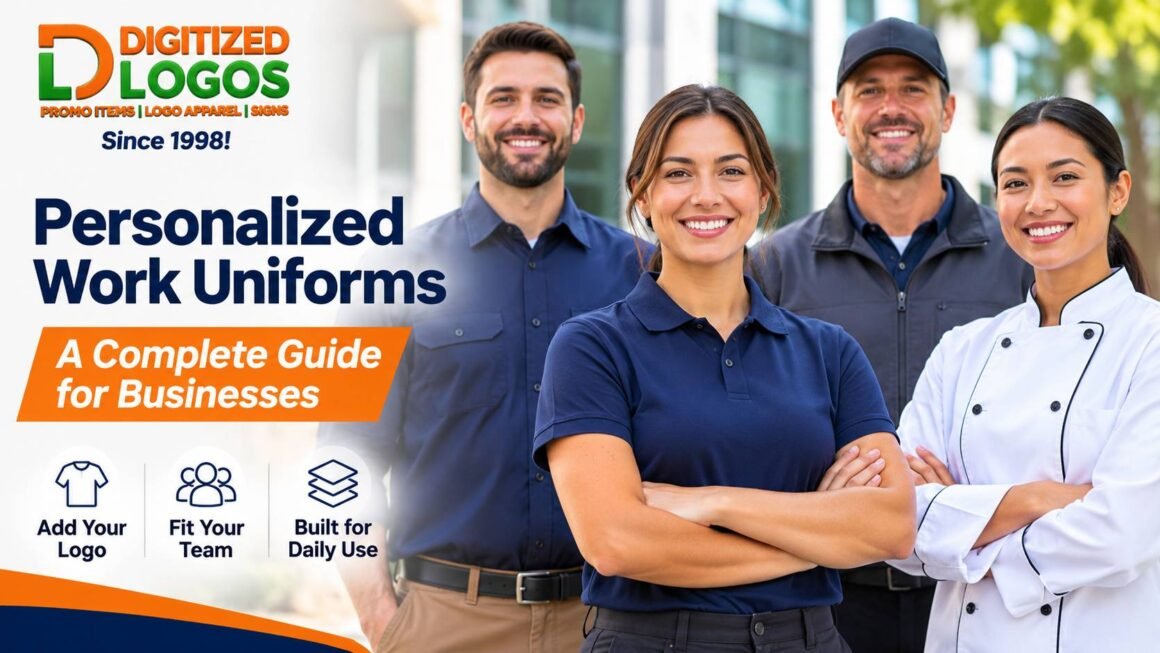
Employee uniforms do more than establish a dress code. They help customers identify staff, create a consistent appearance across departments, and give employees clothing suited to their daily responsibilities. For businesses managing customer-facing teams, field operations, or multiple locations, selecting the right uniforms is both a branding and an operational decision.
Personalized work uniforms allow organizations to combine practical workwear with company logos, employee names, department identification, and consistent brand colors. The right program balances appearance, comfort, durability, replacement needs, and purchasing costs.
Digitized Logos supports businesses with branded apparel, customization, and uniform program solutions. This guide explains how to select appropriate garments, compare decoration methods, manage ordering, and establish a uniform program that works as teams grow.
What Are Personalized Work Uniforms?
Personalized work uniforms are garments customized to identify an organization, employee, team, or professional role. Customization may include an embroidered company logo, printed branding, an employee name, a department designation, or other approved identifying details.
Unlike general promotional clothing, work uniforms are intended for regular use in a professional environment. They must accommodate job responsibilities, movement, workplace conditions, and repeated laundering while maintaining a consistent appearance.
Common options include:
- Embroidered polo shirts for customer-facing staff
- Logo button-down shirts for office and hospitality teams
- Custom T-shirts for service crews and casual workplaces
- Branded jackets and fleece for outdoor employees
- Performance shirts for physically active roles
- Aprons and compatible workwear for food service teams
- Personalized caps, vests, and other workplace accessories
The most appropriate uniform depends on the role. A hotel front desk employee may need a polished shirt that coordinates with a property’s brand standards, while a maintenance technician may prioritize flexibility, reinforced construction, and suitable fabric performance.
Why Businesses Invest in Personalized Employee Uniforms
A well-designed uniform program gives businesses more control over how employees represent the organization. It also establishes clear expectations for clothing selection, logo placement, and replacement procedures.
Consistent Brand Presentation
Matching apparel creates visual continuity across employees, departments, and business locations. Standardizing approved colors, garments, and decoration specifications helps prevent inconsistent branding when new employees join or existing uniforms require replacement.
Easier Employee Identification
Customers can more readily identify staff when uniforms feature recognizable company branding. Employee names and departmental identifiers may provide additional clarity in hospitality, retail, facilities management, and other service environments.
Practical Clothing for Daily Responsibilities
Different jobs require different garment characteristics. Breathable fabrics can improve comfort in warm environments, while appropriate layering supports employees who work outdoors or move between indoor and outdoor spaces.
Uniform specifications should reflect actual working conditions rather than appearance alone. For roles requiring protective clothing, applicable safety requirements must take priority over branding preferences.
More Organized Employee Onboarding
Standardized uniforms simplify the process of outfitting new employees. A documented program identifies approved styles, sizes, colors, logo positions, and quantities so purchasing teams do not need to make these decisions repeatedly.
How to Choose Personalized Work Uniforms for Your Team
The most useful starting point is understanding where employees work, what they do, and how frequently their clothing will be worn and washed.
1. Match Uniforms to Employee Roles
Different departments may require different garments while maintaining a recognizable company identity.
- Office and administrative teams: Polos, button-down shirts, cardigans, and lightweight jackets
- Hospitality teams: Coordinated shirts, polos, vests, and department-specific apparel
- Construction and field service teams: Durable shirts, work jackets, and appropriate protective workwear
- Retail employees: Branded polos, T-shirts, and seasonal outerwear
- Healthcare support teams: Role-appropriate apparel selected according to workplace hygiene and uniform requirements
- Warehouse and logistics teams: Comfortable garments that accommodate movement and working conditions
A company does not necessarily need identical clothing for every employee. Different styles can share consistent brand colors and decoration specifications while meeting individual department needs.
2. Select Materials Based on Working Conditions
Fabric selection affects comfort, garment care, durability, and the suitability of different customization techniques.
Cotton: Often chosen for softness and everyday comfort. Cotton garments may be appropriate for casual workplaces, although shrinkage and drying characteristics depend on the garment construction and care instructions.
Polyester: Common in performance apparel because it can be engineered for moisture management, wrinkle resistance, and shape retention. Performance varies by product and fabric treatment.
Cotton-polyester blends: Combine characteristics of both fibers and are frequently used in employee polos, T-shirts, and everyday workwear.
Technical and specialty fabrics: May be appropriate for outdoor work, temperature management, or specific workplace requirements. Buyers should verify the actual performance claims and suitability of each garment.
Request fabric specifications or samples before approving a large uniform program, especially when employees will wear the garments throughout their shifts.
3. Evaluate Sizing and Fit
Inconsistent sizing is a common source of employee uniform problems. A medium in one apparel style may fit differently from a medium in another.
Businesses should review manufacturer size charts, consider sample garments, and provide employees with clear measurement guidance. Maintaining a record of approved styles and sizes can make subsequent replacement orders more predictable.
4. Establish Brand Standards
Before production, define the approved garment colors, logo dimensions, placement locations, and customization methods.
A simple uniform specification document can prevent purchasing inconsistencies. It becomes especially useful when multiple departments or locations place orders independently.
Custom Employee Work Uniforms With Logo: Decoration Options
The customization method affects how a uniform looks, feels, and performs during regular use. Businesses purchasing custom employee work uniforms with logo should evaluate the design, garment material, anticipated order quantity, and maintenance requirements before selecting a decoration technique.
Embroidery
Embroidery uses stitched thread to reproduce a logo or design directly on suitable fabric. It is commonly selected for polos, button-down shirts, jackets, and other professional apparel.
Its dimensional texture provides a traditional uniform appearance. However, very small lettering, fine lines, and complex gradients may need simplification before a logo can be stitched clearly.
Embroidery pricing may depend on stitch count, design dimensions, garment characteristics, and production requirements.
Screen Printing
Screen printing applies ink through prepared screens and is frequently used for branded T-shirts and larger uniform designs.
It can be economical for repeated designs in larger quantities, although setup requirements and the number of print colors influence pricing.
For businesses purchasing substantial quantities of matching service shirts, screen printing may be worth comparing with other decoration techniques.
Heat Transfer and Digital Transfer Printing
Transfer printing applies a prepared design to a garment using heat and pressure. Depending on the specific process, it can accommodate detailed graphics, multicolor designs, and smaller production runs.
Material compatibility, transfer construction, application settings, and laundering practices affect the finished result. Businesses should confirm the appropriate process for their selected fabric.
Dye Sublimation
Dye sublimation uses heat to transfer suitable dyes into compatible materials, commonly polyester-based fabrics. It is especially useful for full-color performance apparel and designs requiring extensive graphic coverage.
Digitized Logos also provides InfiColor dye sublimation solutions for appropriate custom apparel applications. For standard employee uniforms with a small chest logo, embroidery or another localized decoration method may be more suitable.
How Logo Artwork Affects Uniform Quality
Artwork preparation is one of the most frequently overlooked stages of a uniform project. A logo that looks clear on a computer screen may not reproduce accurately at a small embroidery size or on textured fabric.
Before production, the artwork should be evaluated for:
- Small text and fine graphic details
- Color accuracy and approved brand colors
- Logo proportions and placement dimensions
- Compatibility with the chosen decoration method
- Contrast between the artwork and garment color
- Consistency across different uniform styles
Vector artwork is often preferred for scalable graphics because it can be resized without the pixelation associated with low-resolution raster files. Embroidery also requires digitizing, which converts suitable artwork into machine-readable stitching instructions.
Behind the scenes: A detailed logo may need a different treatment on an embroidered polo than on a printed T-shirt. For example, small lettering that remains readable in a print may need to be enlarged or simplified for stitching. Approving a garment-specific proof helps identify these issues before production.
How Much Do Personalized Work Uniforms Cost?
The cost of personalized work uniforms depends on the garment, decoration requirements, quantities, and fulfillment arrangements. There is no single reliable price that applies to every uniform program.
Major cost factors include:
- Base garment: Material, construction, brand, and performance features
- Decoration: Embroidery, screen printing, transfers, or sublimation
- Design complexity: Stitch count, print colors, artwork preparation, and customization requirements
- Quantity: Order volume and applicable production setup costs
- Personalization: Variable names, employee identifiers, or department details
- Fulfillment: Packaging, individual shipments, and distribution across locations
- Replacement frequency: Garment life and employee turnover
Evaluating Cost Beyond the Initial Order
Businesses should compare the cost of the complete uniform program rather than selecting a garment solely because it has the lowest initial price.
For example, consider a hypothetical company with 50 employees. If each employee receives three shirts, the initial requirement is 150 shirts. If the organization later adds 10 employees who receive the same allocation, it needs another 30 shirts, excluding replacements.
This simple calculation illustrates why businesses should consider future ordering requirements before choosing garment styles that may become difficult to source.
A practical budget also accounts for replacement garments, size exchanges, shipping, and inventory held for future employees.
Personalized Work Uniforms for Different Industries
Personalized work uniforms can be adapted to different business environments, but effective uniform programs must address the specific needs of each industry.
Hospitality and Hotel Operations
Hotels often have several employee groups with different apparel requirements, including front desk staff, housekeeping, food service, and maintenance departments.
Consider a hypothetical hotel group managing several properties. Each property may need approved branded polos and jackets while maintaining consistent logo placement and identifying details. A centralized product selection can help individual locations purchase appropriate uniforms without repeatedly developing separate specifications.
For hospitality buyers, fabric comfort, professional appearance, replacement availability, and coordination with property-specific brand standards are particularly relevant.
Construction and Property Management
Construction and property management organizations often need uniforms for technicians, supervisors, maintenance crews, and customer-facing representatives.
For example, a hypothetical regional property management company could provide branded polos to leasing staff and suitable work shirts to maintenance teams. Both groups would share a common visual identity while using clothing appropriate to their responsibilities.
Safety-related requirements must be assessed separately. A logo does not make an ordinary garment suitable for work requiring high visibility, flame resistance, or other specified protective characteristics.
Corporate Offices and Professional Services
Corporate organizations may use embroidered polos, button-down shirts, quarter-zips, and jackets to establish a consistent business-casual appearance.
These garments may also support employee onboarding, conferences, client visits, and internal events when the selected clothing is appropriate for each activity.
Retail and Customer Service
Retail businesses can use branded uniforms to help customers recognize employees. Employee name personalization, department identification, and consistent garment colors can support a coordinated in-store presentation.
For retail teams working long shifts, fit, comfort, and ease of care should receive as much attention as visual branding.
How to Set Up a Work Uniform Program
A structured uniform program reduces repeated purchasing decisions and helps maintain consistency as employees join, change roles, or require replacement clothing.
- Assess employee requirements: Identify departments, headcounts, working conditions, and required garments.
- Choose approved apparel: Select styles, colors, materials, and size ranges appropriate for each role.
- Finalize branding specifications: Establish logo artwork, decoration methods, placement, and personalization standards.
- Review samples and proofs: Confirm garment fit, appearance, logo positioning, and decoration quality before production.
- Plan quantities and distribution: Account for current staff, expected hiring, replacements, and shipping destinations.
- Establish a reorder process: Maintain approved product information and determine who can authorize future purchases.
For multi-location companies, clear purchasing responsibilities are essential. A designated administrator may manage approved products and spending policies while local managers submit employee requirements.
Managing Uniform Orders Across Multiple Locations
Businesses operating several facilities often encounter challenges that a single-location company may not face. Different managers may select inconsistent garment styles, use outdated logos, or reorder apparel from multiple suppliers.
A centralized uniform program helps address these problems by defining approved products and purchasing procedures.
Depending on the organization’s requirements, a company store can provide employees or authorized managers with access to a curated selection of branded apparel. Available features and ordering conditions should be confirmed when setting up the program.
Digitized Logos provides custom company store solutions alongside branded apparel and uniform services. These solutions can help organizations organize product selections and support recurring merchandise purchases.
Inventory Versus On-Demand Ordering
Some businesses prefer holding frequently used uniform sizes in inventory. Others prefer purchasing garments as employees join or replacements become necessary.
Inventory-based ordering may be useful when employee clothing requirements are predictable and garments are needed immediately.
On-demand ordering may reduce the need to hold excess garments, although production lead times and product-specific minimums must be considered.
The appropriate approach depends on staffing patterns, availability, budgets, and the purchasing options supported by the supplier.
Common Mistakes to Avoid When Ordering Work Uniforms
Uniform problems frequently begin with incomplete specifications rather than the decoration process itself. Addressing common issues before placing an order can reduce unnecessary revisions and replacement purchases.
- Choosing appearance over function: A garment may look professional but perform poorly under actual working conditions.
- Skipping size verification: Manufacturer sizing differences can lead to avoidable exchanges.
- Using unsuitable artwork: Small lettering and detailed graphics may not reproduce well with every decoration method.
- Ignoring future availability: A discontinued garment can make subsequent uniform orders difficult to match.
- Overlooking shipping requirements: Multiple delivery locations may affect distribution costs and timelines.
- Failing to maintain specifications: Missing artwork approvals and garment details can create inconsistencies in future orders.
Maintaining a record of approved samples, artwork files, supplier item identifiers, and previous orders helps businesses avoid many of these issues.
What to Look for in a Personalized Uniform Supplier
A uniform supplier should help an organization evaluate garment suitability, customization, ordering requirements, and fulfillment options rather than focusing exclusively on logo application.
Before committing to a program, buyers should ask:
- Which garment styles are appropriate for our working conditions?
- What decoration methods are available for the selected fabrics?
- Can we review a digital proof or physical sample?
- Are minimum quantities required for each product?
- How are employee names and individual sizes managed?
- What factors determine the production schedule?
- Can orders be shipped to multiple locations?
- How are damaged items, sizing issues, and reorders handled?
- Can approved garment specifications be retained for future purchasing?
Written quotations should clearly identify garments, quantities, decoration locations, applicable setup charges, shipping arrangements, and approval requirements.
Digitized Logos works with business customers on branded apparel, custom decoration, and merchandise programs. Organizations can discuss their uniform needs to determine which product and fulfillment options fit their requirements.
Frequently Asked Questions About Personalized Work Uniforms
Can employee names be added to work uniforms?
Yes. Employee names, initials, job titles, or departmental identifiers can be added to many compatible garments using embroidery or suitable printing methods. The available options depend on garment construction, artwork requirements, and production capabilities. Businesses should verify placement and pricing for variable personalization before ordering.
What is the best material for employee work uniforms?
There is no single best material for every workplace. Cotton and blended fabrics are common in everyday apparel, while polyester performance materials may offer advantages for active roles. The appropriate choice depends on comfort, durability, maintenance requirements, working conditions, and any applicable workplace safety standards.
Is embroidery or screen printing better for company uniforms?
Embroidery is commonly chosen for professional polos, jackets, and smaller chest logos because of its stitched appearance. Screen printing may be more economical for larger designs and repeated bulk orders. The best option depends on fabric compatibility, design detail, garment use, quantity, and overall budget.
Can small businesses order personalized uniforms in low quantities?
Some garments and decoration methods support low-quantity or individual orders, while others require minimum quantities due to production setup or supplier policies. Businesses should confirm the minimum for their exact product and customization method rather than assuming that every uniform is available as a single unit.
How long does it take to receive customized work uniforms?
Production and delivery timelines vary based on garment availability, decoration method, quantity, artwork approval, and shipping destination. Individually personalized garments may have different production requirements from identical bulk orders. Request a confirmed schedule before planning employee onboarding, uniform changes, or a company-wide rollout.
Key Takeaways for Business Uniform Buyers
- Choose uniforms based on employee responsibilities, fabric performance, comfort, and brand requirements.
- Match the decoration method to the garment, artwork complexity, quantity, and intended use.
- Evaluate program costs, including initial purchases, replacements, shipping, and reordering.
- Maintain standardized artwork, garment specifications, and purchasing procedures to support consistency.
- Review samples and supplier requirements before committing to a large or recurring uniform program.
Build a Consistent Uniform Program With Digitized Logos
Successful personalized work uniforms bring together practical garment selection, accurate branding, employee comfort, and a purchasing process that can adapt as the business changes.
Digitized Logos supports organizations seeking branded apparel, logo customization, and coordinated merchandise solutions. From selecting appropriate uniform styles to discussing personalization and fulfillment requirements, businesses can explore options that align with their operational needs and brand identity.
For assistance with a uniform project, contact Digitized Logos at 301-963-3553 or email Info@DigitizedLogos.com. Share your required garment types, estimated quantities, logo artwork, and delivery needs to begin discussing an appropriate solution.