Employees are one of the most underutilized marketing assets in any organization. Businesses routinely invest in digital campaigns, direct mail, signage, and paid media while overlooking the people who already interact with customers and communities every day. With inficolor, dye sublimation apparel, and custom design pillows & chairs, organizations can extend their visual identity beyond conventional advertising and create consistent brand impressions through both their workforce and physical environments.
Digitized Logos helps organizations transform employees into walking billboards through custom dye sublimation apparel while also helping businesses create coordinated promotional and branded environments. The objective is bigger than decorating apparel or furniture: it is about turning everyday business touchpoints into marketing assets that strengthen recognition, familiarity, and long-term growth.
Quick Answer
Inficolor gives organizations a way to create vivid, highly customized branding across dye sublimation apparel and products such as custom design pillows & chairs. When employees wear consistent branded apparel and customers encounter coordinated branding throughout a business environment, every interaction can contribute to visibility, recognition, and brand recall.
What Is Inficolor and Why Does It Matter for Business Branding?
Inficolor can be approached as more than a decoration capability. From a marketing perspective, its value lies in enabling businesses to translate visual identities into customized products that people can wear, use, see, and remember.
This is particularly important when businesses want more creative freedom than a small embroidered logo or basic screen-printed design provides. Dye sublimation apparel can support extensive color, patterns, gradients, visual themes, and edge-to-edge design concepts, allowing company apparel to become part of a broader brand experience.
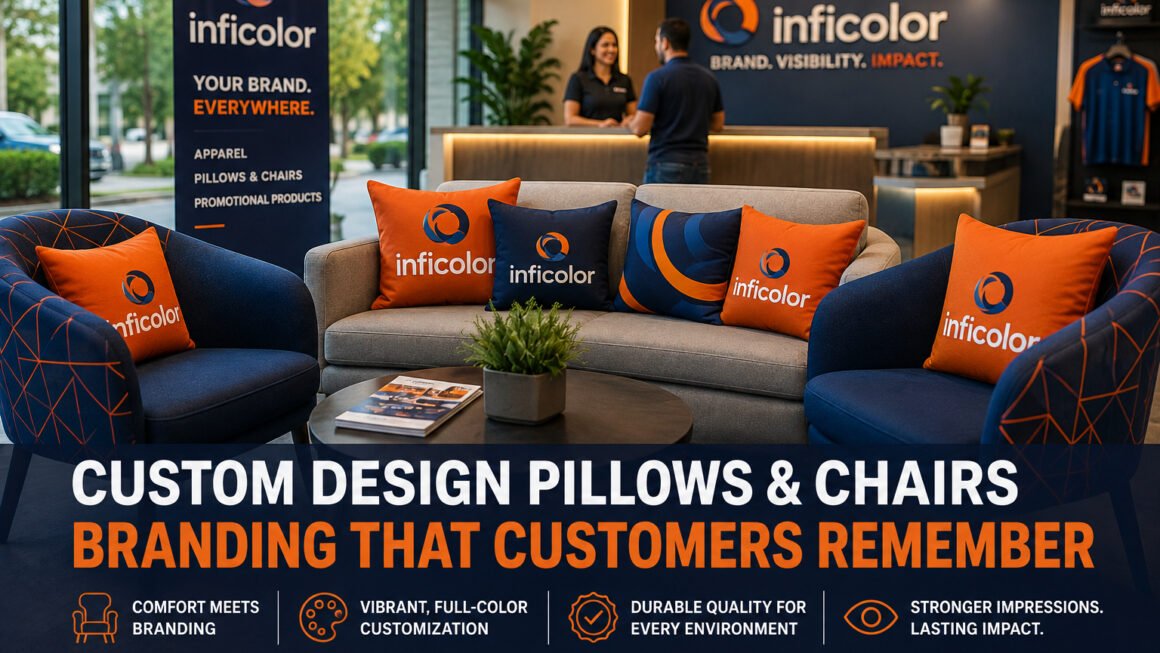
The same principle applies to custom design pillows & chairs. A restaurant lounge, dealership waiting area, hotel lobby, showroom, trade show booth, or corporate collaboration space can reinforce a brand through coordinated environmental elements rather than relying exclusively on wall signage.
The strategic question is therefore not simply, “What products should we customize?” It is, “Where does our audience encounter our business, and how can those encounters reinforce our identity?”
That change in perspective turns customization from a purchasing decision into a brand visibility strategy.
The Walking Billboard Effect
Walking billboard marketing occurs when employees, representatives, technicians, sales teams, and other people associated with a company visibly carry the brand into everyday interactions. Unlike an advertisement that disappears when a campaign ends, branded workwear can generate impressions repeatedly throughout its usable life.
Consider the daily journey of a branded employee. A technician may leave the office, stop for coffee, visit several customer properties, purchase supplies, speak with homeowners, and return home while wearing company apparel. A restaurant employee may be seen by hundreds of customers during a shift. A dealership representative may interact with prospects, vendors, existing customers, and community partners.
Every relevant encounter can create another visual impression.
Repeat exposure matters because people frequently become familiar with businesses before they ever become customers. Seeing the same brand across employees, vehicles, community events, physical locations, and digital channels can make a company easier to recognize when a buying need eventually arises.
This is the walking billboard effect: one branding investment can continue producing visibility long after the initial purchase.
How Many Impressions Can Employee Apparel Generate?
There is no responsible universal number because impressions depend on employee count, work environment, location, customer traffic, frequency of wear, and community activity. A field-service employee working across a busy metropolitan area may generate substantially different exposure from an employee working primarily in a private office.
A better way to evaluate potential is to estimate employee visibility days, average daily interactions, customer traffic, and frequency of use. Multiply that across weeks or months and the cumulative exposure can become meaningful, particularly for local and regional businesses.
Why Employees Are One of the Most Powerful Marketing Channels
Employees are one of the most underutilized marketing assets in any organization because they already occupy the places businesses spend money trying to reach: customer locations, neighborhoods, restaurants, stores, events, showrooms, offices, and community spaces.
Employee branding turns that existing presence into structured brand visibility.
Branded workwear also serves an important recognition function. When a customer arrives at a busy business, enters a showroom, attends an event, or opens the door for a service technician, professional company apparel helps answer an immediate question: “Who represents this business?”
That clarity can support trust and professionalism. Consistent custom uniforms help customers identify employees quickly while reinforcing the organization’s name, colors, and visual identity.
Employee branding can also extend into social interactions and community exposure. Team members may be photographed at events, appear in customer social posts, participate in sponsorships, attend conferences, or simply travel between appointments. Company apparel gives the brand an opportunity to travel with them.
Are Employees Really Walking Billboards?
Yes, when employee apparel is intentionally designed and consistently worn. Employees naturally create real-world brand impressions during customer interactions and community activity, turning existing workforce visibility into an additional marketing channel without requiring businesses to purchase every impression separately.
How Inficolor Supports a Broader Brand Experience
Brand recognition becomes stronger when visual signals are coordinated rather than isolated. Inficolor can support this strategy by allowing organizations to develop distinctive designs across promotional apparel and other customized surfaces.
For example, an organization might establish a recognizable visual system using company colors, patterns, imagery, and brand elements across employee shirts, jackets, event apparel, and selected custom design pillows & chairs in customer-facing environments.
The objective is not to put a logo everywhere. Excessive branding can become visual noise. The stronger approach is to establish deliberate visual consistency so that customers encounter recognizable brand cues at meaningful touchpoints.
This is where customization flexibility becomes a strategic advantage. Different products can serve different roles while still belonging to the same visual system.
Understanding the ROI of Branded Apparel
The ROI of branded uniforms should be evaluated differently from short-duration advertising. A digital advertisement may produce impressions only while media spend continues. A radio campaign stops when purchased airtime ends. Direct mail typically creates a brief opportunity for attention.
Branded apparel can remain in circulation for months or longer, depending on product quality, usage, employee turnover, and care.
That longevity changes the economics.
A practical way to evaluate branded apparel ROI is to consider the total investment against estimated lifetime use. If a garment is worn regularly over an extended period, its effective cost per wearing decreases. If every wearing creates customer or community exposure, the potential cost per impression can also decline over time.
Businesses should also consider indirect returns that are harder to assign to a single transaction: improved employee identification, stronger customer familiarity, more professional presentation, consistent event branding, workforce cohesion, and repeated visual reinforcement.
What Is the ROI of Branded Uniforms?
The ROI depends on how often the apparel is worn, how visible employees are, the usable life of each garment, and whether the design makes the brand easy to recognize. Businesses achieve greater marketing value when company apparel is treated as an actively deployed brand asset rather than merchandise stored in a closet.
Why Does Branded Apparel Improve Brand Recognition?
Branded apparel creates repeated visual exposure to consistent names, colors, logos, and design elements. Repetition can help customers become familiar with a company, making the brand easier to recognize during future interactions or purchase decisions.
Three Business Examples of Workforce and Environmental Branding
1. An HVAC Company Building Neighborhood Recognition
Imagine an HVAC business with 25 technicians serving Maryland, Virginia, and Washington DC. Each technician visits multiple homes and businesses every working day.
Professional custom uniforms immediately help homeowners identify who has arrived at their property. Between appointments, those technicians may also be seen at gas stations, restaurants, supply stores, parking lots, and throughout residential neighborhoods.
The business outcome is broader than uniformity. The company converts an existing field workforce into a distributed local awareness network, reinforcing its identity throughout the same communities where future customers live.
2. A Restaurant Creating a More Memorable Customer Experience
A restaurant uses coordinated promotional apparel for front-of-house employees while introducing custom design pillows & chairs or branded seating accents in selected customer areas.
The result is a more cohesive visual environment. Employees become immediately identifiable, while interior branding gives customers additional opportunities to encounter the restaurant’s distinctive visual identity.
When guests take photographs or share social content from the location, distinctive environmental elements may also become part of the visual backdrop. The business is therefore designing for both the physical customer experience and potential secondary exposure.
3. A Car Dealership Extending Its Brand Beyond the Showroom
A dealership equips sales teams, service advisors, event staff, and community representatives with coordinated company apparel. Customer waiting areas use carefully selected branded environmental accents to reinforce the dealership identity without overwhelming the space.
Employees wear the apparel at dealership events, sponsorships, local programs, and customer interactions. Instead of limiting branding to signage and paid advertising, the dealership creates multiple recurring human and environmental touchpoints.
The business outcome is increased consistency: customers encounter the same identity through advertising, staff, service interactions, events, and the physical dealership experience.
Branded Apparel vs. Traditional Advertising Channels
Branded apparel should not necessarily replace digital advertising, direct mail, radio, print, or outdoor advertising. Each channel performs a different function. The advantage of workforce branding is that it can add persistent visibility to marketing activities the organization is already conducting.
- Digital advertising: Offers precise targeting and measurable actions but usually requires continuous spending to maintain visibility.
- Direct mail: Can reach specific geographic audiences but typically creates a relatively short attention window.
- Radio advertising: Can provide substantial local reach, but exposure is temporary and depends on purchased airtime.
- Print advertising: Can support targeted publications and audiences, although visibility is tied to the lifespan and readership of the publication.
- Outdoor advertising: Can generate repeated geographic exposure but may require significant placement costs and is fixed to specific locations.
- Branded apparel: Moves with employees, supports customer identification, can generate recurring impressions, and continues creating visibility throughout the product’s useful life.
The strongest strategy is often integration. Digital marketing can create awareness, outdoor advertising can establish geographic presence, and employee branding can reinforce the same identity during actual human interactions.
That reinforcement can help close the gap between seeing an advertisement and recognizing the business in the real world.
Custom Design Pillows & Chairs as Customer-Facing Brand Assets
Employee apparel is only one part of a physical branding ecosystem. Custom design pillows & chairs can extend visual identity into hospitality areas, offices, showrooms, dealerships, restaurants, lounges, events, and customer waiting spaces.
These products are particularly useful when the environment itself contributes to the customer experience. A hotel, restaurant, dealership, furniture retailer, or corporate office may have long customer dwell times. During that period, branded environmental elements can quietly reinforce company colors and visual themes.
Successful environmental branding requires restraint. Not every chair or pillow needs a prominent logo. Patterns, color systems, subtle visual elements, and coordinated design themes can often create a more premium experience than simply repeating a corporate mark.
The goal is recognition without clutter.
Is Custom Apparel a Marketing Investment?
Yes. Custom apparel becomes a marketing investment when it has a defined business purpose: increasing brand visibility, helping customers identify employees, strengthening professional presentation, supporting workforce branding, or extending awareness into the community.
The distinction between an expense and an investment is largely determined by deployment. Apparel purchased without a strategy is simply merchandise. Apparel designed around brand recognition, employee adoption, frequency of wear, customer interactions, and consistent visual standards becomes part of the marketing infrastructure.
How Small Businesses Can Increase Visibility Without Huge Advertising Budgets
Small businesses do not necessarily need to outspend larger competitors. They can focus on extracting greater marketing value from activities already happening every day.
Employees already travel to work. Technicians already visit customers. Restaurant teams already interact with guests. Retail employees already work on sales floors. Sales representatives already attend events. Those activities create existing visibility that can be branded.
This makes workforce branding especially relevant for organizations with limited advertising budgets. Instead of paying exclusively for additional audiences, businesses can improve the visibility of the people, spaces, and customer interactions they already have.
Decision Support: Building a Branded Apparel Program That Works
Budget
Start with the employees and roles that receive the most customer exposure. A phased rollout can help an organization establish standards before expanding across departments, locations, events, or additional promotional products.
ROI
Do not evaluate ROI solely by immediate sales attribution. Track garment usage, employee participation, customer feedback, recognition, event utilization, useful life, and the estimated number of customer-facing opportunities.
Implementation
Establish clear brand standards before production. Determine approved colors, logo placement, garment categories, design variations, employee roles, and intended use cases.
Employee Adoption
Employees are more likely to wear company apparel consistently when it is appropriate for their work, professionally designed, comfortable, and aligned with how they want to represent the organization.
Customization Flexibility
Different teams may need different products while maintaining one recognizable visual identity. Field technicians, sales representatives, restaurant teams, executives, event personnel, and warehouse staff do not necessarily need identical garments.
Ordering Logistics
A strong program accounts for sizing, replenishment, onboarding, seasonal requirements, multiple locations, replacement needs, and fulfillment before those issues become operational bottlenecks.
Scalability
Build a system rather than making isolated purchases. Standardized designs and approved product categories make it easier to expand branded workwear across departments, new hires, locations, campaigns, and events.
Why Work With Digitized Logos?
Digitized Logos provides branded apparel and promotional product solutions for organizations that want to turn everyday business activity into consistent brand exposure. The company manages sourcing, customization, production, and fulfillment, helping reduce the operational complexity of coordinating a professional branding program.
Businesses can explore dye sublimation apparel and customization options designed to support distinctive company branding, promotional programs, employee branding, and customer-facing initiatives.
Digitized Logos is an MDOT, DDOT, and VA SWaM Certified Small, Minority, Female-Owned Business, serving organizations seeking capable branded merchandise and customization support in Maryland, Virginia, Washington DC, and across the United States.
Frequently Asked Questions
Are employees walking billboards?
Employees can function as walking billboards when they consistently wear recognizable company apparel in customer-facing and community environments. Their normal daily activities can create additional brand impressions without purchasing each impression through paid media.
What is the ROI of branded uniforms?
ROI depends on product cost, useful life, frequency of wear, employee visibility, customer interactions, and brand recognition. Apparel worn repeatedly can provide continuing marketing value long after the initial purchase.
How does employee branding support business growth?
Employee branding supports growth by increasing visibility, making staff easier to identify, reinforcing professionalism, improving customer familiarity, and extending brand recognition into everyday community interactions.
Can custom design pillows & chairs support marketing?
Yes. Custom design pillows & chairs can reinforce visual identity in restaurants, hospitality spaces, dealerships, showrooms, offices, events, and waiting areas. They are most effective when incorporated into a coordinated environmental branding strategy.
Is dye sublimation suitable for a scalable company apparel program?
It can be. Dye sublimation provides significant design flexibility for organizations seeking distinctive colors, patterns, and coordinated visual concepts. Scalability improves when businesses establish approved designs, product standards, sizing processes, ordering procedures, and replenishment plans.
FAQ Schema
FAQPage: Are employees walking billboards? Employees can function as walking billboards when recognizable branded apparel creates recurring customer and community exposure. What is the ROI of branded uniforms? ROI depends on cost, useful life, frequency of wear, visibility, and customer interactions. How does employee branding support business growth? It increases recognition, professionalism, customer familiarity, and local visibility. Can custom design pillows & chairs support marketing? Yes, they can reinforce visual identity throughout customer-facing environments. Is dye sublimation suitable for scalable company apparel? Yes, particularly when organizations establish consistent design, ordering, sizing, and replenishment standards.
Key Takeaways
- Visibility: Employees can create recurring brand impressions through customer interactions and everyday community exposure.
- Branding: Coordinated apparel and custom design pillows & chairs can create a more consistent physical brand experience.
- Marketing value: Workforce branding turns existing employee activity into an additional visibility channel.
- ROI: Evaluate branded apparel through useful life, frequency of wear, customer exposure, recognition, and cost per potential impression.
- Implementation: Successful programs require thoughtful design standards, employee adoption, ordering processes, replenishment, and scalability.
Turn Inficolor Into a Long-Term Brand Visibility Strategy
The most valuable marketing assets are not always new channels. Sometimes they are resources the business already has but has not fully activated.
Employees are one of the most underutilized marketing assets in any organization. When employees interact with customers, travel through communities, attend events, or represent a company in public, they create opportunities for brand exposure that businesses can intentionally strengthen through professional workforce branding.
Inficolor, custom design pillows & chairs, promotional apparel, custom uniforms, and dye sublimation apparel can help connect those individual touchpoints into a more recognizable brand experience.
Digitized Logos helps organizations approach customization as more than merchandise. By coordinating sourcing, customization, production, and fulfillment, businesses can develop scalable programs built around brand visibility, employee branding, consistency, customization flexibility, fast turnaround, and long-term business growth.
Call 301-963-3553 or visit Digitizedlogos to explore how your employees, apparel, and customer-facing environments can become more productive brand assets.