Inficolor: Turning Employee Apparel Into Everyday Brand Visibility
Quick Answer
Inficolor gives businesses an opportunity to think beyond ordinary company apparel and use custom design sweatshirts and wrist bands as part of a broader visibility strategy. When employees consistently wear distinctive branded apparel, businesses can generate repeated visual impressions, strengthen customer recognition, and extend their marketing presence into workplaces, communities, events, and everyday interactions.
The strategic idea is simple: employees are one of the most underutilized marketing assets in any organization. Apparel transforms an existing workforce into a recurring brand visibility channel without requiring businesses to purchase a new advertising impression every time someone sees the brand.
What Is Inficolor and Why Does It Matter for Employee Branding?
Inficolor can be approached as more than a visual customization concept. From a business perspective, its value lies in helping organizations create distinctive, recognizable apparel that employees can wear consistently across customer-facing and community environments.
That distinction matters because effective employee branding is not simply about putting a logo on clothing. It is about building a recognizable visual identity around the people who represent the organization.
Custom uniforms, branded workwear, promotional apparel, custom design sweatshirts and wrist bands can reinforce that identity across multiple touchpoints. A customer might encounter an employee at a job site, restaurant, trade show, community event, retail location, networking function, or even while the employee is traveling between locations.
Each encounter creates another opportunity for recognition.
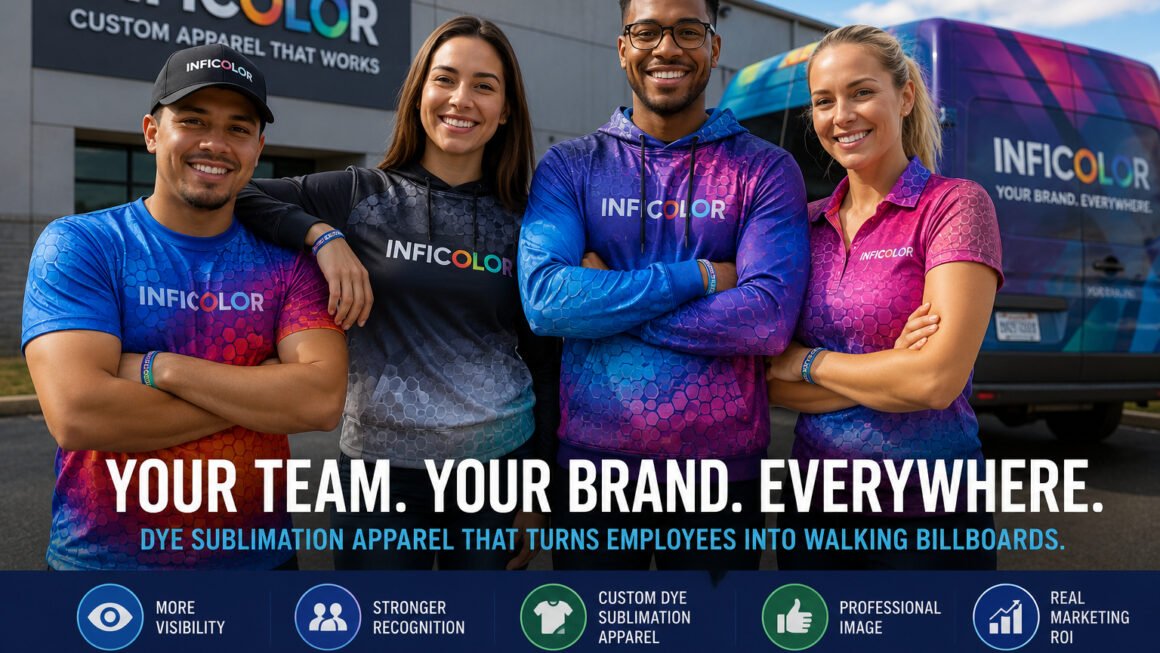
Businesses exploring highly customizable apparel can also consider dye sublimation apparel, which provides extensive flexibility for incorporating colors, patterns, graphics, and brand elements into the overall garment design.
The Walking Billboard Effect
Are employees walking billboards? They can be. When employees wear clearly identifiable company apparel in public-facing environments, they create mobile brand exposure throughout their normal working day.
This is the walking billboard marketing effect.
A traditional billboard depends on people passing one fixed location. Employee apparel moves with the person wearing it. A technician travels through neighborhoods. A restaurant employee interacts with customers. A salesperson attends community events. A delivery team moves between businesses. A retail employee may wear company apparel before or after a shift.
These interactions can produce repeated visual impressions without requiring an additional media purchase for every exposure.
How many impressions can employee apparel generate? There is no responsible universal number because exposure depends on workforce size, working environment, foot traffic, garment usage, employee mobility, and customer interaction. A better approach is to evaluate the number of employees wearing branded apparel, how frequently they wear it, and how many relevant people they encounter.
The cumulative effect is what matters.
Repeated exposure builds familiarity. Familiarity supports recognition. Recognition can make a company easier to remember when a buying need eventually appears.
Unlike a short advertising campaign, quality company apparel can remain in circulation for months or longer. That longevity is one reason businesses should evaluate branded apparel as a marketing asset rather than treating it exclusively as an operating expense.
Why Employees Are One of the Most Powerful Marketing Channels
Employees already travel through the markets businesses want to reach. They meet customers, enter offices, visit job sites, attend events, eat at restaurants, travel through neighborhoods, and interact with other professionals.
That existing activity makes workforce branding unusually efficient.
A service technician wearing professional branded workwear can reinforce legitimacy when arriving at a customer’s home. Restaurant employees wearing coordinated apparel create a more recognizable customer experience. Sales representatives wearing polished company apparel at an event can make the organization easier to identify across a crowded room.
These impressions are especially valuable because they occur alongside real human interactions.
People are not simply seeing an advertisement. They are seeing a person associated with the organization.
That can support trust, professionalism and customer recognition simultaneously.
For businesses operating throughout Maryland, Virginia, Washington DC, or elsewhere in the United States, employee visibility can also strengthen local awareness. A recognizable workforce becomes part of the company’s physical presence within the communities it serves.
How Inficolor Can Strengthen Brand Recognition
The strategic advantage of Inficolor is differentiation. Generic apparel can identify an employee, but thoughtfully designed apparel can communicate a stronger and more memorable brand identity.
Color systems, graphic patterns, typography, visual hierarchy and consistent placement all contribute to recognition. With dye sublimation apparel, businesses have greater freedom to integrate visual elements throughout a garment rather than relying solely on a small decoration area.
This can be particularly useful for companies with energetic, visually distinctive, sports-oriented, hospitality, retail, event, service, or consumer-facing brands.
Why does branded apparel improve brand recognition? Consistency and repetition are the primary drivers. When customers repeatedly encounter the same colors, visual language, logo treatment and employee presentation, those elements become easier to associate with the organization.
The objective is not visual complexity for its own sake. The strongest designs balance distinctiveness with consistency.
Understanding the ROI of Branded Apparel
What is the ROI of branded uniforms? ROI should be evaluated across more than immediate sales attribution. Branded apparel can create value through ongoing impressions, customer recognition, employee identification, professional presentation, internal culture and the useful life of the garment.
Consider cost per impression conceptually.
A digital advertiser generally pays to continue generating traffic or impressions. A direct-mail campaign requires another production and mailing cycle. Radio requires continued media purchases. Outdoor advertising requires ongoing placement costs.
Branded apparel works differently.
The primary investment is made when the product is produced. Every subsequent wear can create additional exposure without purchasing that individual impression again.
This does not mean apparel should replace performance advertising. Digital media can provide precise targeting and measurable conversion data that apparel cannot replicate.
The more useful question is whether company apparel can complement those channels by creating persistent physical visibility between campaigns.
Is custom apparel a marketing investment? It can be when it is intentionally designed, consistently worn and aligned with the organization’s visual identity. The marketing value comes from repeated exposure and recognition rather than from the garment alone.
Three Real-World Business Examples
1. HVAC Company: Turning Service Calls Into Neighborhood Visibility
Imagine an HVAC company with 25 field technicians. Each technician visits homes and commercial properties throughout the week.
Without consistent branded workwear, those technicians create little recognizable exposure beyond their service vehicles. With coordinated custom uniforms, every arrival, property visit, lunch stop and supplier interaction becomes another opportunity for the company to be seen.
The business outcome is not merely a more professional uniform. It is greater local recognition combined with clearer employee identification and a stronger customer-facing presentation.
2. Restaurant Group: Extending the Brand Beyond the Dining Room
A restaurant may spend heavily on social media, local advertising and promotions while overlooking dozens of employees who interact with hundreds of customers every week.
Distinctive shirts, custom design sweatshirts and wrist bands can reinforce the restaurant’s visual identity during shifts, catering events, festivals, community activities and promotional campaigns.
The potential outcome is stronger recognition across both the physical restaurant and the surrounding community.
3. Car Dealership: Creating Consistency Across the Customer Journey
A dealership may have salespeople, service advisors, technicians, event teams and support staff interacting with customers throughout the ownership lifecycle.
Coordinated company apparel can connect those departments visually. Instead of customers encountering disconnected teams, they repeatedly encounter the same recognizable brand.
The result can be a more cohesive customer experience while extending dealership visibility into local events, test-drive activities, service areas and community programs.
Branded Apparel vs. Traditional Advertising
No single marketing channel performs every function equally well. The strategic advantage of promotional apparel is its combination of longevity, physical visibility and human interaction.
- Digital advertising: Excellent for targeting, measurement and rapid campaign deployment, but visibility usually declines when spending stops.
- Direct mail: Useful for geographic targeting and offers, but typically provides a limited exposure window.
- Radio advertising: Can generate broad regional awareness but requires continued media spending and offers no persistent visual identity.
- Print advertising: Can communicate detailed messages but often has a relatively short useful life.
- Outdoor advertising: Provides repeated visibility within a defined geographic area but remains tied to specific locations.
- Branded apparel: Moves with employees, can remain useful for extended periods and connects brand exposure with real people representing the organization.
The strongest strategy is often integration rather than substitution.
A prospect might first encounter a business online, notice its vehicles locally, see employees wearing recognizable apparel and later encounter another digital advertisement. Consistency across those touchpoints strengthens the probability that the company will be remembered.
How Employee Branding Supports Business Growth
How does employee branding support business growth? It increases the number of environments in which customers can encounter and recognize a business while reinforcing a consistent professional identity.
This is particularly relevant for small and midsize businesses that cannot continuously outspend larger competitors.
How can small businesses increase visibility without large advertising budgets? One strategy is to extract more marketing value from assets they already need. If employees require work apparel anyway, strategically designing that apparel for recognition can turn an operational purchase into an additional visibility channel.
This is an important distinction.
The business is not necessarily creating an entirely new expense. It may be improving the marketing productivity of an existing one.
Company Apparel Also Shapes Internal Brand Culture
The external marketing value of company apparel receives most of the attention, but workforce branding also operates internally.
Well-designed apparel can create visual unity across departments, locations and roles. It can help employees feel connected to a recognizable organization and make teams easier to identify at events, job sites and customer locations.
Employee adoption matters, however.
If apparel is uncomfortable, impractical or disconnected from how employees actually work, usage declines. When employees genuinely want to wear the products, the potential number of brand impressions naturally increases.
That makes employee preference a marketing consideration, not merely an HR consideration.
Custom Design Sweatshirts and Wrist Bands as Supporting Brand Assets
Not every branding opportunity requires a formal uniform.
Custom design sweatshirts and wrist bands can extend a company’s identity into different environments and seasons. Sweatshirts can support field teams, outdoor events, employee programs, casual workplaces and colder-weather operations. Wrist bands can complement event campaigns, team initiatives, awareness programs and promotional activities.
The strategic principle remains consistency.
Products should feel like parts of the same brand system rather than unrelated promotional merchandise. Colors, logos, graphics and messaging should reinforce the organization’s established visual identity.
Decision Support: Is Branded Apparel Right for Your Organization?
Budget
Start with the employees and situations that create the most customer exposure. Businesses do not necessarily need to transform the entire workforce simultaneously. A phased rollout can prioritize customer-facing teams before expanding.
ROI
Evaluate apparel based on useful life, frequency of wear, employee count, customer interactions and visibility opportunities. Avoid judging its value solely through direct-response metrics designed for digital advertising.
Implementation
Define brand standards before ordering. Decide which colors, graphics, logo treatments and garment types should remain consistent across teams.
Employee Adoption
Select products employees are likely to wear. Employee participation directly influences the visibility potential of a workforce branding program.
Customization Flexibility
Dye sublimation can support extensive visual customization, making it useful when businesses want apparel to become a recognizable extension of the overall brand rather than simply carrying a small logo.
Ordering Logistics
Plan sizing, quantities, employee distribution, replacement needs and future reorders before deployment. Operational planning prevents a strong branding concept from becoming difficult to manage.
Scalability
Build a repeatable system. Organizations with multiple departments or locations should establish approved designs and product standards that can be reproduced as the workforce grows.
How Digitized Logos Supports Workforce Branding
Digitized Logos provides branded apparel and promotional product solutions for organizations seeking consistent, professionally managed customization programs.
The company manages sourcing, customization, production and fulfillment, helping businesses coordinate the operational components required to move from an apparel concept to a scalable program.
Organizations considering visually distinctive workforce apparel can explore dye sublimation apparel through Digitized Logos at https://www.digitizedlogos.com/product-category/dye-sublimation/.
Digitized Logos is an MDOT, DDOT, and VA SWaM Certified Small, Minority, Female-Owned Business and serves organizations seeking branded apparel and promotional solutions in Maryland, Virginia, Washington DC and across the United States.
Frequently Asked Questions
Are employees really walking billboards for a business?
Yes, when employees wear recognizable branded apparel in customer-facing or public environments. Their normal daily activities can generate repeated exposure while connecting the brand with real human interactions.
How many impressions can branded employee apparel generate?
There is no universal figure. Impressions depend on workforce size, frequency of wear, employee mobility, customer traffic and working environment. Businesses should estimate exposure using their own employee activity rather than relying on a generic industry number.
What is the ROI of branded uniforms?
Branded uniform ROI can include recurring visual impressions, stronger recognition, professional presentation, customer familiarity and long-term garment use. The investment becomes more efficient when employees wear the apparel frequently over an extended period.
Why use dye sublimation for employee apparel?
Dye sublimation apparel provides substantial design flexibility, allowing businesses to integrate colors, graphics and visual patterns into the overall garment. This can help create more distinctive and recognizable employee branding.
Can custom design sweatshirts and wrist bands support a broader branding program?
Yes. Custom design sweatshirts and wrist bands can complement uniforms, events, employee programs and promotional campaigns when their colors, graphics and branding remain consistent with the company’s broader identity.
FAQ Schema
Question: Are employees really walking billboards for a business? Answer: Employees wearing recognizable branded apparel can generate recurring exposure through customer interactions, travel, job sites, events and everyday community activity.
Question: How many impressions can branded employee apparel generate? Answer: The number varies according to employee count, frequency of wear, customer traffic, mobility and operating environment.
Question: What is the ROI of branded uniforms? Answer: ROI can come from long-term visibility, repeat impressions, customer familiarity, professional presentation and the continued useful life of the apparel.
Question: Why use dye sublimation for employee apparel? Answer: Dye sublimation enables extensive visual customization that can help organizations create distinctive, consistent and recognizable workforce apparel.
Question: Can custom design sweatshirts and wrist bands support employee branding? Answer: Yes. They can extend a consistent visual identity into events, seasonal apparel, employee initiatives and promotional programs.
Key Takeaways
- Visibility: Employees can create recurring brand exposure during customer interactions and normal daily activity.
- Branding: Consistent workforce branding makes organizations easier for customers to recognize and remember.
- Marketing value: Company apparel can transform an operational necessity into a long-lasting marketing asset.
- ROI: Evaluate branded apparel through frequency of wear, useful life, impressions, recognition and customer-facing value.
- Implementation: Successful programs balance distinctive customization with employee adoption, operational consistency and scalability.
Turn Inficolor Into a Business Visibility Strategy
The larger opportunity behind Inficolor is not simply creating better-looking apparel. It is recognizing that employees are one of the most underutilized marketing assets in any organization.
Every employee who interacts with customers or moves through the community represents an opportunity to reinforce the company’s identity. With thoughtfully designed dye sublimation apparel, custom uniforms, custom design sweatshirts and wrist bands, businesses can turn those ordinary interactions into recurring opportunities for recognition.
Digitized Logos can help organizations develop scalable branded apparel programs with the customization flexibility, consistency, sourcing, production, fulfillment and fast turnaround required to support growing teams.
Ready to turn your workforce into a stronger brand visibility channel? Call 301-963-3553 or visit Digitizedlogos to explore custom dye sublimation apparel that can help employees carry your brand further.