
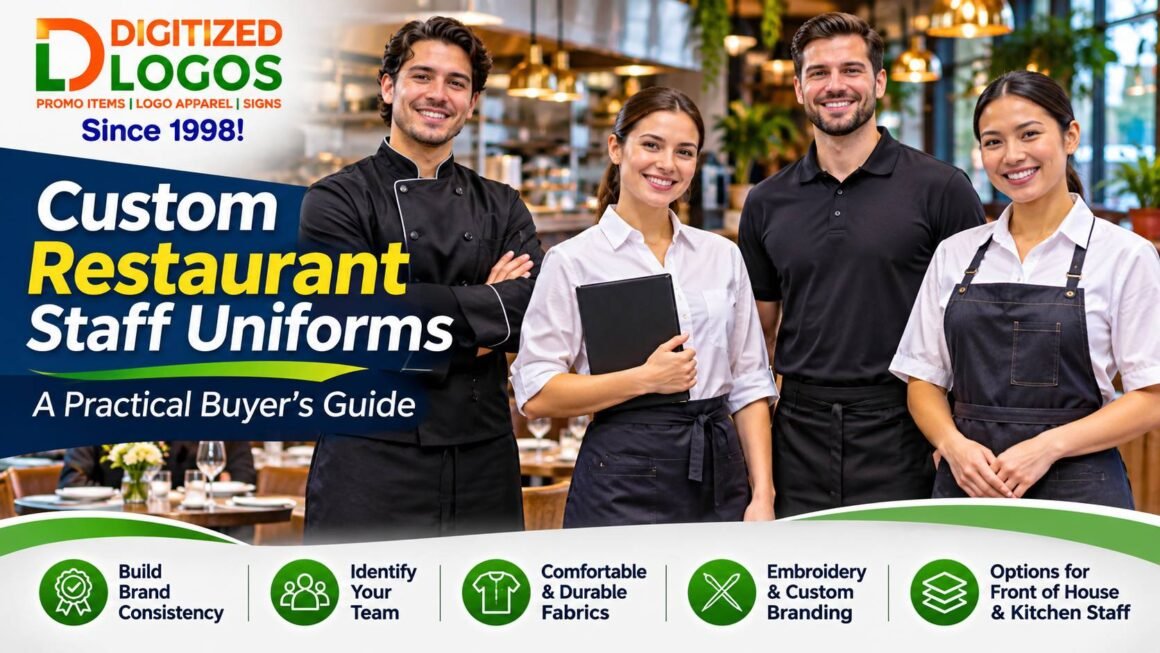
Restaurant uniforms do more than establish a professional appearance. They help employees identify their roles, support a consistent guest experience, and create a recognizable visual identity throughout the dining establishment. From front-of-house servers to kitchen employees, the right apparel should balance comfort, functionality, durability, and brand presentation.
For restaurant owners, hospitality managers, and purchasing teams, selecting custom restaurant staff uniforms involves more than choosing shirts and adding a company logo. Fabric performance, employee responsibilities, decoration methods, sizing, cleaning requirements, and replacement procedures can all influence the success of a uniform program.
This guide explains how to select restaurant employee apparel, compare customization methods, coordinate staff orders, and establish a practical uniform program that supports everyday restaurant operations.
What Are Custom Restaurant Staff Uniforms?
Custom restaurant staff uniforms are work garments selected or personalized to represent a restaurant’s identity while meeting the practical requirements of different employee roles. Common options include embroidered polo shirts, button-down shirts, aprons, chef coats, work pants, and branded outerwear.
Restaurant uniforms can incorporate business logos, restaurant names, employee names, or department identifiers. Decoration methods may include embroidery, screen printing, and other garment-compatible printing techniques.
The most suitable uniform depends on the employee’s duties, working environment, brand standards, and expected garment maintenance.
Why Restaurant Staff Uniforms Matter
1. Consistent Brand Presentation
Restaurant employees represent the establishment during nearly every customer interaction. Coordinated uniforms help reinforce the restaurant’s visual identity through recognizable colors, logos, and apparel styles.
For restaurant groups operating multiple locations, documented garment specifications can also help maintain a consistent appearance when different locations recruit employees or replace uniforms.
2. Clear Employee Identification
Customers should be able to recognize restaurant employees without confusion. Consistent staff attire makes it easier to distinguish servers, hosts, bartenders, and other customer-facing personnel from guests.
Different garment styles or subtle color variations can also help supervisors and employees identify responsibilities within the restaurant.
3. Comfort During Demanding Shifts
Restaurant employees often spend extended periods standing, walking, carrying equipment, and working in environments with changing temperatures. Poorly fitted or unsuitable clothing may interfere with everyday tasks.
Appropriate workwear should allow natural movement, accommodate job-specific responsibilities, and remain comfortable throughout the employee’s shift.
4. Easier Uniform Management
Standardized garments simplify the process of assigning uniforms to employees, communicating dress requirements, and arranging replacements.
Restaurant managers can establish approved styles, colors, logo placements, and garment specifications rather than making separate apparel decisions for every new employee.
Types of Custom Restaurant Staff Uniforms
Different positions require different clothing characteristics. A practical uniform program should account for job responsibilities rather than assigning the same garment to every department.
Restaurant Polo Shirts
Branded polo shirts are suitable for many casual dining environments, fast-casual restaurants, catering teams, and supervisory positions.
They provide a structured appearance without requiring the formality of a dress shirt. Restaurant buyers should evaluate collar construction, fabric weight, fit, color consistency, and laundering requirements.
Logo embroidery is frequently considered for polos because it creates a stitched design that can complement the garment’s professional appearance.
Button-Down Restaurant Shirts
Button-down shirts are often appropriate for upscale restaurants, hotel dining operations, hosts, and management teams.
These garments can support a more formal dress code while providing space for embroidered restaurant logos or employee identification.
Before purchasing, consider sleeve length, fabric care, fit options, and whether employees need flexibility for physical tasks.
Custom Restaurant Aprons
Aprons provide a practical uniform layer for servers, bartenders, baristas, and certain food preparation roles.
Available designs may include waist aprons, bib aprons, and styles featuring pockets for frequently used accessories.
Restaurant managers should consider apron coverage, pocket placement, strap adjustability, laundering needs, and compatibility with the employee’s underlying clothing.
Chef Coats and Kitchen Apparel
Kitchen apparel serves different operational needs from front-of-house uniforms. Depending on the position, garments may require particular attention to fabric construction, coverage, ease of movement, and cleaning.
Chef coats can incorporate restaurant branding or employee names, provided the customization does not interfere with the garment’s intended function.
Kitchen managers should select apparel according to the actual tasks and workplace hazards involved. Decorative customization does not replace appropriate protective clothing or established food safety practices.
Restaurant Jackets and Outerwear
Outdoor dining personnel, delivery teams, and employees working in cooler areas may need additional uniform layers.
Branded jackets, fleece garments, and other outerwear can be coordinated with standard employee apparel while allowing the restaurant to maintain a recognizable appearance.
For cold-weather or outdoor duties, garment selection should account for weather exposure and employee safety requirements.
Choosing the Right Fabric for Restaurant Uniforms
Fabric selection affects comfort, durability, care requirements, and how uniforms look after repeated use.
Cotton
Cotton is a familiar apparel material valued for its natural feel. Depending on fabric construction, cotton garments may provide comfortable everyday wear.
However, some cotton fabrics are more susceptible to wrinkling or shrinkage. Restaurant purchasers should review the specific garment’s care instructions and dimensional stability.
Polyester
Polyester is commonly used in work apparel because many polyester fabrics offer wrinkle resistance, dimensional stability, and practical laundering characteristics.
Performance varies by fabric construction and finishing treatment. Polyester content alone does not establish how breathable, moisture-managing, or comfortable a garment will be.
Cotton-Polyester Blends
Blended fabrics can combine characteristics of natural and synthetic fibers. They are worth considering for restaurant polos, shirts, and other frequently laundered employee garments.
Evaluate the actual fabric rather than assuming every blend performs identically.
Performance Fabrics
Certain restaurant roles may benefit from garments designed with moisture-management properties, stretch, or specialized fabric finishes.
Restaurant buyers should request garment specifications and assess whether those features are relevant to the working environment.
Embroidered Restaurant Uniforms With Logo: What Buyers Should Know
Choosing embroidered restaurant uniforms with logo can be an appropriate approach for restaurants seeking a clean, stitched brand presentation on compatible apparel.
Embroidery uses thread to reproduce a logo or design on the garment. It is commonly applied to polos, button-down shirts, aprons, jackets, and other suitable textiles.
However, embroidery is not automatically the best solution for every design or fabric. Small lettering, intricate gradients, very lightweight materials, and oversized artwork can require alternative approaches.
How Logo Embroidery Works
- Artwork review: The restaurant supplies its approved logo, preferably in a clean, high-quality format.
- Digitizing: The artwork is converted into embroidery instructions specifying how stitches should form the design.
- Placement selection: The buyer approves the logo location, dimensions, and orientation.
- Thread selection: Thread colors are chosen to match the approved design as closely as practical.
- Production review: A sample or production proof may be evaluated when supported by the supplier.
- Decoration: The approved design is stitched onto the selected garments.
One detail restaurant buyers sometimes overlook is that embroidery digitizing is different from simply resizing a digital logo. Stitch direction, density, underlay, and lettering dimensions influence the finished appearance.
A logo that looks sharp on a computer screen may require adjustments to reproduce effectively with thread.
Common Restaurant Logo Placement Options
- Left chest: A familiar placement for polo shirts, dress shirts, and jackets.
- Right chest: Useful for restaurant logos or employee identification when garment construction permits.
- Sleeve: Can display a secondary mark or department identifier.
- Apron front: Provides visible branding on many bib-style aprons.
- Upper back: May be appropriate for larger designs, depending on garment type and decoration method.
Placement should be evaluated on the actual garment. Seams, pockets, buttons, fabric stretch, and panel dimensions can affect how artwork is positioned.
Embroidery vs. Printing for Restaurant Employee Apparel
Both embroidery and garment printing can work for restaurant uniforms, but they serve different design and operational needs.
When Embroidery Makes Sense
Embroidery is often considered for small restaurant logos on polos, dress shirts, and jackets. It offers a textured appearance and is suitable for many garments designed to accommodate stitched decoration.
Before selecting embroidery, assess logo complexity, garment material, design dimensions, and expected cleaning conditions.
When Printing May Be More Appropriate
Printing may be suitable for restaurant T-shirts, event apparel, larger graphics, or designs containing details that are difficult to reproduce through stitching.
Screen printing and other apparel decoration methods have different setup requirements, artwork considerations, and production characteristics.
Restaurant buyers should compare the completed garment, expected quantities, care instructions, and overall program requirements rather than selecting a method based on appearance alone.
How to Choose Custom Restaurant Staff Uniforms
Selecting custom restaurant staff uniforms is easier when purchasing decisions follow a defined operational process.
Step 1: Identify Employee Roles
List the positions requiring uniforms, including servers, hosts, bartenders, kitchen employees, managers, catering staff, and outdoor service personnel.
Document which employees need formal apparel, functional work garments, protective clothing, or additional layers.
Step 2: Define Brand Standards
Choose approved garment colors, styles, logo placements, and decoration requirements.
Businesses managing multiple restaurants should document these standards so future purchasing decisions remain consistent.
Step 3: Evaluate Garment Samples
Whenever practical, review physical samples before committing to a larger uniform program.
Check fabric feel, stitching, collar construction, garment length, fit, ease of movement, and care requirements.
Step 4: Establish a Sizing Process
Collect employee sizes using manufacturer-specific size charts and fit guidance.
Do not assume a medium shirt from one manufacturer fits the same as a medium from another.
Where feasible, offering fit samples or a controlled sizing trial can reduce unnecessary exchanges.
Step 5: Confirm Decoration Specifications
Provide the approved logo and review decoration dimensions, positioning, thread colors, and garment compatibility.
Confirm whether artwork preparation, digitizing, or setup services are required and how those activities affect the quotation.
Step 6: Plan Purchasing and Distribution
Determine the number of employees, garments per person, backup inventory requirements, and delivery locations.
Consider employee onboarding dates, seasonal staffing changes, and the time needed to review proofs before production.
Step 7: Document Reorder Requirements
Retain approved garment descriptions, supplier style numbers, colors, artwork specifications, and decoration placements.
This information helps make future reorders more consistent, although fabric availability and manufacturer changes should still be checked.
Restaurant Uniform Costs: What Influences Pricing?
The total cost of a restaurant uniform program depends on more than the garment’s advertised unit price.
Relevant variables include:
- Garment brand, construction, and material.
- Number of garment styles and sizes required.
- Decoration method and design complexity.
- Embroidery stitch count or applicable print requirements.
- Artwork preparation and setup charges, if applicable.
- Purchasing quantities and supplier minimums.
- Individual packaging and distribution requirements.
- Shipping destinations and delivery schedules.
- Replacement frequency and future reorder requirements.
Consider a hypothetical restaurant with 25 employees that provides three shirts per person. Its initial requirement would be 75 shirts before accounting for replacement inventory or additional hires.
This example illustrates quantity planning only. It does not represent a Digitized Logos customer, quotation, or actual purchasing result.
When comparing suppliers, request an itemized quotation showing garment charges, customization costs, setup requirements, shipping, and any additional services.
Practical Restaurant Uniform Examples
Example 1: Casual Dining Restaurant
Imagine a casual restaurant that employs servers, hosts, and shift managers. The establishment wants recognizable staff attire without requiring formal dress shirts.
One possible approach is to select coordinated polo shirts with approved logo embroidery. Managers could wear a complementary color while maintaining consistent logo placement.
Before implementing the program, the business would evaluate sample garments, confirm sizing, and establish a replacement process.
Example 2: Multi-Location Restaurant Group
Consider a hypothetical restaurant group with several locations that periodically hires new staff.
Without standardized garment specifications, individual managers might select different shirt shades, logo dimensions, or apparel styles. Over time, these variations could weaken visual consistency.
The group could reduce unnecessary variation by developing a central uniform specification covering approved garments, decoration details, size references, and reorder instructions.
Both examples are illustrative purchasing scenarios, not documented customer projects.
Common Mistakes When Purchasing Restaurant Uniforms
Ordering Without Checking Sizes
Unverified sizing can create unnecessary exchanges and leave employees without properly fitting garments.
Use the selected manufacturer’s measurements and consider fitting samples before confirming quantities.
Choosing Apparel Based Only on Price
A lower initial garment price does not necessarily mean a lower long-term expense. Frequent replacements, unsuitable fabrics, or inconsistent fit can affect the overall purchasing budget.
Consider the expected service life and maintenance requirements alongside the initial quotation.
Using Artwork That Is Too Detailed
Complex logos may lose clarity when reduced to a small embroidered area.
Review artwork with the decoration provider before finalizing the logo size. A simplified, approved version of the restaurant’s brand mark may sometimes be appropriate.
Ignoring Laundry Requirements
Restaurant uniforms may require frequent cleaning. Garments should be selected with realistic laundering procedures in mind.
Check manufacturer care instructions and confirm that decoration materials are compatible with the expected cleaning process.
Failing to Plan for Replacement Uniforms
Restaurants experience staffing changes, damaged garments, and unexpected uniform needs.
Maintaining accurate garment specifications and a reasonable replacement plan can make these situations easier to manage.
Managing Restaurant Uniforms Across Multiple Locations
Multi-location restaurant operators often need a repeatable ordering process that supports brand consistency without creating unnecessary administrative work.
A practical centralized uniform program can include:
- An approved catalog of garments and colors.
- Standardized embroidery or printing specifications.
- Defined employee apparel allowances or purchasing rules.
- Centralized artwork and logo approvals.
- Documented ordering and replenishment procedures.
- Location-specific shipping instructions.
- Periodic reviews of garment quality and employee feedback.
Some businesses also evaluate branded online company stores as a method for organizing approved merchandise and employee purchases. The appropriate approach depends on staffing structure, fulfillment requirements, and available supplier capabilities.
How to Evaluate a Restaurant Uniform Supplier
A suitable restaurant apparel supplier should help purchasing teams understand garment options, decoration requirements, ordering conditions, and fulfillment considerations.
Before selecting a supplier, ask:
- Which garments are appropriate for our employee roles and working conditions?
- What customization methods are available for our selected garments?
- Can we review artwork proofs or physical samples before full production?
- Are setup charges or minimum order quantities applicable?
- How are sizing discrepancies, damaged items, and replacements handled?
- What production and delivery schedules apply to our requirements?
- Can the supplier maintain approved artwork specifications for future orders?
- What options are available for shipping to different restaurant locations?
Clear answers help restaurant purchasing teams compare vendors based on operational suitability rather than promotional claims.
How Digitized Logos Supports Restaurant Uniform Purchasing
Digitized Logos provides branded apparel and promotional product solutions for business customers. Restaurant operators can explore apparel options for employee identification, brand presentation, and coordinated merchandise programs.
The purchasing process should begin with the restaurant’s operational needs, including garment type, intended use, customization preferences, sizing, and anticipated quantities.
Digitized Logos can assist businesses exploring suitable branded merchandise and customization options. Product specifications, minimum quantities, decoration compatibility, pricing, and delivery arrangements should be confirmed for the selected items.
Frequently Asked Questions About Restaurant Staff Uniforms
What uniforms are suitable for restaurant employees?
The appropriate uniforms depend on employee responsibilities and restaurant dress standards. Front-of-house teams may use branded polos, button-down shirts, or aprons, while kitchen employees may require specialized work garments. Managers should consider comfort, laundering needs, workplace safety, brand consistency, and the physical demands of each position.
Can restaurant uniforms include embroidered logos?
Yes. Many restaurant apparel styles can accommodate logo embroidery, including compatible polo shirts, button-down shirts, aprons, and jackets. However, fabric construction, garment design, and logo complexity affect suitability. A decoration provider should review the selected garment and artwork before confirming production specifications.
Is there a minimum quantity for custom restaurant uniforms?
Minimum quantities vary by supplier, garment, and decoration method. Some products may support smaller purchases, while others have minimums related to manufacturing or customization setup. Restaurant buyers should confirm quantities, setup requirements, and applicable charges for each selected product before placing an order.
How long does it take to produce restaurant uniforms with logos?
Production time depends on garment availability, order quantity, decoration method, artwork approvals, and supplier scheduling. Shipping requirements can add additional time. Restaurants preparing for openings, events, or seasonal staffing should request a confirmed production and delivery schedule before relying on a particular completion date.
How can restaurants maintain consistent uniforms when hiring new employees?
Restaurants can retain approved garment style numbers, colors, logo files, decoration measurements, and supplier information. Using a documented sizing and reorder process helps purchasing managers maintain consistency. Product availability and specifications should still be reconfirmed because suppliers and manufacturers may change their assortments over time.
Key Takeaways for Restaurant Uniform Buyers
- Match uniforms to employee responsibilities: Kitchen, service, management, and outdoor positions may need different garments.
- Evaluate decoration methods carefully: Embroidery and printing have different applications depending on garment materials and artwork.
- Review sizing and samples: Proper fit and practical fabric selection are essential to an effective employee apparel program.
- Consider total purchasing costs: Include customization, shipping, replacement requirements, and potential setup charges.
- Document uniform specifications: Consistent garment and artwork records support future purchasing across individual or multiple locations.
Final Thoughts: Building a Practical Restaurant Uniform Program
An effective restaurant uniform program starts with understanding how employees work, how the restaurant presents its brand, and how garments will be maintained and replaced.
Thoughtful apparel selection can help create a coordinated staff appearance while supporting everyday operational needs. Restaurant owners should prioritize suitable materials, reliable sizing, appropriate customization, and clear purchasing procedures rather than treating uniforms as a one-time branding decision.
For businesses exploring custom restaurant staff uniforms, Digitized Logos provides a starting point for reviewing branded apparel and merchandise options.
Explore Restaurant Staff Apparel With Digitized Logos
Planning employee uniforms for a restaurant, catering operation, or hospitality business? Digitized Logos can help you explore branded apparel options and discuss customization requirements for your team.
Browse the product catalog at Digitized Logos branded apparel and promotional products, or contact the team to discuss your preferred garment styles, logo artwork, quantities, and distribution requirements.
Phone: 301-963-3553
Email: Info@DigitizedLogos.com
Start with your restaurant’s actual uniform requirements and build a program that supports comfortable employees, consistent branding, and practical long-term purchasing.