Custom Branded Bags: A Business Guide to Bags and Backpacks
Custom branded bags give businesses something many promotional products struggle to deliver: practical value combined with repeated brand exposure. A useful backpack, tote, laptop bag, duffel, or cooler can travel from the office to conferences, airports, customer meetings, campuses, gyms, and everyday errands.
For organizations purchasing corporate merchandise, the real decision is not simply which bag can hold a logo. Buyers need to consider who will receive it, how it will be used, which decoration method suits the material, how many units are required, and how production and fulfillment will fit the campaign timeline. Businesses can explore options through https://products.digitizedlogos.com/
Quick Answer: Why Do Businesses Use Branded Bags?
Short Answer: Businesses use branded bags because they combine utility, portability, and brand visibility in one promotional product. Branded backpacks, totes, laptop bags, duffels, and travel bags can support employee onboarding, trade shows, corporate gifting, recruiting, customer appreciation, conferences, and long-term merchandise programs.
The most effective bag is not necessarily the cheapest or most expensive option. It is the one that fits the recipient, intended use, brand positioning, budget, and distribution strategy.
What Are Custom Branded Bags?
Custom branded bags are bags personalized with an organization’s logo, colors, messaging, or other approved brand elements. Depending on the product and material, branding may be applied through embroidery, screen printing, heat transfer, full-color decoration, or another compatible process.
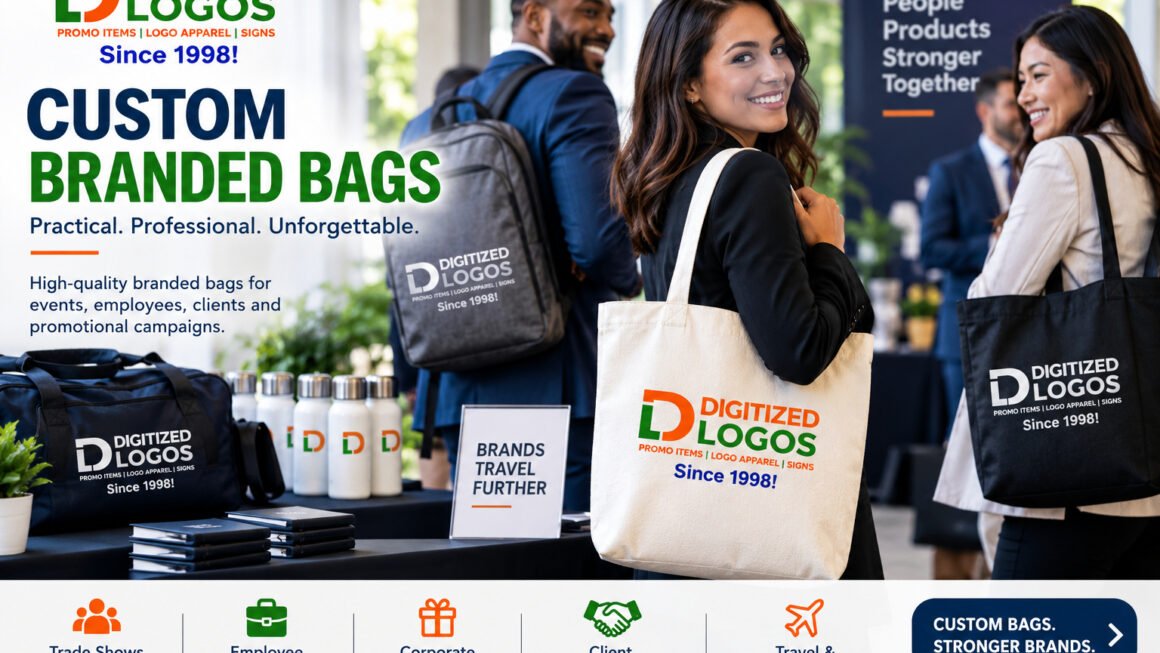
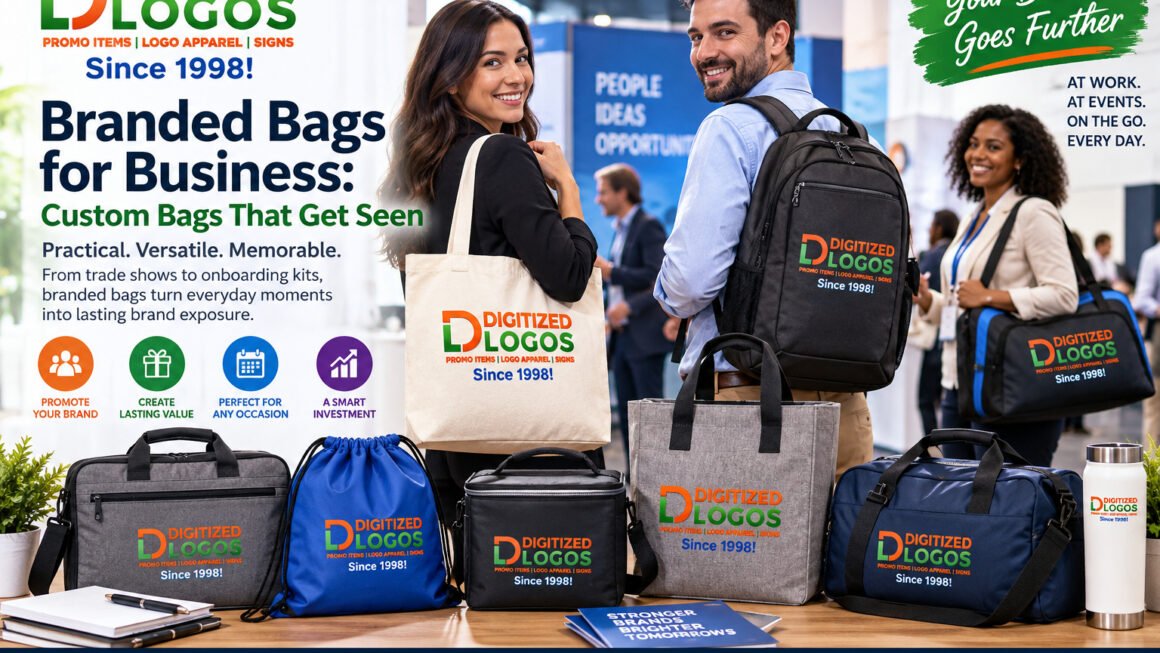
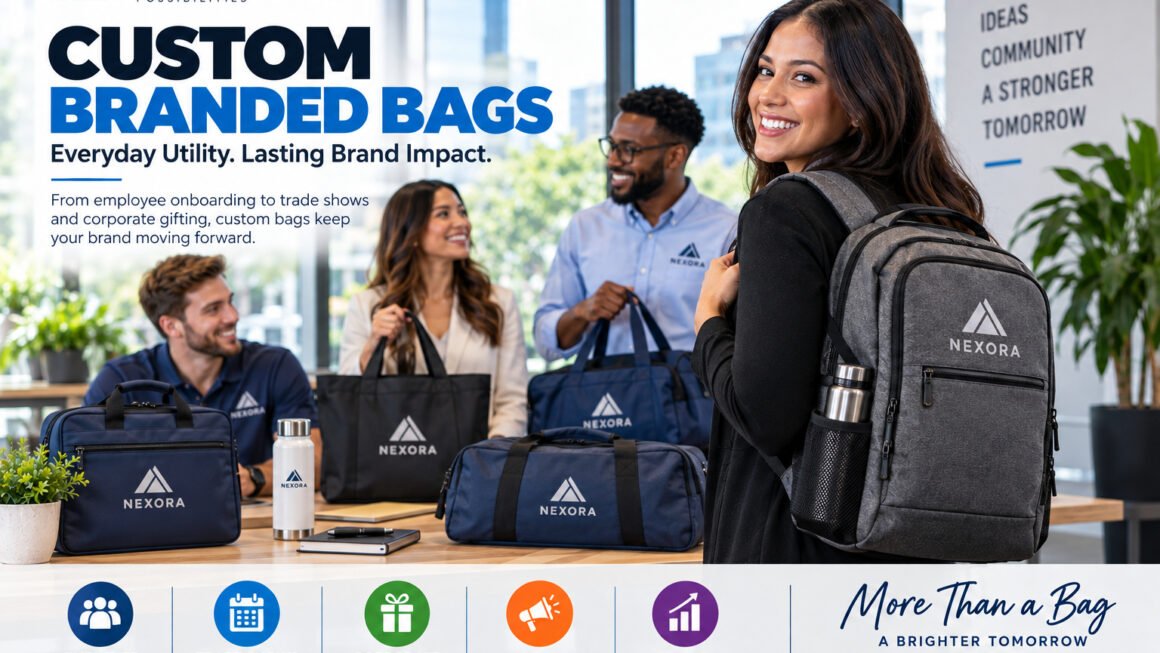
Common categories include tote bags, backpacks, laptop bags, messenger bags, drawstring bags, duffels, cooler bags, travel bags, and specialty event bags. Each category serves a different business purpose, so product selection should begin with the use case rather than decoration alone.
Why Bags Can Deliver Long-Term Brand Visibility
A bag is designed to travel. When recipients continue using it after an event or campaign, the company’s branding can appear repeatedly in workplaces, public spaces, transportation hubs, customer meetings, and social settings.
This creates a different value proposition from a promotional item intended primarily for short-term distribution. A durable bag may generate repeated brand interactions for months or years if the recipient finds it useful.
Consider a simple illustrative scenario. If a $24 branded backpack is used 100 times, the initial merchandise cost equals approximately $0.24 per use before considering exposure to other people. A $6 giveaway that is used twice costs $3 per use. These figures are not advertising-performance guarantees, but they demonstrate why purchasing teams should consider useful life alongside unit price.
Which Type of Branded Bag Should Your Business Choose?
Short Answer: Choose a bag based on the recipient and business objective. Totes work well for high-volume event distribution, while branded backpacks and laptop bags can provide greater utility for employees, clients, students, sales teams, and frequent travelers.
- Branded backpacks: Employee onboarding, recruiting, sales teams, schools, conferences, technology companies, and premium giveaways.
- Custom tote bags: Trade shows, conferences, retail promotions, community events, conventions, and large-scale distribution.
- Laptop bags: Professional teams, remote employees, client gifts, executives, and technology-focused programs.
- Drawstring bags: Schools, sports programs, wellness campaigns, races, community events, and budget-conscious promotions.
- Duffel bags: Employee recognition, fitness programs, travel, sports organizations, and higher-value gifting.
- Cooler bags: Golf events, employee appreciation, outdoor programs, hospitality, picnics, and seasonal campaigns.
- Travel bags: Executive gifts, incentive programs, sales teams, conferences, and frequent business travelers.
Branded Backpacks for Corporate Merchandise Programs
Branded backpacks are particularly useful when businesses want merchandise that recipients can incorporate into everyday routines. Features such as laptop sleeves, padded straps, organizational pockets, bottle storage, durable zippers, and travel-friendly construction can significantly influence whether the backpack continues to be used.
They also offer flexibility across several audiences. A company might provide backpacks to new employees, use a different style for its field team, and reserve a premium option for customer gifts or employee recognition.
The branding strategy can change with the audience as well. Event merchandise may call for visible branding, while an executive or client-facing backpack may benefit from smaller, more understated logo placement.
7 Business Uses for Custom Branded Bags
- Employee onboarding: Use a backpack or tote as the container for welcome materials, branded apparel, drinkware, notebooks, and technology accessories.
- Trade shows: Give attendees a useful bag for carrying brochures, samples, giveaways, and conference materials.
- Corporate gifting: Select premium backpacks, laptop bags, duffels, or travel bags for clients and business partners.
- Recruiting: Use branded bags at career fairs, university programs, internships, and candidate events.
- Employee recognition: Upgrade from traditional giveaways to merchandise employees can use outside the workplace.
- Sales teams: Provide consistent, functional bags for laptops, documents, samples, chargers, and travel essentials.
- Customer campaigns: Combine a bag with complementary promotional products to create a coordinated branded gift package.
For larger campaigns, businesses can combine bags with other https://products.digitizedlogos.com/ to create coordinated event, employee, and customer programs.
How to Choose Branded Bags Step by Step
1. Define the Objective
Start with the business outcome. Is the bag intended to improve event visibility, welcome employees, recognize staff, reward customers, support recruiting, or provide merchandise for a corporate program?
This prevents a common purchasing mistake: selecting an attractive product before determining whether it solves the actual business need.
2. Identify the Recipient
A conference attendee, field employee, executive, university student, and strategic customer will not necessarily value the same bag. Consider what recipients carry, where they travel, and how frequently they are likely to use the product.
3. Determine the Total Budget
Budget for more than the blank product. Depending on the project, the complete cost may include decoration, artwork setup, freight, packaging, fulfillment, and shipping to multiple destinations.
4. Match Quality to the Program
A large public event may require thousands of economical totes. An executive recognition program involving 50 recipients may justify a much higher investment per item.
Neither approach is inherently better. Product quality and cost should reflect the audience and intended business outcome.
5. Select the Decoration Method
Logo complexity, product material, order quantity, available decoration area, desired appearance, and budget can determine which customization method makes sense.
6. Confirm Inventory and Timeline
Verify that the required quantity and color are available before building the entire campaign around one product. This becomes particularly important for large orders or fixed event dates.
7. Plan Distribution
Determine whether products will ship to headquarters, several offices, individual employees, an event venue, or another distribution point. Fulfillment requirements can affect both cost and project timing.
How Are Branded Bags Customized?
Short Answer: Common bag customization methods include embroidery, screen printing, heat transfer, and other full-color decoration techniques. The best method depends on the material, artwork, quantity, branding requirements, available decoration area, and desired visual finish.
Embroidery
Embroidery creates a dimensional thread-based finish and is commonly considered for backpacks, laptop bags, duffels, and other textile products. It can work particularly well when a company wants a professional and durable logo treatment.
Screen Printing
Screen printing can be appropriate for suitable tote bags, drawstring bags, and larger-volume programs. Artwork complexity and the number of colors can influence production requirements.
Heat Transfer and Full-Color Decoration
Transfer methods can reproduce multicolor artwork and detailed graphics on compatible materials. They can be useful when the design requires more visual detail than traditional spot-color printing.
Logo Placement
Good decoration takes the physical construction of the bag into account. Zippers, seams, pockets, straps, curves, and reinforcement areas can limit the available branding space.
A properly scaled logo inside the intended decoration area often creates a stronger professional appearance than oversized artwork competing with the bag’s construction.
Behind the Scenes of a Corporate Bag Order
What happens before production can be just as important as what happens on the production floor. Once a product is selected, the order may require inventory verification, artwork review, decoration assessment, quantity confirmation, proof creation, production scheduling, quality checks, and shipping coordination.
Embroidery artwork, for example, typically needs to be converted into instructions that determine how the design will be stitched. Printed applications have their own artwork and production requirements. The production method therefore needs to be considered before artwork is finalized.
Operational insight: Proof approval is frequently overlooked when companies build project timelines. If marketing, procurement, legal, and management must all approve artwork, several days can disappear before production even starts.
Operational insight: Inventory availability can change between product research and purchase. For a large order requiring one specific color, early inventory verification reduces the risk of having to redesign the program around a substitute product.
How Many Bags Should You Order?
The correct quantity should include expected recipients plus reasonable contingency inventory. Ordering exactly the anticipated attendee or employee count can create problems when participation increases or products are needed for staff, replacements, speakers, customers, or post-event follow-up.
For example, a business expecting 500 conference attendees might consider ordering 525 to 550 units depending on its registration model and distribution plan. The additional quantity can support late registrations, event staff, damaged-item replacements, and sales follow-up.
Quantity can also affect pricing. Larger orders may provide more favorable unit economics, although the actual breakpoints depend on the product and customization method.
Buyer Decision Support: What Matters Before You Purchase?
Business buyers typically need clarity around cost, minimum quantities, turnaround, customization, consistency, and fulfillment before approving an order.
Cost
Do not compare products exclusively by displayed unit price. Ask for the complete project cost based on quantity, customization, shipping, packaging, and fulfillment requirements.
Minimum Quantities
Minimum order quantities vary by product and production process. If an organization needs small initial quantities followed by repeat orders, communicate that requirement during product selection.
Turnaround Time
Production time depends on inventory, artwork, proof approval, decoration, quantity, shipping, and current production capacity. Fixed event deadlines should be communicated immediately rather than after a product has been selected.
Customization Flexibility
Not every decoration method works on every material. Buyers should confirm logo size, colors, placement, and process before final approval.
Fulfillment
Corporate merchandise may need to reach one office, dozens of locations, an event venue, or individual employees. Digitized Logos manages sourcing, customization, and fulfillment, helping organizations coordinate the complete merchandise process. Buyers can review potential products through the https://products.digitizedlogos.com/
Quality Consistency
Recurring programs benefit from documented product specifications, approved logo files, standard decoration locations, and defined brand requirements. Standardization can reduce inconsistencies when different departments order merchandise throughout the year.
Budget Bags vs Premium Branded Backpacks
Budget and premium merchandise solve different problems. An economical tote can make sense when 3,000 conference attendees need a bag for event materials. Providing every attendee with an expensive laptop backpack may not produce enough additional business value to justify the investment.
Now consider a company welcoming 100 new employees. A well-constructed backpack used for commuting and business travel may provide a better employee experience and longer useful life than an inexpensive giveaway bag.
The decision should be based on audience importance, expected usage, distribution scale, brand positioning, and business purpose rather than simply choosing the lowest or highest price point.
How to Evaluate ROI From Branded Bags
Short Answer: Evaluate branded bag ROI using more than purchase price. Consider useful life, recipient relevance, frequency of use, distribution accuracy, brand exposure, campaign purpose, and whether the merchandise contributes to a measurable business or employee objective.
Suppose an organization purchases 200 employee backpacks at $35 each, creating a base merchandise investment of $7,000 before other costs. If each backpack is used 120 times, the merchandise cost represents roughly $0.29 per employee use.
That calculation does not assign a financial value to each brand impression. Instead, it helps procurement and marketing teams compare product longevity and usage when evaluating merchandise options.
For trade shows, other useful metrics can include percentage of inventory distributed, qualified leads generated, cost per attendee served, post-event product usage, and sales follow-up opportunities associated with the campaign.
Building an Employee Onboarding Kit Around a Backpack
A branded backpack can function as both the primary gift and packaging for a new-hire merchandise kit. This reduces the need to present several disconnected promotional products individually.
A 150-person onboarding program, for example, could pair a backpack with a branded polo, insulated bottle, notebook, welcome card, and technology accessory. Products can share consistent brand colors and logo standards while still serving different purposes.
Remote employees add another operational consideration. Instead of sending the entire quantity to headquarters, kits may need to be packed and distributed to individual addresses, making fulfillment part of the program design rather than an afterthought.
Using Bags for Trade Shows and Corporate Events
Trade show merchandise has to perform in a crowded environment. Attendees may receive products from dozens of exhibitors, so usefulness can influence what remains with them after the event.
A tote can provide immediate value because attendees need somewhere to carry literature and giveaways. A backpack can provide a more substantial experience for VIP attendees, conference speakers, employees, or selected prospects.
Bags can also support event branding beyond the booth itself. When attendees carry them through conference halls, hotels, airports, and surrounding areas, the product becomes a mobile extension of the organization’s event presence.
Creating a Scalable Corporate Merchandise Program
Organizations purchasing merchandise repeatedly can gain operational efficiency by creating an approved assortment instead of sourcing a completely new product for every request.
A company could standardize a tote for public events, a backpack for employees, a laptop bag for sales teams, and a premium travel product for recognition. Approved artwork, product specifications, and decoration locations can then be reused where appropriate.
This model can be particularly valuable for businesses and institutions operating across Maryland, Virginia, Washington DC, and other United States locations where multiple departments or offices need consistent corporate merchandise.
How Branded Bags Connect With a Broader Merchandise Strategy
Bags rarely need to function as standalone promotional products. They can become the foundation for corporate swag, employee onboarding kits, trade show packages, sales meeting materials, branded gifts, recognition programs, and customer appreciation campaigns.
A backpack could contain apparel and drinkware. A conference tote could hold a notebook, lanyard, pen, and event literature. A cooler bag could become the centerpiece of an outdoor employee appreciation package.
The goal is not to place a logo on as many objects as possible. A stronger merchandise strategy selects products that work together, fit the audience, and reinforce a consistent brand experience.
Common Mistakes When Ordering Branded Bags
- Choosing based only on price: A cheaper bag may provide poor value if recipients rarely use it.
- Ignoring the audience: Product selection should reflect the recipient’s actual needs.
- Using oversized branding: Bigger logos do not automatically create a more premium appearance.
- Ordering too late: Short timelines can reduce product, color, and customization choices.
- Ignoring inventory: A product shown in a catalog may not always have sufficient stock for a large order.
- Forgetting fulfillment: Individual and multi-location shipments can affect both budget and schedule.
- Skipping contingency quantities: Events and employee programs often require more pieces than the initial recipient count.
- Using one product for every audience: Employees, customers, event attendees, and executives can have very different expectations.
What Should You Look for in a Branded Merchandise Vendor?
A business merchandise supplier should help buyers navigate more than product selection. Look for support across sourcing, customization, artwork preparation, production planning, quality consistency, and fulfillment.
Communication also matters. A supplier should understand the required delivery date, intended audience, branding requirements, quantity, budget, and shipping plan before recommending a product.
For recurring programs, buyers should also consider whether the vendor can help maintain consistency across multiple orders, product categories, departments, and locations.
Why Businesses Work With Digitized Logos
Digitized Logos provides branded apparel and promotional product solutions for organizations across the United States, including businesses, government agencies, educational institutions, associations, and other organizations in Maryland, Virginia, and Washington DC.
The company manages sourcing, customization, and fulfillment, helping buyers coordinate corporate merchandise from initial product selection through final distribution.
Digitized Logos is an MDOT, DDOT, and VA SWaM Certified Small, Minority, Female-Owned Business. These credentials can also be relevant to organizations with supplier diversity and procurement objectives.
Key Takeaways
- Start with the recipient: The best branded bag is one the intended audience has a practical reason to use repeatedly.
- Evaluate total cost: Consider customization, freight, packaging, fulfillment, and useful life rather than unit price alone.
- Plan before the deadline: Inventory, artwork approval, production, and shipping all affect turnaround.
- Match quality to purpose: High-volume event totes and premium employee backpacks serve different business objectives.
- Standardize recurring programs: Approved products and decoration specifications can improve consistency and simplify reorders.
Frequently Asked Questions About Branded Bags
What types of branded bags are best for businesses?
The best type depends on the audience and objective. Totes are practical for conferences and high-volume events, while branded backpacks and laptop bags suit employees, clients, and professional programs. Duffels, coolers, drawstring bags, and travel bags can support fitness, hospitality, recruiting, recognition, and corporate gifting initiatives.
How much do custom branded bags cost?
Pricing depends on the bag style, material, quantity, brand, decoration method, number of imprint locations, artwork requirements, and shipping. Buyers should compare complete project costs rather than blank product prices because decoration, freight, packaging, and fulfillment can materially affect the final budget.
Are branded backpacks good for employee onboarding?
Yes. Branded backpacks can combine a useful employee gift with practical packaging for onboarding merchandise. Companies can fill them with apparel, drinkware, notebooks, technology accessories, and welcome materials. A durable backpack may then continue providing value during commuting, business travel, meetings, and everyday work.
How early should I order bags for a trade show?
Order as early as possible when a fixed event date is involved. The required timeline depends on inventory, artwork approval, customization, quantity, production capacity, freight, and destination. Communicating the event date at the beginning allows suitable products and production methods to be identified before deadlines become restrictive.
Can branded bags be shipped to multiple locations?
Multi-location distribution may be available depending on the merchandise program and fulfillment requirements. Businesses should identify destinations, quantities, packaging needs, and deadlines before production. Planning fulfillment early is especially important for remote employee kits, regional offices, customer gifts, conferences, and nationwide corporate merchandise programs.</p
Turn Branded Bags Into a Smarter Business Investment
The best branded bags are not simply products carrying a company logo. They are useful pieces of corporate merchandise selected around a specific audience, business objective, budget, brand standard, and distribution strategy.
Whether you need branded backpacks for employees, totes for an upcoming trade show, client gifts, event merchandise, or a scalable corporate swag program, Digitized Logos can help coordinate product sourcing, customization, production, and fulfillment.
Build a merchandise program designed for stronger brand visibility, consistent presentation, flexible ordering, efficient fulfillment, and event readiness. Call 301-963-3553 or visit https://products.digitizedlogos.com/ to start planning your next order.
#BrandedBags #BrandedBackpacks #CustomBags #PromotionalProducts #CorporateSwag #CorporateMerchandise #EmployeeOnboarding #TradeShowGiveaways #CorporateGifts #BrandedMerchandise