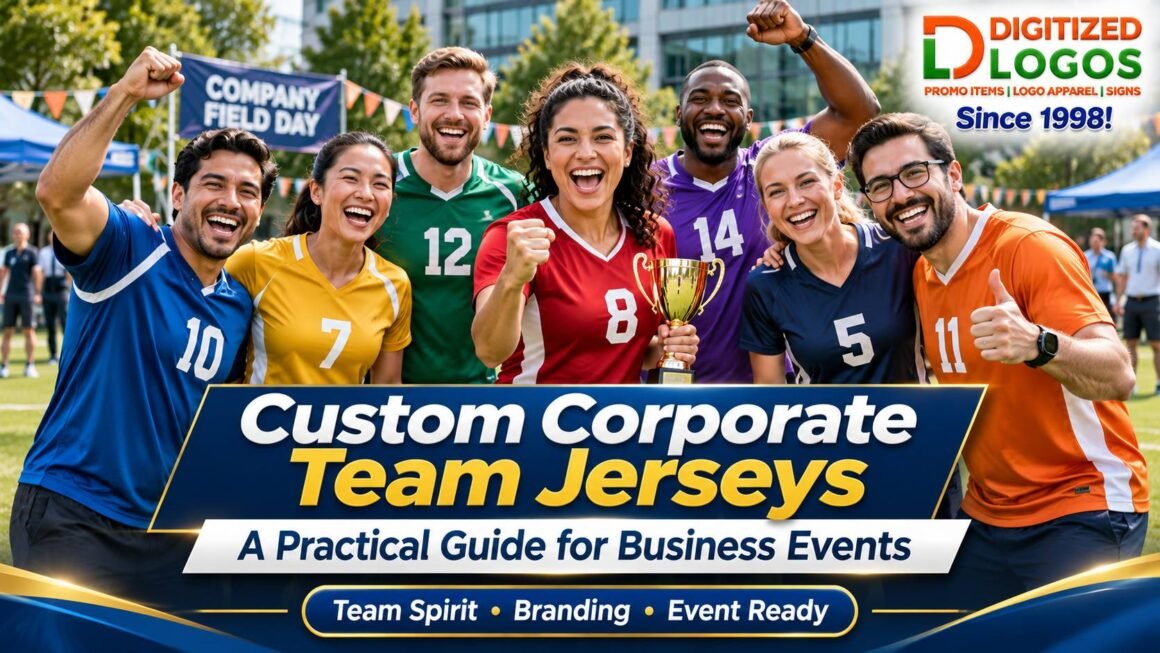
Corporate team jerseys can turn an ordinary company activity into a more organized, recognizable, and engaging experience. From employee sports tournaments to charity fundraisers and company competitions, coordinated jerseys help participants identify their teams while representing the organization’s visual identity.
Choosing custom corporate team jerseys involves more than selecting colors and adding a company logo. Business buyers must consider fabric performance, decoration methods, size availability, artwork requirements, production schedules, and distribution. A well-planned jersey program should meet the practical needs of participants while supporting the company’s branding goals.
This guide explains how businesses can select, customize, and coordinate corporate jerseys for different events, including the purchasing decisions that can affect comfort, appearance, and overall project execution.
What Are Custom Corporate Team Jerseys?
Custom corporate team jerseys are branded athletic-style garments designed for employees, company-sponsored teams, event participants, and organizational groups. They typically incorporate company colors, logos, team names, player numbers, or personalized names.
Unlike standard office uniforms, corporate jerseys are generally intended for active participation, recreational events, and occasions where team identification is useful. Their construction and decoration can vary depending on the activity, desired appearance, and budget.
Quick Answer: How Should Businesses Choose Corporate Team Jerseys?
Businesses should choose corporate team jerseys based on the event’s activity level, expected wearing conditions, branding requirements, participant sizes, available budget, and delivery deadline. Lightweight performance fabrics may be appropriate for active events, while other knit materials may suit casual gatherings. Buyers should also verify customization capabilities, artwork specifications, minimum quantities, and production requirements before approving an order.
Why Businesses Use Custom Corporate Team Jerseys
Corporate jerseys serve several practical purposes beyond creating a coordinated appearance. They can help organizers identify participants, distinguish competing teams, and create merchandise that employees may continue using after an event.
Team Identification and Coordination
Color-coded jerseys can help distinguish departments, participating groups, and company-sponsored teams. During tournaments or large company activities, this visual separation makes it easier for organizers and participants to recognize different teams.
Brand Visibility at Organized Events
A company logo displayed on a jersey connects participating employees with the organization. This can be useful during community tournaments, charity events, employee activities, and company-sponsored competitions.
However, visibility alone does not establish a measurable marketing return. Any business value depends on factors such as event attendance, garment use, audience relevance, and overall program objectives.
Employee Participation and Shared Identity
Coordinated apparel can contribute to a sense of shared identity during group activities. Jerseys give participants a visible connection to their team, although employee engagement ultimately depends on the broader event experience and organizational culture.
Reusable Event Merchandise
When jerseys are comfortable, durable, and visually appealing, employees may choose to wear them for future recreational activities. Selecting versatile designs can make the garments more useful beyond a single company event.
Popular Uses for Corporate Team Jerseys
Different business activities require different jersey features. Understanding the event environment helps buyers avoid choosing apparel based on appearance alone.
Corporate Sports Tournaments
Company basketball, softball, volleyball, soccer, and recreational sports tournaments are natural applications for custom jerseys. Teams may require distinctive colors, player numbers, and breathable fabrics suitable for movement.
For more competitive activities, organizers should consider whether the selected garments comply with applicable league or tournament rules concerning numbers, colors, and uniform design.
Employee Appreciation and Team-Building Events
Businesses may use branded jerseys during company field days, departmental competitions, and employee appreciation activities. Names, department identifiers, and event graphics can give each participant a more personalized garment.
Charity Runs and Community Fundraisers
Company-sponsored participation in charity runs, walks, and recreational fundraisers provides another opportunity for coordinated apparel. Lightweight materials and comfortable fits are particularly relevant when employees will be physically active.
Company Milestones and Internal Celebrations
Anniversary celebrations, company outings, and internal competitions can incorporate event-specific jersey designs. The organization may choose understated branding for continued use or more prominent event graphics when the garments are intended as commemorative merchandise.
Multi-Location Employee Programs
Organizations with several offices may coordinate jersey designs across regional teams. Standardized artwork, approved colors, and consistent garment specifications can help maintain a recognizable appearance even when items are distributed to different locations.
How to Select the Right Custom Corporate Team Jerseys
The most effective selection process begins with the intended use rather than the decoration method. Buyers should establish what participants will be doing, how long they will wear the garments, and which customization features are necessary.
1. Choose a Fabric That Matches the Activity
Fabric selection affects breathability, comfort, care requirements, and garment appearance.
- Polyester performance fabrics: Commonly used for athletic apparel because they can be lightweight and suitable for active use. Moisture-management performance depends on the specific fabric and construction.
- Polyester mesh: Can provide additional airflow through its open-knit structure, making it relevant for certain sports applications.
- Cotton blends: May offer a softer casual feel for less physically demanding activities. Performance and drying characteristics vary by composition.
- Specialized performance knits: May incorporate stretch, ventilation, or other features depending on the garment specifications.
Rather than assuming every performance jersey has identical properties, review the specific garment’s fabric composition, weight, construction, and care instructions.
2. Evaluate Fit and Size Availability
A jersey that looks attractive in a product image may not fit every participant comfortably. Businesses should review available size ranges, garment measurements, intended fit, and whether separate cuts are needed for different employee preferences.
For large events, collecting size information before production reduces the risk of incorrect quantities. A size chart should be shared with participants rather than relying exclusively on familiar labels such as small, medium, or large.
3. Decide Where Branding Should Appear
Common decoration positions include the center chest, left chest, upper back, sleeves, and other locations permitted by the garment design.
The ideal placement depends on logo proportions, jersey construction, readability, and whether names or player numbers will also appear. A large company emblem may work well on the front, while smaller identifiers may be more suitable for sleeves.
4. Confirm Personalization Requirements
Businesses considering personalized team jerseys for company events should decide whether each garment requires an individual name, number, department, location, or team identifier.
Individual personalization adds another layer of production coordination. Names must be spelled correctly, numbers should be checked for duplication when required, and all participant information should correspond to the correct garment size.
5. Review the Complete Purchasing Budget
The total project budget may include more than the garment itself. Depending on the supplier and decoration method, relevant cost components can include artwork preparation, customization, individual personalization, setup, shipping, and distribution.
Request an itemized quotation based on the actual specifications. Do not assume that two visually similar jerseys will have equivalent pricing or decoration requirements.
Customization Methods for Corporate Team Jerseys
Different decoration methods produce different visual and practical results. The best choice depends on the garment material, artwork, quantity, design complexity, and intended use.
Dye Sublimation
Dye sublimation uses heat to transfer specialized dyes into compatible polyester-based materials or coatings. On appropriate performance fabrics, it can support detailed graphics, gradients, and extensive color coverage.
Full-sublimation construction can incorporate artwork into large areas of a garment, including front panels, backs, and sleeves, depending on the product and manufacturing process.
This method is particularly relevant when businesses want multicolor team graphics or integrated designs that extend beyond a small printed logo. However, compatibility depends on the specific polyester material and manufacturing method.
Screen Printing
Screen printing applies ink through a prepared screen onto garment surfaces. It can be suitable for simple logos and graphics, particularly when the artwork and quantity justify the setup requirements.
Buyers should confirm how many print colors are required, whether the chosen fabric is compatible, and how the supplier calculates setup and production charges.
Heat Transfer Printing
Heat transfer methods apply prepared graphics to garments using heat and pressure. Depending on the transfer system, they can be useful for logos, names, numbers, and other event-specific details.
Transfer compatibility, finish, stretch, and care requirements vary. Businesses should request information about the selected decoration process rather than treating all heat transfers as interchangeable.
Embroidery
Embroidery creates designs using stitched thread. It may be appropriate for certain structured or heavier garments, but dense stitching can affect the flexibility and feel of lightweight athletic materials.
For performance jerseys, embroidery suitability should be evaluated against fabric weight, design size, backing requirements, and comfort.
Which Decoration Method Is Best for Company Jerseys?
There is no universally superior method for every corporate jersey project. Dye sublimation is often worth evaluating for detailed designs on compatible polyester garments. Screen printing can work for simpler printed graphics, while suitable transfer methods may support individual names and numbers.
The final decision should consider design complexity, fabric compatibility, decoration durability, quantity, budget, and the supplier’s available production capabilities.
How to Prepare Company Artwork for Jersey Production
Artwork preparation is one of the most frequently overlooked parts of custom apparel purchasing. A design that looks acceptable on a computer screen may require adjustment before it can be reproduced properly on fabric.
For example, a company logo with thin lettering may lose clarity when reduced to a small chest placement. Similarly, a detailed multicolor graphic may require a different decoration approach than a simple one-color emblem.
For an efficient artwork approval process:
- Collect approved brand assets. Use the official company logo and current branding guidelines.
- Provide suitable artwork files. Vector files such as AI, EPS, or vector PDF are often useful for scalable graphics. Exact requirements depend on the production method.
- Specify intended placement. Identify the front, back, sleeves, and any individual personalization areas.
- Confirm colors. Supply brand color references and discuss possible differences between digital previews and finished textile decoration.
- Review the production proof. Check placement, dimensions, spelling, and graphic proportions before authorization.
- Maintain an approved reference. Keep the final proof and specifications for future orders or additional locations.
For full-sublimation jerseys, panel layouts and garment construction also matter. Artwork crossing seams may not align exactly as it appears on a flat digital layout, and print placement can vary slightly during manufacturing. Buyers should review the supplier’s production tolerances when precise alignment is important.
Corporate Jersey Design Ideas That Work for Business Events
Effective corporate jersey design balances brand recognition with practical wearability. Excessive graphics can reduce readability, while overly minimal designs may fail to distinguish teams.
Department-Based Jersey Designs
Use a consistent logo placement while assigning different colors to departments such as sales, marketing, operations, and customer support. This approach creates visual differentiation without requiring unrelated designs for each group.
Company Anniversary Jerseys
Incorporate an anniversary year or approved commemorative graphic while retaining the company’s primary brand elements. Buyers should consider how much event-specific text is appropriate if employees may wear the garments after the celebration.
Personalized Employee Jerseys
Individual names and player numbers can make jerseys feel more specific to participants. Establish a uniform text style and maximum character length to maintain consistency across the program.
Minimal Corporate Athletic Designs
A solid base color, contrasting accents, and a clearly positioned company logo can create a professional athletic appearance. This approach may be useful when the same jersey design will be reused for multiple activities.
Ordering Custom Corporate Team Jerseys: A Step-by-Step Process
A structured ordering process helps businesses coordinate employee information, supplier communication, and event deadlines.
- Define the event requirements. Record the activity, location, event date, intended participants, and expected garment use.
- Determine the quantity. Confirm participant counts and identify whether additional sizes or replacement units may be needed.
- Select garment specifications. Review fabric, fit, color, available sizes, and construction details.
- Prepare branding and personalization information. Supply approved artwork, names, numbers, and placement instructions.
- Request a detailed quotation. Confirm applicable minimum quantities, decoration charges, personalization fees, shipping, and other project costs.
- Review proofs or samples. Verify artwork accuracy and, where practical, evaluate a physical sample for fit, material, and appearance.
- Approve production. Confirm the final specifications and clarify when the production schedule begins.
- Coordinate delivery and distribution. Establish the receiving location, shipping instructions, and method for distributing jerseys to employees.
For a large personalized project, a spreadsheet containing each participant’s name, selected size, team assignment, and jersey number can help reduce data-entry errors. A designated coordinator should review the information before it is submitted to production.
Minimum Order Quantities and Turnaround Considerations
Minimum order quantities for corporate jerseys vary according to the garment, supplier, decoration process, and customization requirements. Some products may support smaller quantities, while others may require a minimum production run.
Production timelines also vary. A stock jersey with a relatively simple decoration may follow a different workflow than a fully customized jersey produced with individual names, numbers, and integrated graphics.
Before purchasing, ask the supplier to confirm:
- Minimum quantity for the selected garment and decoration method
- Whether individual names and numbers affect production requirements
- Artwork approval and sample requirements
- Estimated production time after final approval
- Shipping options and delivery expectations
- Whether additional jerseys can be produced later using the approved design
Buyers should build a reasonable planning margin into the schedule for artwork revisions, employee size corrections, and shipping uncertainty. No delivery deadline should be treated as confirmed until the supplier has verified it for the specific project.
Corporate Jersey Programs: Two Practical Business Examples
Example 1: A Company-Wide Employee Sports Tournament
Consider a hypothetical organization arranging a recreational tournament for 120 employees across six departments. Each department needs a distinct jersey color, while the company’s logo must remain consistent across the entire collection.
The purchasing coordinator could begin by collecting participant sizes, selecting one compatible jersey style, and assigning approved colors to each department. If names and numbers are required, a centralized personalization sheet could be used to confirm individual information.
Using one garment specification and consistent artwork placement would simplify proof review and help organizers distribute jerseys by department. This is an illustrative planning example, not a reported Digitized Logos customer project.
Example 2: A Multi-Office Corporate Charity Event
Imagine a business with employees from three regional offices participating in a community charity run. The organization wants a unified jersey design while allowing each office to display its location name.
A practical solution would be to establish a common jersey fabric, logo placement, and color scheme, then add approved location identifiers. The coordinator would gather quantities and sizes from each office and determine whether consolidated or separate shipments make more sense.
This approach illustrates how consistent specifications and organized fulfillment planning can support a multi-location apparel program without requiring a different design process for every office.
Common Mistakes to Avoid When Buying Corporate Jerseys
Choosing Appearance Without Considering Performance
A jersey intended for an outdoor summer activity should be evaluated differently from one used for an indoor company celebration. Garment material, ventilation, fit, and comfort should reflect the event’s actual conditions.
Submitting Incomplete Personalization Information
Missing sizes, inconsistent name formatting, and incorrect player numbers can create production complications. Establish a final data-review process and clarify whether changes are permitted after artwork approval.
Using Low-Resolution Artwork
Small raster images can produce poor results when enlarged. Where possible, provide original vector artwork and allow the supplier to assess whether the files meet production requirements.
Approving a Design Without Reviewing Its Layout
Logos and graphics can appear differently on a finished garment than on a flat digital image. Review artwork proportions, seams, neckline placement, and garment dimensions before finalizing the design.
Ignoring the Reorder Process
Businesses sometimes focus exclusively on the first event. If jerseys may be needed again, ask whether the garment style, approved artwork, and personalization format can be reused. Future material availability and design consistency should be confirmed rather than assumed.
How to Evaluate a Supplier for Corporate Team Jerseys
Supplier selection should consider more than the quoted unit price. Business buyers benefit from clear technical communication, accurate artwork review, documented specifications, and reliable coordination throughout the purchasing process.
When evaluating custom corporate team jerseys, ask potential suppliers how they handle garment selection, personalization files, proof revisions, minimum quantities, quality concerns, and multi-location delivery.
It is also useful to determine whether the supplier can explain why a particular garment and printing method suit the intended event. Recommendations grounded in fabric compatibility and practical use are more informative than broad claims about quality.
Planning Corporate Jersey Costs and Business Value
The total cost of a corporate jersey program depends on garment selection, quantity, decoration, personalization, fulfillment, and shipping. An appropriate budget should consider the full delivered project rather than comparing garment-only prices.
For example, a business evaluating two jersey options should compare the total expenditure under the same assumptions, including employee personalization and delivery to the event location. A lower initial unit price does not necessarily produce a lower overall program cost.
Businesses may evaluate the value of the jerseys through participant feedback, continued garment use, event organization, and whether the merchandise fulfills its intended branding or operational purpose. These outcomes are context-dependent and should not be interpreted as guaranteed financial returns.
Key Takeaways for Business Buyers
- Choose corporate jerseys according to event requirements, expected activity levels, and participant comfort.
- Confirm fabric compatibility before selecting dye sublimation, screen printing, heat transfers, or embroidery.
- Use accurate sizing information, approved artwork, and carefully reviewed personalization data.
- Evaluate the total project cost, including customization, shipping, and distribution requirements.
- Coordinate supplier approvals and delivery planning early, especially for large or multi-location events.
Frequently Asked Questions About Corporate Team Jerseys
What information is needed to order custom corporate team jerseys?
Businesses should prepare the approximate quantity, event date, preferred jersey style, size requirements, company artwork, decoration locations, and any individual names or numbers. The supplier may also need delivery addresses, design preferences, and budget information. Complete specifications help establish an accurate quotation and production plan.
Can corporate team jerseys include employee names and numbers?
Many customizable jersey styles can support individual names and numbers, depending on the garment and decoration method. Buyers should verify the specific personalization options, character limitations, placement requirements, and applicable charges. An approved participant list is recommended to reduce spelling and assignment errors.
What material is suitable for corporate sports jerseys?
Polyester performance fabrics are commonly considered for active team jerseys because suitable constructions can provide lightweight comfort and moisture management. However, not every polyester jersey performs identically. Fabric weight, knit structure, fit, and intended activity should guide the decision. Request product specifications or samples when available.
How far in advance should a company order custom jerseys?
Businesses should begin planning early enough to accommodate product selection, artwork preparation, proof approval, production, shipping, and possible revisions. Exact lead times depend on garment availability, order quantity, customization complexity, and supplier capacity. Confirm the project-specific schedule before committing to an event delivery date.
Can businesses reorder the same corporate jersey design later?
Reorders may be possible when the supplier retains approved artwork and the required garment or suitable alternative remains available. However, colors, fabrics, fit, and decoration specifications may change over time. Businesses planning recurring events should preserve design records and confirm reorder conditions before the initial purchase.
Explore Custom Corporate Team Jerseys With Digitized Logos
Corporate jerseys are most effective when the design, fabric, personalization, and purchasing process are aligned with the event’s actual needs. Careful planning helps businesses avoid unnecessary revisions while creating branded apparel that participants can comfortably wear.
Digitized Logos provides branded apparel and promotional product solutions for business customers. Organizations exploring custom jerseys can review potential merchandise options and discuss their artwork, customization, quantity, and fulfillment requirements before making purchasing decisions.
Explore custom corporate team jerseys and related branded merchandise through Digitized Logos to begin evaluating options for your next company activity.
Contact Digitized Logos: Call 301-963-3553 or email Info@DigitizedLogos.com to discuss your corporate apparel requirements, design preferences, and event planning needs.