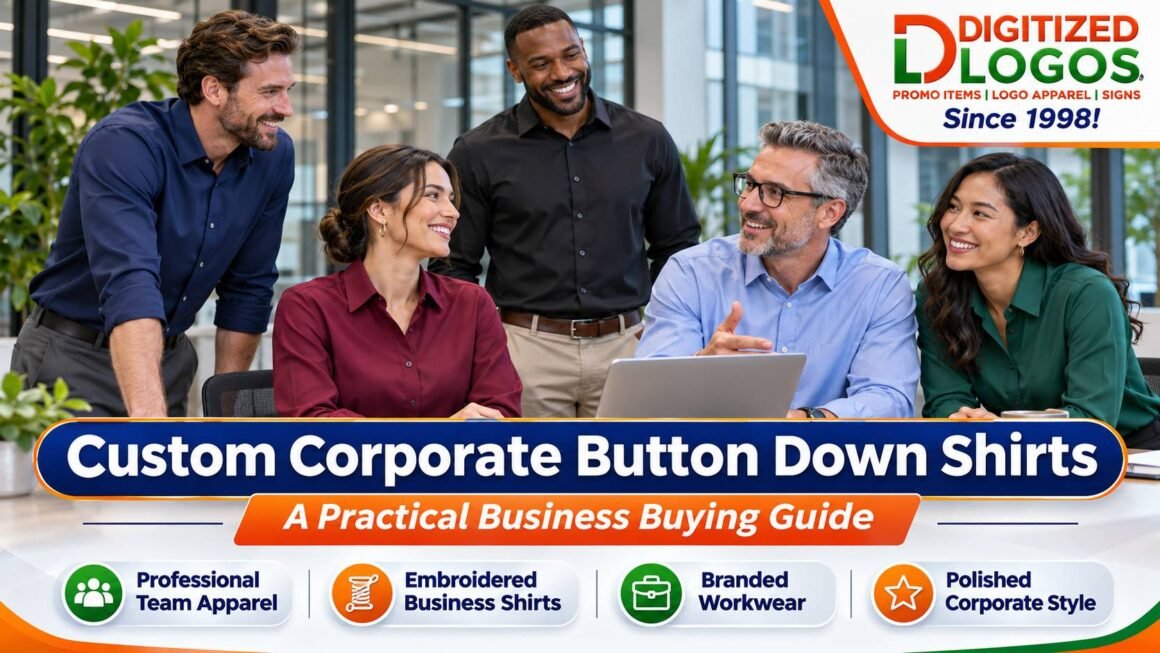
Professional apparel plays an important role in how a business presents itself. From client meetings and corporate events to everyday office operations, the clothing employees wear can reinforce brand identity while supporting a consistent, polished appearance.
Custom corporate button down shirts offer businesses a practical way to combine professional workwear with company branding. Available in different fabrics, fits, sleeve lengths, and decoration styles, these shirts can be customized to reflect an organization’s visual identity and workplace requirements.
However, selecting the right corporate shirt involves more than choosing a color and adding a logo. Fabric performance, embroidery placement, sizing, durability, employee comfort, and ordering logistics can affect the success of a branded apparel program.
This guide explains how businesses can evaluate custom button down shirts, choose appropriate decoration methods, prepare artwork, and manage purchasing decisions with greater confidence.
What Are Custom Corporate Button Down Shirts?
Custom corporate button down shirts are professional shirts personalized with a company’s logo, name, or other approved branding elements. Businesses commonly use them as employee uniforms, office attire, event apparel, and client-facing workwear.
In business apparel catalogs, the term often includes both traditional button-down collar shirts and button-front dress shirts with other collar styles.
Corporate button down shirts typically feature structured collars, front button closures, and woven fabrics. Depending on the garment, customization may include embroidered logos, employee names, or other decorative details.
Unlike casual promotional T-shirts, button down shirts provide a more structured appearance, making them particularly relevant for organizations that want professional attire without requiring formal business suits.
Why Businesses Choose Custom Button Down Shirts
Branded button down shirts serve several business purposes. They help establish visual consistency, simplify workplace dress expectations, and make employees easier to recognize in customer-facing environments.
Professional Brand Presentation
A coordinated apparel program can help teams maintain a consistent appearance across departments and locations. When company colors, logos, and garment styles are applied consistently, employees represent a recognizable visual identity.
Employee Identification
In hotels, offices, showrooms, and corporate events, branded shirts can help customers identify employees. This is particularly useful in environments where staff members regularly interact with visitors.
Practical Workplace Attire
Corporate shirts can establish a professional dress standard while giving employees practical clothing options. Depending on the fabric and fit, button down shirts may be appropriate for extended workdays, meetings, presentations, and daily office activities.
Brand Consistency Across Locations
Organizations operating multiple offices or branches can use standardized apparel specifications to maintain a consistent appearance. Documenting approved shirt styles, colors, embroidery designs, and placement guidelines also makes future reorders easier to coordinate.
How to Choose the Right Corporate Button Down Shirts
The best shirt for a corporate apparel program depends on how employees will use it. A shirt selected for occasional executive meetings may have different requirements from one worn during daily hospitality operations.
Before selecting products, businesses should consider the following factors:
- Work environment: Determine whether employees work primarily in offices, customer-facing locations, or environments requiring frequent movement.
- Fabric: Evaluate comfort, breathability, appearance, and maintenance requirements.
- Fit: Consider the size range and available fit options for different employees.
- Brand compatibility: Choose garment colors that complement the company’s visual identity.
- Decoration: Confirm that the selected fabric and shirt construction support the intended logo application.
- Care requirements: Consider washing, pressing, and long-term garment maintenance.
- Reordering: Ask about style continuity, replacement availability, and future purchasing requirements.
Making these decisions before production helps reduce sizing problems, inconsistent decoration, and unnecessary replacement purchases.
Choosing the Best Fabric for Corporate Button Down Shirts
Fabric selection influences how a shirt looks, feels, performs, and responds to decoration. Businesses should compare fabric composition and construction rather than selecting garments based only on product photographs.
100% Cotton Shirts
Cotton button down shirts are often selected for their natural fiber feel and breathability. They can be suitable for professional environments where comfort and a traditional woven appearance are priorities.
However, cotton fabrics may require ironing and can be more susceptible to wrinkling than some blended alternatives. Shrinkage behavior depends on the fabric construction, finishing, and care instructions.
Cotton-Polyester Blend Shirts
Cotton-polyester blends combine characteristics of both fibers. Depending on the formulation and finish, these fabrics may provide improved wrinkle resistance, easier maintenance, or greater shape retention compared with certain all-cotton alternatives.
They can be practical for employee uniform programs where shirts are worn and washed frequently.
Performance and Easy-Care Fabrics
Some corporate shirts use performance-oriented materials or specialized finishes designed to improve moisture management, wrinkle resistance, or ease of care.
These features vary by manufacturer. Buyers should review the individual garment specifications before assuming that a particular shirt provides moisture-wicking, stretch, stain resistance, or other performance properties.
Oxford, Poplin, and Twill Weaves
Fabric weave also affects the appearance and feel of corporate shirts.
- Oxford: Commonly associated with a textured, slightly substantial appearance suitable for business casual settings.
- Poplin: Generally provides a smooth, lightweight woven appearance that works well for dress shirts.
- Twill: Features a diagonal weave structure and can offer a distinctive drape and appearance.
No single fabric is ideal for every organization. The most practical choice balances professional appearance, employee comfort, care requirements, and the intended decoration method.
Embroidered Button Down Shirts With Business Logo
Embroidery is a widely used decoration method for corporate button down shirts because it creates a stitched design directly on the garment. It is often appropriate for company logos, employee identification, and professional uniform programs.
Businesses exploring embroidered button down shirts with business logo should evaluate the artwork, placement, fabric, and stitching requirements before approving production.
Why Embroidery Works for Corporate Apparel
Embroidery creates a textured finish that can complement structured woven shirts. It is particularly useful for logos containing distinct shapes, readable lettering, and a manageable number of colors.
However, embroidery is not suitable for every design. Very small text, intricate gradients, and extremely fine details may need to be simplified for accurate stitching.
Common Corporate Logo Placement Options
Left chest: A popular placement for corporate logos because it is visible without dominating the garment.
Right chest: May be used for employee names, departments, or secondary identifiers.
Sleeve: Can accommodate smaller branding elements when the garment construction and embroidery area permit.
Collar or cuff: May work for subtle designs, although available decoration space and garment construction can limit customization.
Businesses should request artwork placement confirmation before production. A logo that looks balanced on a computer mockup may appear different on an actual shirt because of garment size, seams, pockets, and fabric movement.
What Happens During the Embroidery Process?
Understanding the production process helps buyers recognize why embroidery requires more preparation than simply uploading a logo.
Step 1: Artwork Review
The supplier reviews the company logo to determine whether it can be reproduced through embroidery. Clear vector artwork is generally helpful because it provides defined shapes and design details.
Step 2: Embroidery Digitizing
The artwork is converted into a stitch file that guides the embroidery machine. This process, called digitizing, determines stitch direction, density, sequence, and other production characteristics.
A digital embroidery file is different from a standard image file. Simply enlarging a low-resolution logo does not automatically make it suitable for embroidery.
Step 3: Garment and Stabilizer Selection
The shirt fabric, weave, and weight influence how embroidery should be applied. Appropriate stabilizers and machine settings help support the material during stitching.
Lightweight woven fabrics may require particular attention because excessive stitch density can cause puckering or distortion around the design.
Step 4: Sample or Production Approval
Where available, businesses can review a physical embroidery sample or production proof. This helps confirm logo proportions, thread colors, placement, and overall appearance.
Digital mockups are useful for planning, but they do not always represent exact thread texture, fabric behavior, or the final physical dimensions of a stitched design.
Step 5: Production and Quality Review
After approval, the shirts proceed through decoration and quality checks. Important inspection points include design placement, readable lettering, stitch consistency, and the condition of the garment surrounding the embroidery.
This preparation is especially valuable for organizations ordering shirts for multiple employees or locations.
Corporate Button Down Shirts for Different Industries
Different business environments require different combinations of appearance, comfort, and branding. Selecting shirts around actual job responsibilities is more effective than applying one garment style to every department.
Hospitality and Hotel Operations
Hotels and hospitality businesses may use coordinated button down shirts for front desk associates, concierge teams, administrative employees, and event personnel.
For example, a hypothetical hotel group could select a consistent shirt color and embroidered logo for guest-facing employees while allowing different approved fits and sleeve lengths. A centralized apparel specification would help individual properties maintain a coordinated appearance.
Corporate Offices and Professional Services
Consulting firms, technology companies, financial organizations, and administrative teams may choose branded button down shirts for meetings, presentations, onboarding, and company events.
For example, a hypothetical consulting company with several regional offices could develop an approved apparel collection containing long-sleeve and short-sleeve options. By standardizing the logo placement and thread colors, the company could give employees flexibility without losing visual consistency.
Real Estate and Property Management
Real estate professionals, leasing teams, and property management employees may wear branded button down shirts during property tours, open houses, office visits, and customer meetings.
A structured shirt with subtle embroidery can provide visible company identification while maintaining a professional appearance.
Trade Shows and Corporate Events
Button down shirts are useful for event representatives who need coordinated attire when speaking with prospective customers, partners, and industry professionals.
For event programs, buyers should consider whether shirts will be worn with jackets, tucked into trousers, or used in warm exhibition environments. These considerations affect the appropriate fabric, fit, and sleeve length.
Long-Sleeve vs. Short-Sleeve Corporate Shirts
Both sleeve styles can serve professional branding programs, but each is suited to different working conditions.
Long-Sleeve Button Down Shirts
Long-sleeve shirts generally provide a more traditional business appearance. They can be appropriate for formal meetings, administrative environments, executive apparel, and cooler indoor conditions.
Buyers should examine cuff construction, sleeve length availability, and how the garment fits beneath jackets or other outerwear.
Short-Sleeve Button Down Shirts
Short-sleeve shirts may provide greater comfort in warmer environments and during active work. They can be useful for hospitality employees, event teams, and business casual workplace settings.
Organizations can also offer both sleeve styles within the same uniform program, provided the shirt colors, branding, and overall appearance remain consistent.
How to Select the Right Size and Fit
One of the most common problems in corporate apparel purchasing is relying on general size labels without reviewing garment measurements.
A medium shirt from one manufacturer may fit differently from a medium shirt from another. Fit differences can also occur between classic, relaxed, modern, and tailored garment designs.
Businesses should review:
- Chest and body measurements
- Shoulder width and sleeve length
- Garment length
- Collar measurements where applicable
- Available fit options and size ranges
- Manufacturer-specific sizing charts
For larger programs, a size-sampling process can help employees choose suitable garments before the main purchase is finalized.
Organizations should also consider whether the chosen style offers an adequate range of sizes and fits to support their workforce.
How Much Do Custom Corporate Button Down Shirts Cost?
The cost of custom corporate button down shirts depends on the garment, decoration requirements, quantity, and fulfillment arrangements. There is no universal price because different combinations of these factors can produce significantly different quotes.
Important pricing variables include:
- Garment selection: Brand, fabric construction, features, and shirt style.
- Quantity: The number of shirts purchased and any applicable quantity pricing.
- Embroidery complexity: Logo dimensions, stitch requirements, and decoration locations.
- Artwork preparation: Potential digitizing or setup requirements.
- Additional personalization: Employee names, departments, or individual design variations.
- Fulfillment: Packaging, shipping destinations, and distribution arrangements.
- Production schedule: Any applicable requirements related to a specific delivery deadline.
Buyers should request an itemized quotation that identifies garment costs, decoration charges, setup fees where applicable, shipping, and any other relevant expenses.
Why the Lowest Unit Price Is Not Always the Best Value
Consider a hypothetical company comparing two shirt options. One has a lower initial price but requires more frequent replacement due to its suitability for the intended work environment. Another has a higher purchase price but may better meet the organization’s comfort and maintenance requirements.
The company should evaluate the expected cost over the period the shirts will be used, rather than comparing unit prices alone.
Actual value depends on garment performance, employee use, replacement frequency, and the company’s operational needs. Durability and cost savings should not be assumed without evidence.
Minimum Quantities and Production Timelines
Minimum order quantities vary by supplier, garment style, decoration method, and production arrangement. Some apparel programs may accommodate smaller purchases, while others require specific production quantities.
Businesses should confirm minimum quantities before selecting a garment, particularly when purchasing for small teams or making replacement orders.
Production timelines also vary based on inventory, artwork approval, embroidery requirements, purchasing volume, and shipping destinations.
For events or planned uniform launches, buyers should allow time for artwork review, product selection, sizing confirmation, production, and transportation.
Digitized Logos can be contacted to discuss specific product options and purchasing requirements. Minimum quantities, inventory, pricing, and delivery schedules should be confirmed for the selected products rather than assumed in advance.
How to Order Custom Corporate Button Down Shirts
A structured purchasing process helps businesses reduce avoidable mistakes and organize future reorders.
- Define the business requirements. Identify which employees will wear the shirts, the working environment, the required quantity, and the intended use.
- Choose garment specifications. Compare fabric composition, shirt colors, sleeve lengths, fits, and care instructions.
- Prepare approved branding files. Provide company logo artwork, brand colors, and any relevant identity guidelines.
- Select decoration locations. Determine where the embroidered logo, employee name, or other branding elements should appear.
- Review sizing requirements. Collect employee sizes using the applicable manufacturer’s size chart.
- Request pricing and production details. Confirm decoration charges, minimum quantities, artwork requirements, and expected fulfillment arrangements.
- Approve the design. Carefully review the proof or physical sample when available before authorizing production.
- Coordinate delivery and reorders. Confirm shipping details and retain the approved specifications for future purchases.
Businesses developing a branded workwear program can explore custom corporate button down shirts through Digitized Logos and discuss garment selection, branding, and fulfillment requirements.
Common Mistakes to Avoid When Ordering Branded Shirts
Choosing Shirts Based Only on Appearance
A garment may look attractive in a catalog but be unsuitable for frequent wear or the intended work environment. Review fabric, maintenance instructions, and sizing information before making a final decision.
Using Artwork That Is Too Detailed for Embroidery
Small lettering, complex gradients, and intricate graphics may not reproduce clearly as stitched designs. An embroidery review can help determine whether the artwork needs adjustment.
Ignoring Differences Between Garment Sizes
Using generic sizing assumptions may lead to shirts that fit poorly. Manufacturer-specific charts and sample garments can help reduce uncertainty.
Overlooking Reorder Consistency
Changing shirt brands, colors, or embroidery specifications between orders can create noticeable differences in an employee uniform program.
Retaining approved product identifiers, logo dimensions, thread references, and decoration placement specifications can support future consistency.
Waiting Until the Deadline to Begin
Custom apparel requires coordination between product selection, artwork preparation, approval, decoration, and delivery. Starting early provides more flexibility if changes are necessary.
Managing Corporate Apparel Across Multiple Locations
Businesses with employees in different offices or branches may benefit from a standardized apparel program rather than separate purchasing decisions at every location.
An organized program can define approved garments, colors, logo placements, employee eligibility, and ordering procedures.
For example, a multi-location organization could establish a central list of approved shirt styles while allowing each branch to request appropriate sizes and quantities.
Useful program controls include:
- Approved garment models and colors
- Standard embroidery artwork and placement dimensions
- Documented employee sizing information
- Department-specific apparel guidelines
- Reorder procedures and purchasing authorization
- Shipping and distribution instructions
These controls help reduce inconsistencies and make purchasing easier to manage as employee needs change.
Digitized Logos provides branded apparel and corporate merchandise solutions for business customers. Organizations can discuss sourcing, customization, and fulfillment requirements when planning coordinated employee apparel programs.
How to Care for Embroidered Corporate Button Down Shirts
Appropriate garment care helps preserve the appearance of both the shirt and its embroidered design.
Employees should follow the manufacturer’s care label because washing and drying requirements vary by fabric, finish, and construction.
General considerations include:
- Follow the garment’s recommended washing temperature.
- Use compatible detergents and avoid treatments prohibited by the care label.
- Avoid excessive heat during drying or ironing when the fabric instructions advise against it.
- Follow pressing instructions for the embroidered area.
- Inspect shirts periodically for loose threads, damaged buttons, or fabric wear.
- Store shirts appropriately to help maintain their shape and appearance.
Care requirements should be part of the purchasing decision, especially for employees who wear corporate shirts frequently.
Frequently Asked Questions About Custom Corporate Button Down Shirts
Can company logos be embroidered on button down shirts?
Yes. Many corporate button down shirts can accommodate embroidered company logos. Suitability depends on the garment fabric, construction, available decoration area, and artwork complexity. Common placements include the left chest and certain sleeve locations. The embroidery design should be reviewed before production to confirm feasibility and appearance.
Are custom button down shirts suitable for employee uniforms?
Yes. Custom button down shirts are commonly used in professional uniform programs, particularly in corporate offices, hospitality, real estate, and customer-facing workplaces. Businesses should select garments based on employee responsibilities, comfort, care requirements, and branding consistency rather than appearance alone.
What is the best fabric for embroidered corporate shirts?
There is no single best fabric for every embroidered corporate shirt. Cotton, cotton-polyester blends, and performance-oriented fabrics can each be suitable depending on the workplace and garment construction. Buyers should evaluate comfort, maintenance, embroidery compatibility, and the manufacturer’s specifications before making a decision.
Can employees have their names embroidered on corporate shirts?
Employee name embroidery may be available depending on the selected garment and decoration arrangement. Businesses should confirm the permissible personalization area, lettering size, thread colors, and additional production requirements. Consistent formatting is useful when many employees receive individually personalized shirts.
How long does it take to receive custom button down shirts?
Production and delivery schedules depend on product availability, order quantity, embroidery complexity, artwork approval, and shipping arrangements. Businesses planning uniforms for meetings, events, or employee onboarding should confirm the estimated timeline with their supplier before finalizing their purchasing schedule.
Key Takeaways for Corporate Apparel Buyers
- Custom button down shirts can provide consistent professional branding for employee uniforms, customer-facing teams, and business events.
- Fabric selection should reflect workplace requirements, employee comfort, garment maintenance, and decoration compatibility.
- Embroidery artwork, placement, and stitch requirements should be reviewed before production.
- Manufacturer sizing charts, documented specifications, and sample approvals can help reduce ordering mistakes.
- Pricing, minimum quantities, inventory, and delivery schedules should be verified for each purchasing requirement.
Find Custom Corporate Button Down Shirts With Digitized Logos
Choosing professional branded apparel requires balancing appearance, comfort, quality, and purchasing logistics. The right shirt should support employees’ daily responsibilities while representing the company’s visual identity consistently.
Digitized Logos helps businesses explore branded apparel, promotional products, and corporate merchandise options. Organizations planning employee uniforms, customer-facing workwear, or event apparel can discuss product selection, customization, and fulfillment considerations based on their requirements.
Explore custom corporate button down shirts and related branded apparel options through Digitized Logos.
For assistance with product selection, embroidery requirements, or a corporate apparel program, contact Digitized Logos at 301-963-3553 or email Info@DigitizedLogos.com.
A thoughtful apparel purchasing process can help your business create a consistent professional appearance while making future employee clothing needs easier to manage.