
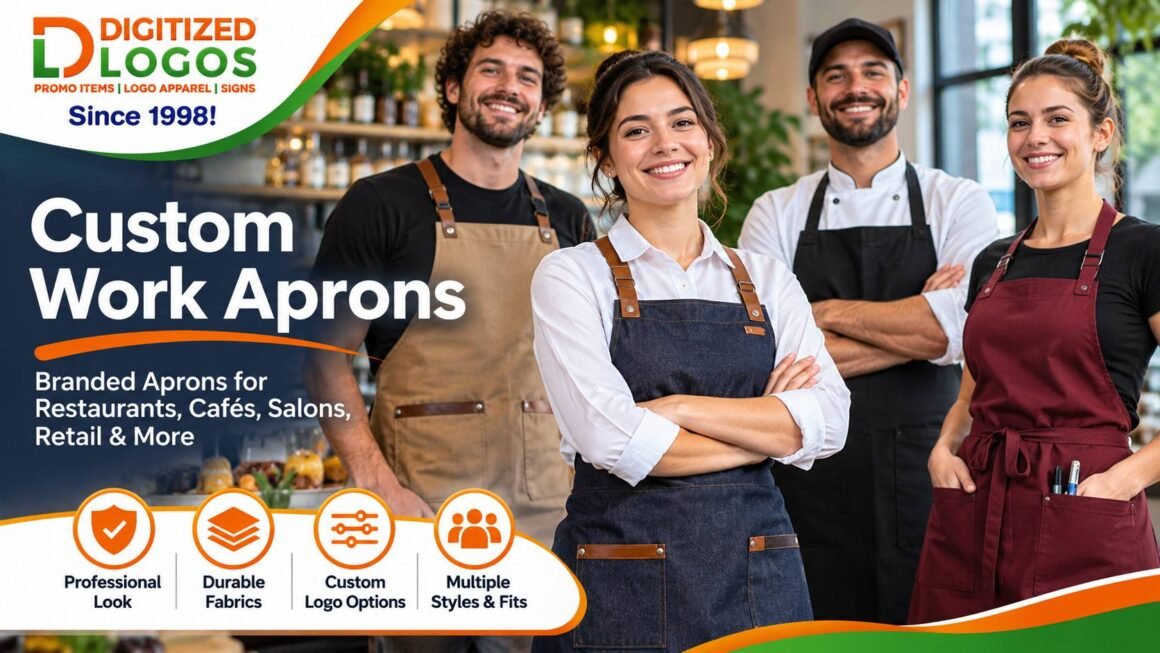
Work aprons do more than protect clothing. In restaurants, coffee shops, salons, workshops, and other customer-facing businesses, they are part of the employee uniform and daily workflow. The right apron helps employees carry essential tools, maintain a consistent appearance, and work comfortably throughout their shifts.
Choosing custom work aprons requires more than selecting a color and adding a logo. Business buyers should consider fabric durability, pocket placement, apron coverage, adjustability, decoration methods, cleaning requirements, and the practical needs of employees who will wear them.
This guide explains how to select personalized work aprons, compare common styles, prepare business logos for production, and organize purchasing decisions for teams of different sizes.
What Are Custom Work Aprons?
Custom work aprons are protective garments designed for workplace use and customized with a company’s logo, business name, employee identification, or other approved artwork. They are commonly worn over regular clothing or uniforms in jobs where employees need additional coverage, convenient storage, or a consistent professional appearance.
Unlike standard aprons, customized versions incorporate an organization’s visual identity into the garment. Depending on the product and decoration method, businesses may add embroidered logos, printed graphics, employee names, or department identifiers.
Common applications include food service, hospitality, retail, personal care, creative workshops, and certain light-duty industrial environments.
Why Businesses Use Custom Work Aprons
A work apron should perform a practical function first. Branding becomes valuable when it complements that function without making the garment uncomfortable or difficult to maintain.
Consistent Employee Appearance
Aprons help establish a recognizable uniform across employees who may otherwise wear different shirts, pants, or personal clothing. A consistent apron color and logo placement can create a coordinated appearance without requiring every employee to wear an identical outfit.
For example, a coffee shop might use the same apron style for its baristas while allowing employees to wear approved clothing underneath. This approach supports a uniform look while leaving some flexibility in everyday attire.
Clothing Protection
Aprons provide an additional layer between everyday clothing and certain workplace spills, splashes, dust, or residue. The amount of protection depends on the apron material, coverage, and intended use.
Standard fabric aprons should not be treated as specialized personal protective equipment. Work involving hazardous chemicals, high heat, sharp tools, or other regulated hazards may require purpose-designed protective garments that meet applicable safety requirements.
Convenient Access to Tools
Apron pockets can reduce unnecessary movement by keeping frequently used items within reach. Servers may carry pens and order pads, retail employees may carry handheld devices, and salon professionals may use pockets for suitable lightweight accessories.
Pocket dimensions and placement should reflect the actual equipment employees use rather than simply the appearance of the apron.
Brand Recognition
An apron displaying a recognizable company logo helps customers identify staff members. This can be useful in open retail environments, hospitality venues, demonstrations, and promotional events.
The most effective branding is usually easy to read, appropriately sized, and consistent with the organization’s established brand guidelines.
Types of Custom Work Aprons
Different apron designs provide different levels of coverage, mobility, storage, and comfort. Selecting the correct type begins with understanding how employees perform their jobs.
Bib Aprons
Bib aprons cover the front of the torso and typically extend toward the waist or knees. They commonly include neck straps and waist ties, with optional pockets.
These aprons are widely used in kitchens, coffee shops, bakeries, and other workplaces where upper-body coverage is useful.
Buyers should evaluate the length of the neck strap, the position of the bib, and whether the apron remains comfortable during extended wear.
Waist Aprons
Waist aprons wrap around the waist and cover the lower front of the body. They generally provide greater upper-body freedom of movement than full bib aprons.
They are practical for servers, bartenders, retail employees, and event staff who need access to small accessories but do not require full torso coverage.
Businesses should compare two-pocket, three-pocket, and other available compartment configurations based on their actual storage requirements.
Bistro Aprons
Bistro aprons are typically longer waist aprons that extend below the knees or toward the ankles. They are commonly associated with restaurant, hospitality, and upscale service environments.
Their longer silhouette may complement formal uniforms, although buyers should assess movement, walking comfort, and the risk of fabric interfering with daily tasks.
Cross-Back Aprons
Cross-back aprons distribute support across the shoulders and back rather than relying entirely on a conventional neck strap.
Some employees find this configuration more comfortable, particularly when wearing an apron for extended periods. However, comfort depends on individual fit, strap design, garment weight, and adjustments.
A sample fitting is useful before standardizing cross-back aprons across a team.
Utility and Workshop Aprons
Utility aprons may incorporate reinforced pockets, heavier fabrics, adjustable straps, or specialized storage features.
They are often considered for workshops, garden centers, maker spaces, and similar work environments.
Buyers should verify that the selected garment is appropriate for the working conditions. A utility apron is not automatically suitable for welding, chemical handling, or other hazardous activities.
How to Choose the Right Material for Custom Work Aprons
Fabric selection directly influences how an apron feels, wears, cleans, and accepts decoration. Material choice should be based on the working environment and the product manufacturer’s specifications.
Cotton
Cotton aprons are often selected for their natural feel and general comfort. They can be suitable for cafes, creative studios, and certain retail environments.
However, cotton fabrics may shrink, wrinkle, or retain stains depending on their construction and care instructions. Businesses should verify laundering guidance before selecting cotton for frequent commercial washing.
Polyester
Polyester aprons can provide good shape retention and may resist wrinkling better than some cotton alternatives. Performance varies by fabric weight, weave, and finishing treatment.
Polyester may be a practical option for uniform programs requiring regular cleaning and consistent appearance.
Cotton-Polyester Blends
Blended fabrics combine characteristics of cotton and polyester. They can offer a useful balance of comfort, maintenance, and durability, although the result depends on the specific blend and fabric construction.
For businesses purchasing aprons in quantity, a blended material may be worth evaluating when both employee comfort and repeated laundering are priorities.
Canvas and Denim
Canvas and denim aprons are often chosen for a more substantial appearance and heavier fabric feel. These materials are associated with workshops, barbershops, specialty retail, and certain hospitality concepts.
Heavier fabrics may offer greater resistance to everyday abrasion, but they can also add weight and reduce flexibility. Buyers should compare actual material weights rather than assuming all canvas or denim products perform alike.
Water-Resistant Materials
Some aprons feature coated fabrics or water-resistant finishes intended to limit moisture penetration.
Water resistance should not be confused with complete waterproofing or chemical protection. Businesses should review the manufacturer’s performance information and confirm suitability for their specific applications.
Personalized Aprons With Business Logo: Customization Options
Choosing personalized aprons with business logo involves matching the artwork, fabric, decoration method, and intended appearance.
Common customization techniques include embroidery, screen printing, and suitable digital transfer methods. Not every technique is appropriate for every garment, so buyers should confirm product compatibility before approving production.
Embroidered Logos
Embroidery uses stitching to reproduce approved artwork on the apron. It is commonly selected for company names, monograms, and logos with relatively clear shapes.
Embroidery can provide a textured, professional appearance, particularly on suitable canvas, denim, cotton, and blended fabrics.
Very small lettering, thin lines, and highly detailed graphics may require simplification because thread has physical limits that affect reproduction.
Screen-Printed Logos
Screen printing applies ink through a prepared screen to produce a graphic on fabric.
It can be appropriate for larger artwork, bold designs, and certain quantity-based production runs. Setup requirements and costs depend on the supplier, artwork, color count, and order specifications.
Businesses considering screen printing should verify the printable area, supported colors, and compatibility with the selected fabric.
Digital Transfer Printing
Digital transfer processes can reproduce multicolor artwork and detailed graphics on compatible apron fabrics.
The feel, flexibility, wash performance, and appearance of the finished transfer depend on the specific process and materials used.
Buyers should request applicable care instructions and review a sample when the final print texture or durability is important.
Employee Name Personalization
Adding individual names or job titles can help customers identify employees and may be useful in hospitality, events, and other service settings.
Personalization introduces additional production considerations. Buyers should verify spelling, capitalization, naming conventions, and placement before approving customized items.
Where Should a Business Logo Be Placed on an Apron?
Logo placement affects both visibility and usability. A decoration location that looks attractive in a product photograph may not perform as well when an employee wears the apron throughout a shift.
Common areas include the upper center chest on bib aprons, selected pocket panels, and suitable front sections of waist aprons.
Before approving a position, businesses should consider pocket openings, seams, straps, fabric folds, and the areas likely to be covered by equipment or accessories.
For example, placing a large design across a frequently used pocket may interfere with the intended appearance or restrict certain decoration techniques. A smaller design on an uninterrupted fabric panel may be more practical.
Always confirm the manufacturer’s decoration area and review a digital proof showing the proposed position and dimensions.
How to Select Custom Work Aprons for Different Industries
Apron requirements vary considerably between business environments. The most effective purchasing decision reflects how the garment will be used rather than treating every apron as interchangeable.
Restaurants and Cafes
Food-service teams often need aprons that accommodate frequent movement, routine cleaning, and small accessories.
A hypothetical cafe purchasing uniforms for baristas might compare adjustable bib aprons with front pockets, then test the preferred material under its existing laundering procedures.
The business could choose one standard color, establish an approved logo size, and retain the product specifications for future employee onboarding.
Hotels and Hospitality Businesses
Hospitality teams may require different apron configurations for food service, banquet operations, housekeeping-related tasks, or other suitable roles.
A hotel purchasing for multiple departments might maintain consistent brand colors while selecting different apron lengths or pocket configurations according to each department’s needs.
For multi-property programs, maintaining approved artwork, garment specifications, and reorder records can help limit inconsistencies.
Salons and Barbershops
Salon and barber teams may prefer aprons that offer convenient storage and are appropriate for exposure to common workplace residue.
Businesses should carefully evaluate how fabrics respond to hair products, dyes, cleaning agents, and repeated laundering. Decorative aprons should not be assumed to provide chemical protection.
Retail Stores and Promotional Events
Retail employees and event representatives may benefit from lightweight waist or bib aprons with accessible pockets and recognizable branding.
When an apron is used primarily for customer identification and carrying small items, excessive material weight or unnecessary coverage may reduce comfort.
Workshops and Creative Businesses
Art studios, craft businesses, and light-duty workshops may prioritize heavier fabrics, appropriate pocket construction, and adjustable straps.
Material selection should account for the specific tasks involved. Specialized hazards require separate assessment and appropriate protective equipment.
Important Features to Evaluate Before Purchasing
Visual appearance is only one part of product selection. Business buyers should assess several operational details before finalizing an apron program.
Fit and Adjustability
Look for adjustable neck straps, appropriate waist-tie lengths, and garment dimensions that accommodate the intended employee population.
Apron sizing is not always comparable to standard apparel sizing. Reviewing actual product measurements and testing samples can reduce fit-related problems.
Pocket Construction
Check pocket depth, width, placement, and stitching. Employees should be able to retrieve frequently used items without awkward movement or excessive stretching.
More pockets are not automatically better. Unnecessary compartments may add bulk or encourage employees to carry too much weight.
Fabric Weight
Heavy fabrics may be appropriate for some work environments, but weight can affect comfort during long shifts.
Compare fabric specifications and real-world sample performance before selecting a garment for an entire team.
Cleaning Requirements
Aprons used in food service and other environments requiring frequent cleaning should be evaluated against the organization’s laundering procedures.
Confirm water-temperature limits, drying instructions, stain-treatment restrictions, and any additional requirements associated with the decoration method.
Replacement Availability
Employee turnover, damaged garments, and additional locations can create recurring uniform requirements.
Ask whether the selected style and color can be reordered and how the supplier handles discontinued products or substitutions.
How to Order Custom Work Aprons for Your Business
A structured purchasing process helps reduce artwork errors, fit problems, and discrepancies between initial orders and future reorders.
Step 1: Define the Work Environment
Document where the aprons will be worn, how frequently employees will use them, and which operational requirements matter most.
Step 2: Determine the Required Quantity
Count the employees who need aprons, consider shift rotations, and assess the number of spare or replacement garments required.
For businesses operating several locations, calculate requirements by location or department rather than relying solely on a company-wide estimate.
Step 3: Select the Apron Style and Material
Compare suitable options according to coverage, fit, storage, fabric construction, cleaning needs, and employee preferences.
If possible, have representative employees try samples during normal activities.
Step 4: Prepare Logo Artwork
Provide the clearest available version of the company logo, preferably an appropriate vector file when required by the decoration process.
Confirm brand colors, design proportions, desired decoration location, and any restrictions in the company’s brand guidelines.
Step 5: Review the Proof
Check the proposed logo size, alignment, colors, spelling, and location.
A digital proof helps evaluate the design, but it may not fully represent fabric texture, thread appearance, or final physical dimensions. Requesting a production sample may be appropriate for larger or more complex programs.
Step 6: Confirm Order Requirements
Before authorizing production, verify quantities, product specifications, decoration details, minimum order requirements, estimated production timelines, shipping arrangements, and applicable charges.
Do not assume that all apron styles have identical minimum quantities or decoration setup requirements.
Step 7: Establish Reordering Procedures
Retain approved artwork, product identifiers, color selections, quantities, and decoration specifications.
This information can simplify future purchasing and help maintain a consistent employee appearance as the business grows.
What Affects the Cost of Custom Work Aprons?
The cost of a customized apron depends on several variables, including the garment itself and the services required to decorate and deliver it.
Important pricing considerations include fabric type, apron style, quantity, decoration method, artwork complexity, number of print locations, individual personalization, setup requirements, packaging, and shipping.
For embroidery, the design’s physical dimensions and stitching requirements may affect pricing. For screen printing, the number of colors and applicable setup processes can influence the total. Pricing rules vary by supplier.
Buyers should compare the full delivered cost rather than evaluating the blank garment price alone.
Understanding Total Program Cost
Consider a hypothetical restaurant that needs 60 aprons for its employees, plus a reserve for replacements. An initially less expensive apron may not represent the most economical option if it becomes unsuitable after repeated laundering or is uncomfortable enough that employees avoid wearing it.
A more useful comparison considers expected service life, cleaning requirements, replacement frequency, employee suitability, and reorder availability.
Because these variables depend on actual usage and product performance, businesses should not assume a specific return on investment without relevant cost and operational data.
Common Mistakes When Buying Branded Aprons
Several avoidable purchasing decisions can lead to unnecessary expense or operational inconvenience.
Choosing Appearance Over Function
An apron may look attractive in a catalog but lack the pocket capacity, coverage, or adjustability employees need.
Include operational staff in product evaluation when practical.
Using Artwork That Is Too Detailed
Small lettering and intricate graphics may not reproduce clearly with certain decoration techniques.
Prepare simplified logo versions where appropriate and review decoration proofs carefully.
Ignoring Fabric Care
Some fabrics and decorations require specific washing or drying procedures. Selecting an apron without considering the workplace’s cleaning practices can create maintenance problems.
Ordering Without a Sample
For larger programs, purchasing without assessing material, fit, and construction may introduce avoidable uncertainty.
A sample can help teams evaluate practical suitability before committing to a larger quantity.
Failing to Plan for Reorders
Without documented product identifiers and approved artwork, later purchases may differ in color, fabric, or logo placement.
Maintaining clear records supports more consistent uniform purchasing.
Managing Custom Apron Programs Across Multiple Locations
Businesses operating multiple restaurants, stores, or service locations face additional challenges when coordinating branded uniforms.
Different managers may select similar-looking but nonidentical garments, use outdated artwork, or request inconsistent logo sizes.
A centralized product standard can help reduce these issues.
For example, a hypothetical hospitality business operating five cafes could create an approved apron specification containing the garment model, selected color, logo dimensions, decoration technique, and reorder instructions.
Each location could then reference the same specifications when requesting additional aprons. Any substitutions would be reviewed before approval.
This approach is especially useful when coordinating employee onboarding, seasonal staffing, replacements, and expansion into additional locations.
How to Evaluate a Custom Apron Supplier
A suitable supplier should help buyers understand product limitations, available decoration options, and the details that affect the finished garment.
Useful evaluation questions include the following:
1. Product selection: Which apron styles and fabrics are available for the intended workplace?
2. Decoration compatibility: Which logo application methods are supported for the selected garment?
3. Proofing: Can the supplier provide artwork proofs showing decoration dimensions and positioning?
4. Minimum quantities: What minimum order requirements apply to the selected style and customization method?
5. Samples: Are blank or decorated samples available for evaluation, and what are the applicable terms?
6. Production planning: What lead times should be considered after artwork approval?
7. Reordering: How are approved artwork and product specifications handled for future orders?
8. Fulfillment: Can the supplier accommodate the required delivery locations and shipping arrangements?
Clear answers help purchasing teams compare suppliers using relevant operational criteria rather than promotional claims alone.
Frequently Asked Questions About Custom Work Aprons
What is the best material for custom work aprons?
There is no single best material for every business. Cotton may suit workplaces prioritizing natural fabric feel, polyester or blended fabrics may support certain maintenance needs, and heavier canvas or denim may fit selected workshop or hospitality applications. Compare fabric specifications, cleaning requirements, and actual working conditions before choosing.
Can a company logo be embroidered on an apron?
Yes. Many apron styles support embroidery when the fabric and construction are suitable. Embroidery is often used for company names and logos with clear shapes. Small lettering or complex artwork may need adjustment, and placement must account for seams, pockets, and other garment features.
Are custom work aprons suitable for restaurants?
Custom work aprons can be suitable for restaurants, cafes, bakeries, and other food-service establishments. Buyers should consider garment coverage, employee mobility, fabric care, and pocket requirements. An apron used as part of a uniform does not automatically replace any protective clothing required for specific workplace hazards.
Is there a minimum quantity for personalized aprons?
Minimum quantities depend on the selected product, decoration process, and supplier requirements. Some customization arrangements may accommodate small quantities, while others require larger production runs. Buyers should confirm the applicable minimum, setup requirements, and pricing before approving an order.
How long does it take to produce custom aprons?
Production time varies with product availability, quantity, decoration method, artwork approval, personalization requirements, and the supplier’s schedule. Shipping adds another consideration. Businesses preparing for openings, events, or employee onboarding should request a confirmed production estimate and plan accordingly.
Key Takeaways for Business Buyers
Choose for the job: Match apron coverage, pockets, fit, and fabric to employees’ actual work requirements.
Prioritize practical customization: Use an appropriate logo application method and verify artwork placement before production.
Evaluate total purchasing needs: Consider garment quality, decoration, maintenance, replacement requirements, and shipping.
Plan for consistency: Maintain approved product and artwork specifications to simplify future reorders.
Verify before committing: Confirm minimum quantities, samples, estimated lead times, and fulfillment requirements with the supplier.
Find Custom Work Aprons for Your Business With Digitized Logos
Choosing the right custom work aprons starts with understanding what employees need from their uniforms. A well-selected apron should provide suitable coverage, comfortable wear, practical functionality, and branding that reflects the business professionally.
Digitized Logos provides branded apparel and promotional product solutions for business customers. Organizations exploring customized aprons can use product requirements such as fabric, fit, decoration, quantity, and intended use to guide their selection.
For restaurants, hotels, salons, retail businesses, and other organizations, reviewing these requirements before ordering can help reduce purchasing uncertainty and support a more consistent employee uniform program.
Phone: 301-963-3553
Email: Info@DigitizedLogos.com