Branded Bags for Business: Custom Bags That Get Seen
Branded bags turn an everyday item into a practical, mobile brand touchpoint. Unlike promotional items that may be used once and forgotten, a well-selected tote, backpack, drawstring bag, cooler, duffel, or laptop bag can remain in circulation through commutes, conferences, shopping trips, travel, and daily work routines.
For organizations evaluating branded bags, the purchasing decision goes beyond adding a logo to a product. Material, decoration method, intended use, order quantity, production schedule, distribution strategy, and perceived value all influence whether the final merchandise actually supports the business objective.
Digitized Logos provides branded apparel and promotional product solutions for organizations across the United States, including businesses and agencies in Maryland, Virginia, and Washington DC. The company manages sourcing, customization, and fulfillment to help buyers build coordinated corporate merchandise programs rather than treating every promotional order as an isolated purchase.
Quick Answer: What Are Branded Bags?
Short Answer: Branded bags are reusable bags customized with a company logo, message, artwork, or campaign identity. Businesses use them as promotional bags, employee merchandise, event giveaways, corporate gifts, onboarding items, retail packaging, and components of larger branded merchandise programs.
The most effective bag is not necessarily the most expensive option. It is the product that matches the audience, expected usage, branding requirements, distribution method, budget, and desired lifespan.
Why Branded Bags Work for Business Marketing
Bags occupy an unusually useful position within promotional products. They provide a large decoration area while also solving a practical need. Recipients can carry documents, technology, groceries, gym equipment, conference materials, travel essentials, or other branded merchandise inside them.
That usefulness can extend the marketing life of the product. A bag carried repeatedly can generate substantially more brand exposure than an item that remains on a desk, stays inside a drawer, or is discarded immediately after an event.
Consider a simple planning scenario. A company orders 1,000 reusable bags for an annual conference. If 600 recipients continue using their bags twice per month for six months, that creates 7,200 individual uses after the original event. The precise number of people who see each bag will vary, but the example demonstrates why utility and continued use matter when evaluating promotional merchandise ROI.
Common Types of Promotional Bags
Short Answer: Promotional bags range from economical event totes and drawstring bags to premium backpacks, coolers, travel bags, laptop bags, and executive gifts. Product selection should reflect how recipients will realistically use the item after receiving it.
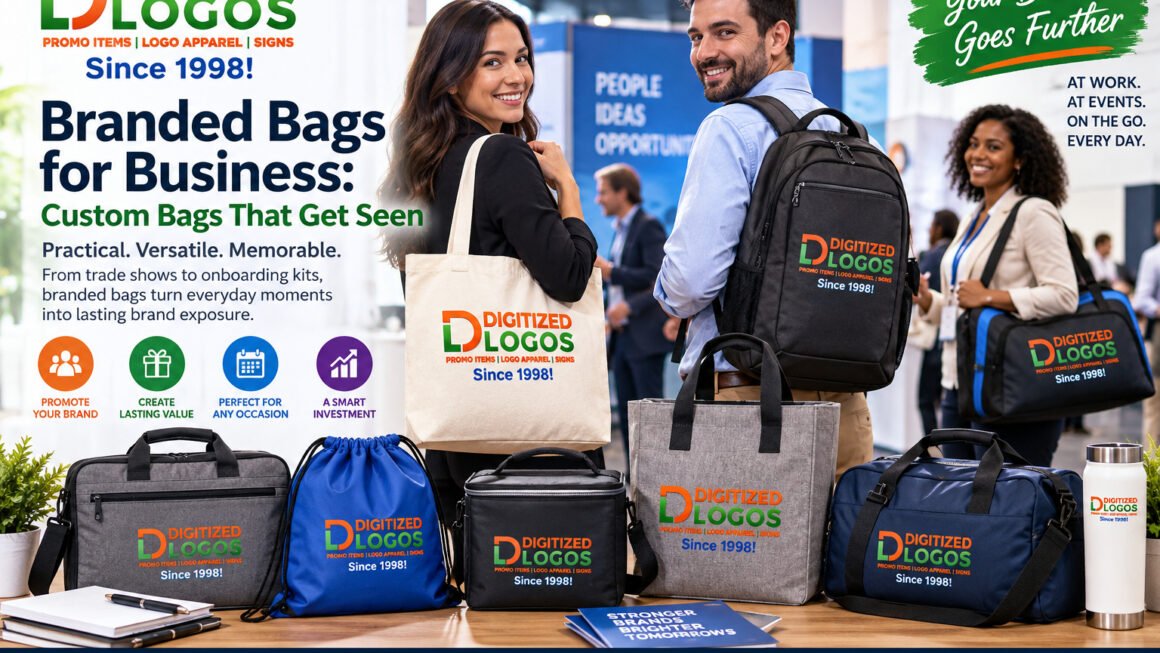
- Tote bags: Versatile for conferences, recruiting events, community programs, retail promotions, employee events, and everyday carrying.
- Drawstring bags: Lightweight choices for schools, fitness programs, races, youth events, sports activities, and high-volume campaigns.
- Backpacks: Higher-value merchandise suitable for employees, students, technology teams, travel programs, and premium giveaways.
- Laptop and messenger bags: Professional options for employees, executives, remote teams, sales representatives, and client gifts.
- Cooler bags: Useful for outdoor events, employee appreciation programs, golf outings, hospitality campaigns, and summer promotions.
- Duffel and travel bags: Strong choices for recognition programs, sales incentives, sports organizations, corporate travel, and premium merchandise.
- Non-woven bags: Cost-conscious solutions for conventions, community outreach, mass distribution, and event kits.
How to Choose Branded Bags: A Step-by-Step Framework
The strongest merchandise programs begin with the business objective, not the catalog. Buyers can narrow thousands of available products quickly by defining who receives the bag, what the recipient needs it to do, and how it will be distributed.
- Define the business objective. Determine whether the bags are intended to increase event visibility, welcome employees, reward customers, support sales outreach, package other promotional products, or create a premium corporate gift.
- Identify the recipient. An executive client, new employee, conference attendee, student, construction professional, healthcare worker, or community-event visitor may require a completely different product.
- Establish the working budget. Calculate the complete program cost, including the product, decoration, setup when applicable, packaging, freight, fulfillment, and potential expedited production.
- Select the appropriate bag category. Match capacity, compartments, carrying style, durability, materials, and perceived value to actual recipient needs.
- Plan the decoration. Evaluate logo dimensions, artwork complexity, brand colors, imprint location, and the decoration method available for the selected material.
- Confirm production requirements. Review minimum quantities, artwork requirements, proofing, production time, inventory, shipping destinations, and the required in-hand date before final approval.
- Plan distribution. Decide whether the bags will ship to one office, multiple locations, individual employees, an event venue, or recipients across the United States.
Branded Bags by Business Use Case
Trade Shows and Conferences
A conference bag can perform two jobs simultaneously: carry event materials and extend brand visibility throughout the venue. Tote bags are particularly effective when attendees need somewhere to store brochures, notebooks, promotional products, and materials collected from exhibitors.
A business expecting 800 attendees, for example, might order 900 units rather than exactly 800. The additional inventory creates a practical buffer for speakers, staff, unexpected attendance, damaged units, and post-event follow-up packages. Businesses can explore promotional merchandise options at https://products.digitizedlogos.com/ when building event programs.
Employee Onboarding Kits
A backpack, laptop bag, or tote can become the container for an entire onboarding experience. Instead of handing a new employee several disconnected items, organizations can package a branded shirt, notebook, drinkware, technology accessories, and welcome materials inside one coordinated bag.
This approach improves presentation while simplifying internal distribution. It also helps HR and procurement teams standardize what employees receive across departments and locations.
Corporate Gifting
Premium bags can support client appreciation, executive gifting, milestone recognition, sales incentives, and employee awards. In these programs, material quality, construction, zipper performance, interior organization, comfort, and subtle branding often matter more than achieving the lowest unit cost.
Community and Public-Sector Programs
Reusable totes and practical promotional bags can support outreach events, workforce programs, conferences, educational initiatives, public information campaigns, and community engagement. Digitized Logos serves organizations in Maryland, Virginia, Washington DC, and throughout the United States and is an MDOT, DDOT, and VA SWaM Certified Small, Minority, Female-Owned Business.
Customization Methods for Branded Bags
Short Answer: Common bag customization methods include screen printing, embroidery, heat transfer, digital transfer, and other product-specific decoration processes. The best technique depends on the bag material, artwork, quantity, desired appearance, available imprint area, and durability requirements.
Screen Printing
Screen printing is often practical for straightforward logos and larger promotional quantities. It can provide strong visual impact on compatible tote and drawstring materials, particularly when artwork uses a limited number of colors.
Embroidery
Embroidery creates a dimensional, professional appearance and works especially well on backpacks, duffels, laptop bags, and premium merchandise. Fine artwork may need to be simplified or digitized appropriately so small lettering and detailed elements reproduce cleanly in thread.
Heat and Digital Transfer
Transfer methods can be useful for detailed or multicolor graphics when the bag material supports the process. They can provide more design flexibility than traditional spot-color decoration for certain products and campaign artwork.
Full-Color Customization
Some products support larger or more extensive full-color decoration. These options can be valuable when a campaign depends on photography, gradients, complex graphics, or visual storytelling rather than a simple logo imprint.
Behind the Scenes: What Happens Before Production?
A professional promotional bag order involves more than uploading a logo and pressing print. The product must first be matched with a suitable decoration process and imprint area. Artwork is then evaluated for resolution, line thickness, typography, colors, proportions, and production compatibility.
A proof typically represents the intended logo placement and decoration before production begins. This approval stage is important because a logo that looks balanced on a computer screen may need adjustments when placed on a curved pocket, narrow panel, textured fabric, zipper compartment, or small imprint area.
Operational insight: Buyers should approve artwork and product specifications as early as possible. Delayed proof approvals can compress the production and shipping window even when the original project schedule was realistic.
Operational insight: Inventory should be verified near the time an order is ready to proceed. Popular colors and styles can change availability, particularly around major conferences, holidays, employee appreciation periods, and seasonal campaigns.
Branded Bags vs. Other Promotional Products
Bags are not automatically the right merchandise for every campaign. Their advantage is the combination of usable surface area, practical utility, portability, and the ability to package additional promotional products.
Drinkware may offer strong daily desk visibility. Branded apparel can turn employees or customers into visible brand representatives. Technology accessories can provide targeted utility. Bags become particularly valuable when the organization needs both a useful promotional item and a delivery vehicle for other merchandise.
A trade show kit, for example, could combine a branded tote with a notebook, pen, bottle, and informational materials. The tote unifies the collection while making the entire kit easier for attendees to carry.
Buyer Considerations: What Should You Check Before Ordering?
Procurement teams, marketing departments, HR leaders, event planners, and business owners should evaluate more than unit price when comparing promotional bags.
- Material: Consider weight, texture, durability, appearance, and suitability for the intended environment.
- Construction: Review handles, seams, zippers, pockets, closures, reinforcement, and carrying comfort.
- Capacity: Confirm that the bag can accommodate the items recipients actually need to carry.
- Brand presentation: Make sure the available imprint area supports appropriate logo visibility without overwhelming the product.
- Decoration compatibility: Confirm that the selected customization method works with both the artwork and material.
- Quantity requirements: Check minimum order quantities and price breaks before building the budget.
- Production schedule: Work backward from the required delivery date and leave time for artwork, proof approval, production, and shipping.
- Fulfillment: Determine whether merchandise needs to reach one location, several offices, an event venue, or individual recipients.
Decision Support: Cost, Turnaround, Minimums, ROI and Fulfillment
Short Answer: The total cost of branded bags depends on the bag style, material, quantity, decoration method, number of imprint locations, packaging, freight, and fulfillment requirements. Buyers should compare complete program cost and expected usefulness rather than choosing solely by the lowest unit price.
How Much Do Branded Bags Cost?
Pricing can vary substantially between basic event totes and premium backpacks or travel bags. Quantity also matters because larger orders may reach more favorable price tiers, although buying excess inventory simply to achieve a lower unit cost can create unnecessary storage and cash-flow costs.
For illustration, suppose one option costs $4 per bag and another costs $8. If the $4 item is rarely reused but the $8 bag becomes part of an employee’s weekly routine, the more expensive product may generate greater practical and branding value. ROI should therefore consider usefulness, audience quality, longevity, and business objective, not price alone.
What About Minimum Quantities?
Minimum order quantities vary by product and decoration process. Some programs accommodate relatively small runs, while other manufacturing or customization methods become practical only at larger quantities. Buyers with uncertain demand should discuss quantities before finalizing a product rather than assuming every bag has the same minimum.
How Long Does Production Take?
Turnaround depends on inventory, decoration method, quantity, proof approval, production capacity, shipping method, and destination. An event date should be treated as an in-hand deadline, not a production deadline.
For time-sensitive programs, build backward from the event and include a contingency window. Waiting until the final days can reduce product choices and increase the likelihood that expedited production or freight will be necessary.
How Does Fulfillment Work?
Fulfillment requirements can range from shipping cartons to a single convention center to distributing individual packages across dozens or hundreds of addresses. Multi-location programs require accurate recipient data, packaging rules, inventory control, and shipping coordination.
Digitized Logos manages sourcing, customization, and fulfillment, allowing buyers to coordinate the merchandise lifecycle through a more unified process. Organizations evaluating a larger program can review available options at https://products.digitizedlogos.com/.
Two Realistic Branded Bag Program Examples
Example 1: Regional Recruiting Program
A professional services company is attending eight recruiting events in Maryland, Virginia, and Washington DC. Rather than purchasing unrelated giveaways for every event, the marketing team selects a reusable tote and builds a standard kit containing a notebook, pen, informational card, and branded apparel offer.
The organization orders 1,200 bags and allocates inventory according to expected attendance at each event. Standardized artwork and centralized sourcing help maintain brand consistency, while reserved inventory gives the team flexibility when attendance exceeds projections.
Example 2: Distributed Employee Onboarding
A growing employer hires 25 to 40 people per month across several U.S. locations. Instead of purchasing merchandise whenever an employee starts, the company establishes a standardized onboarding kit using a branded backpack containing selected corporate swag and welcome materials.
If the organization averages 30 hires per month, it needs approximately 360 kits annually before accounting for replacements or special hires. Forecasting quarterly demand can help procurement plan inventory, reduce repeated rush orders, and maintain a more consistent employee experience.
Common Mistakes When Ordering Promotional Bags
One of the most common mistakes is choosing a bag based entirely on price without considering whether recipients will use it. A low-cost item produces limited marketing value if the construction, dimensions, appearance, or functionality does not fit the audience.
Other problems include ordering too close to an event, selecting artwork that does not reproduce well, overlooking freight costs, ignoring bag dimensions, failing to verify inventory, and using the same merchandise strategy for every audience.
Another frequent mistake is placing too much information on the bag. A clean logo or concise campaign message can often create stronger visibility than a crowded design containing a logo, website, phone number, tagline, multiple icons, and several lines of text.
How to Scale a Corporate Merchandise Program
Scaling merchandise requires moving from individual orders toward repeatable standards. Organizations can define approved bag categories, brand colors, decoration specifications, budget tiers, inventory thresholds, and distribution procedures.
This creates a practical framework for marketing, HR, procurement, sales, and event teams. Instead of starting from zero each time someone needs promotional products, stakeholders can work within a pre-established merchandise system.
Branded bags can also connect multiple merchandise categories. A standardized bag can serve as the packaging layer for employee onboarding kits, corporate gifts, event merchandise, sales kits, recognition programs, and seasonal campaigns.
Promotional Bag Trends for Modern Merchandise Programs
Business buyers are increasingly focused on usefulness and perceived quality rather than simply distributing the highest possible number of items. Products that fit work, travel, technology, fitness, and everyday routines are easier to integrate into long-term merchandise strategies.
Buyers are also paying closer attention to cohesive presentation. Coordinating bags with branded apparel, drinkware, notebooks, technology accessories, and corporate gifts can create a more intentional brand experience than distributing unrelated promotional products.
Personalization, premium construction, retail-inspired design, thoughtful packaging, and flexible fulfillment are also increasingly important in employee and client programs where the experience of receiving the merchandise matters alongside the logo itself.
Key Takeaways
- Prioritize usefulness: Branded bags deliver more value when recipients have a genuine reason to keep and reuse them.
- Evaluate total program cost: Include decoration, freight, packaging, fulfillment, and potential rush requirements rather than comparing unit prices alone.
- Plan production early: Artwork approval, inventory availability, customization, production, and shipping all affect the final timeline.
- Match the product to the audience: Event attendees, employees, executives, customers, students, and community audiences have different practical needs.
- Build for scalability: Standardized merchandise programs can improve consistency and simplify repeat ordering across events, locations, and departments.
Frequently Asked Questions About Branded Bags
What are the best branded bags for corporate events?
The best choice depends on audience, budget, event format, and what attendees need to carry. Reusable totes work well for conferences and trade shows, while backpacks, laptop bags, and premium totes may be better for executive events, employee programs, or higher-value gifts.
How far in advance should promotional bags be ordered?
Order as early as practical because timing depends on inventory, artwork approval, decoration, quantity, production capacity, and shipping. Buyers should work backward from the required in-hand date and include contingency time, especially for conferences, national distribution programs, large quantities, or complex customization.
Can branded bags be used in employee onboarding kits?
Yes. Bags can function as both a useful employee gift and the packaging for an onboarding kit. A backpack or tote can hold branded apparel, drinkware, notebooks, technology accessories, and welcome materials, helping employers create a consistent experience across departments and locations.
What affects the price of custom promotional bags?
Pricing is influenced by product style, material, construction, order quantity, decoration technique, artwork, imprint locations, packaging, freight, and fulfillment. Comparing complete program costs is more useful than comparing product prices alone because distribution and customization requirements can materially affect the final budget.
Can branded bags be shipped to multiple locations?
Yes, depending on the fulfillment program. Merchandise may be shipped in bulk to offices or event venues, divided among multiple business locations, or individually distributed to recipients. Multi-address fulfillment should be planned early because packaging, address data, inventory allocation, and freight affect execution.
Build a Branded Bag Program That Supports Your Business Goals
The best branded bags do more than display a logo. They give recipients something useful, extend brand visibility, support events and employee programs, and connect naturally with broader promotional products, branded apparel, corporate gifting, and corporate merchandise strategies.
Digitized Logos provides branded apparel and promotional product solutions while managing sourcing, customization, and fulfillment. Whether you are preparing for a trade show, building employee onboarding kits, coordinating corporate swag, or scaling a multi-location merchandise program, thoughtful planning can improve consistency, control costs, and keep your organization event-ready.
Ready to plan your next merchandise program? Call 301-963-3553 or visit https://products.digitizedlogos.com/ to explore options. Start early to preserve product choice, customization flexibility, turnaround options, merchandise consistency, and fulfillment confidence.
SEO Hashtags
#BrandedBags #PromotionalBags #PromotionalProducts #CorporateSwag #BrandedMerchandise #CorporateGifts #EmployeeOnboarding #TradeShowGiveaways #BrandedApparel