
Custom Awards and Recognition: A Practical Guide to Employee Appreciation
Great work deserves more than a generic thank-you. Custom awards and recognition give organizations a tangible way to celebrate achievement, reinforce company values, recognize milestones, and make employees feel that their contributions matter.
For HR teams, procurement professionals, business owners, event planners, and corporate leaders, the challenge is not simply finding an award. It is choosing recognition products that look professional, fit the occasion, arrive on time, and remain consistent with the organization’s brand. Digitized Logos provides branded apparel, promotional products, corporate merchandise, and customized recognition solutions that help businesses turn appreciation into a repeatable program. Explore available products at https://products.digitizedlogos.com/.
Quick Answer: What Are Custom Awards and Recognition?
Short Answer: Custom awards and recognition are personalized physical items used to acknowledge employee performance, service milestones, leadership, team achievements, sales results, or other meaningful contributions. They can include engraved awards, plaques, trophies, desk pieces, branded gifts, apparel, and coordinated employee appreciation awards.
The strongest recognition programs match the award to the accomplishment. Instead of treating every occasion the same, organizations can vary the product, personalization, presentation, and supporting merchandise according to the significance of the achievement.
Why Custom Awards and Recognition Matter
Recognition becomes more memorable when it is specific. An employee receiving an award with their name, achievement, company identity, and date sees clear evidence that the organization took time to acknowledge what they accomplished.
The business value goes beyond the physical product. A well-designed recognition program can reinforce desired behaviors, communicate organizational priorities, create visible traditions, and give managers a structured way to acknowledge employees consistently.
Consider a company with 250 employees that recognizes 50 service anniversaries, 20 quarterly performance achievements, and 10 leadership accomplishments during a year. Rather than sourcing each occasion separately, the organization can establish a coordinated recognition catalog with predetermined products, personalization rules, budgets, and ordering procedures. That approach makes 80 annual recognition moments easier to manage while improving brand and quality consistency.
What Can Be Customized on an Employee Award?
Short Answer: Depending on the product and production method, businesses can typically customize company branding, recipient names, job titles, award categories, achievement details, dates, event names, messages, artwork, and selected product colors.
Customization should have a hierarchy. The recipient and achievement generally deserve the most attention, while the company logo supports the presentation rather than overwhelming it. The result should feel like an award created for a person, not an advertisement with a name added afterward.
Employee Appreciation Awards for Different Business Needs
Employee recognition is not limited to an annual awards banquet. Organizations can create recognition touchpoints throughout the employee lifecycle, from onboarding and early achievement to major career milestones.
- Service awards: Recognize one-year, five-year, ten-year, and longer employment anniversaries.
- Performance awards: Celebrate measurable achievements in sales, operations, customer service, production, or project delivery.
- Leadership awards: Recognize managers and employees who demonstrate exceptional leadership or mentorship.
- Values-based recognition: Reward employees who demonstrate behaviors connected to company values.
- Team achievement awards: Celebrate departments or project groups rather than only individuals.
- Safety recognition: Mark meaningful safety achievements and operational milestones.
- Peer recognition: Give employees opportunities to acknowledge colleagues for meaningful contributions.
- Event recognition: Create awards for conferences, annual meetings, corporate celebrations, competitions, and partner events.
Recognition can also be coordinated with branded gifts, corporate swag, merchandise programs, onboarding kits, or event merchandise. This creates a more complete employee experience than treating awards as an isolated purchasing category. Businesses can explore customizable merchandise through https://products.digitizedlogos.com/.
How to Build a Custom Awards and Recognition Program
A scalable recognition program requires more than selecting attractive products. Procurement, HR, marketing, leadership, and fulfillment requirements should be considered before orders begin.
- Define the achievement. Establish exactly what behavior, milestone, result, or contribution the organization wants to recognize.
- Create recognition levels. Separate everyday appreciation from quarterly achievement, major performance, leadership, and long-service recognition.
- Set budgets by level. Predetermined spending ranges help managers recognize employees without creating inconsistent purchasing decisions.
- Select appropriate products. Match perceived value, size, material, personalization capability, and presentation to the importance of the achievement.
- Establish customization rules. Decide how logos, employee names, dates, award titles, departments, and messages should appear.
- Plan production timelines. Build enough time for artwork approval, personalization, production, quality checks, packing, and transportation.
- Determine fulfillment requirements. Decide whether awards go to one office, multiple locations, event venues, managers, or individual recipients.
- Measure participation and outcomes. Track program usage, recognition frequency, employee feedback, reorder activity, and administrative efficiency.
Choosing the Right Award for the Achievement
Short Answer: Match the perceived value and permanence of the award to the significance of the accomplishment. Frequent recognition can use practical branded gifts, while major service, leadership, or performance achievements often justify more substantial personalized awards.
Traditional Awards and Plaques
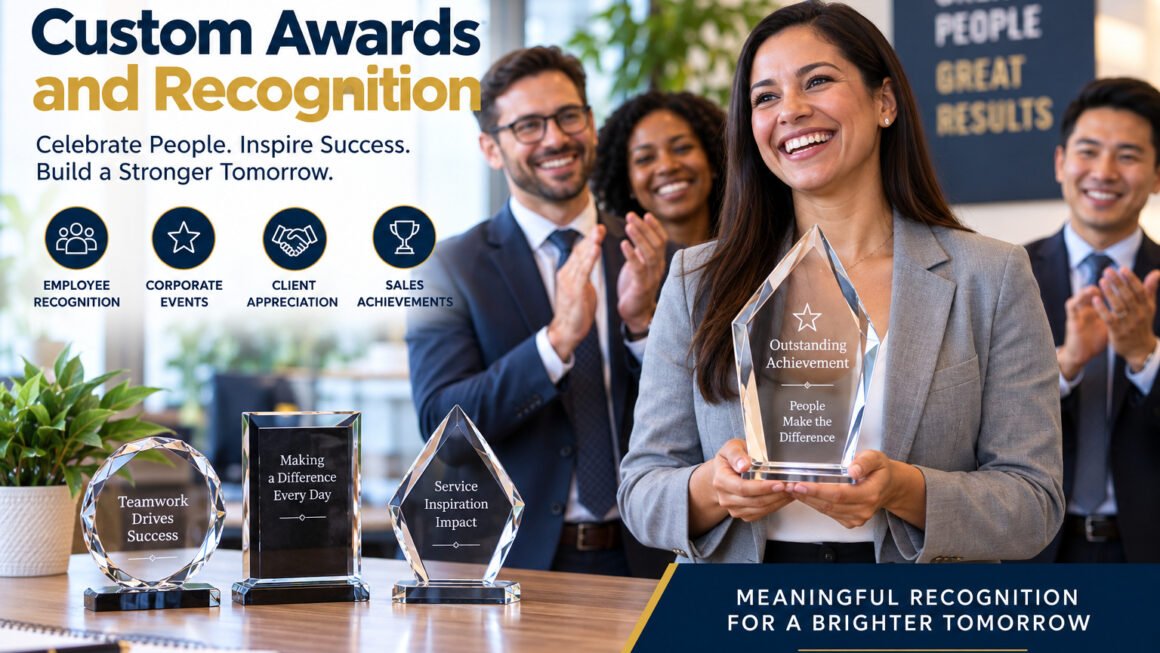
Traditional trophies, plaques, crystal-style pieces, acrylic awards, and desk displays work well when permanence and ceremony matter. These products are particularly appropriate for leadership recognition, annual awards, major sales achievements, service milestones, and formal corporate events.
Branded Gifts
A practical premium gift can complement or sometimes replace a traditional trophy. Drinkware, bags, technology accessories, office merchandise, travel products, and other useful branded merchandise can make appreciation part of the recipient’s everyday routine.
Branded Apparel
Premium branded apparel can work well for team achievements, employee appreciation campaigns, company anniversaries, volunteer programs, internal events, and recognition initiatives where belonging is part of the objective.
Recognition Kits
For significant achievements, organizations can combine several elements into one experience. A recognition kit might contain a personalized award, handwritten message, premium branded gift, apparel item, and presentation packaging.
This same program-based thinking can connect employee recognition with corporate gifting, onboarding kits, trade show giveaways, branded merchandise strategies, and broader corporate merchandise programs.
Custom Awards vs. Generic Recognition Products
Generic awards can be appropriate when speed and low unit cost are the dominant requirements. Custom recognition is better suited to situations where personalization, company identity, perceived value, and long-term memorability matter.
A generic plaque may identify an accomplishment, but a thoughtfully customized award can communicate who earned it, why the achievement matters, when it occurred, and which organization is recognizing it. Those details turn an object into a record of accomplishment.
The decision therefore should not be based on price alone. Buyers should consider the significance of the occasion, expected lifespan of the item, presentation environment, recipient experience, and administrative requirements.
What Should Business Buyers Consider Before Ordering?
Short Answer: Evaluate total cost, customization options, minimum quantities, production method, proofing, turnaround, packaging, shipping destinations, reorder consistency, and the vendor’s ability to manage the program as it grows.
Cost and Budget
Compare total program cost rather than unit price alone. Setup charges, personalization, packaging, expedited production, split shipping, individual delivery, and replacement requirements can affect the final budget.
For example, suppose an organization budgets $75 per recipient for 100 annual recognition packages. That creates a $7,500 merchandise budget before any separate freight or event expenses. Establishing that figure early allows buyers to compare product combinations without repeatedly redesigning the program.
Minimum Quantities
Minimum order quantities vary by product and customization method. A recognition program that adds recipients throughout the year may need different sourcing criteria from a one-time order of 200 identical event awards.
Ask about reorder requirements before approving the initial product. This is particularly important for service awards or recurring quarterly programs that may remain active for several years.
Turnaround Time
Production time should be separated from shipping time. A product may require artwork preparation, proof approval, personalization data processing, production, inspection, packing, and transportation before it reaches the recipient.
Practical operational insight: Create an internal deadline earlier than the actual presentation date. This provides a buffer for late recipient lists, proof revisions, address corrections, weather disruptions, or carrier delays.
Customization Flexibility
Ask whether individual names and award details can change within the same production run. Variable personalization can be particularly valuable when dozens or hundreds of recipients receive similar awards with unique information.
Quality Consistency
A recurring recognition program depends on consistency. Buyers should consider whether the same or comparable product can be reordered, whether branding specifications can be retained, and how color, engraving, printing, and packaging standards will be managed.
Behind the Scenes: How a Recognition Order Moves From Idea to Delivery
A professional recognition order usually begins well before production. The supplier first needs the product selection, artwork, quantities, personalization information, delivery requirements, and deadline. Artwork is then prepared according to the decoration method and product specifications.
Personalized programs add another operational layer. Recipient names, titles, dates, award levels, addresses, and other variable fields need to be organized accurately. A spreadsheet containing inconsistent capitalization, missing addresses, duplicate names, or incorrect award levels can create problems even when the physical product is perfect.
Practical operational insight: Assign one internal owner to approve both artwork and personalization data. A controlled approval process reduces contradictory revisions from multiple stakeholders and creates a clearer production record.
After approval, products move through decoration or personalization, quality review, packing, and fulfillment. Depending on the program, completed awards may ship together to headquarters, to regional offices, or individually to employee addresses.
How Recognition Programs Scale Across Multiple Locations
Recognition becomes operationally more complex when a company has distributed teams. A headquarters-based program might require one bulk delivery, while a national workforce may require dozens or hundreds of individual shipments.
For example, a professional services company with employees in Maryland, Virginia, Washington DC, and other U.S. markets could standardize three recognition levels. Managers select the appropriate level, HR supplies approved recipient data, and the merchandise program follows predefined branding, personalization, and fulfillment rules.
This reduces the risk of one office buying a premium award while another gives employees an unrelated item for the same achievement. Standardization creates consistency without eliminating personalization.
Employee Recognition ROI: What Should Businesses Measure?
Recognition ROI should not be reduced to a claim that an award automatically creates a specific percentage increase in retention or productivity. Workplace outcomes depend on compensation, management, culture, career opportunities, workload, communication, and many other factors.
A more practical approach is to measure the recognition program itself. Organizations can track participation rates, number of employees recognized, recognition frequency by department, manager adoption, employee feedback, program cost per recipient, fulfillment accuracy, and administrative time.
Consider a 500-person organization spending $25,000 annually across awards and appreciation initiatives. Instead of asking whether the merchandise alone produced $25,001 in measurable return, leadership can evaluate whether the program reaches the intended employees, supports desired behaviors, is used consistently by managers, and delivers a positive recipient experience at an acceptable cost.
Common Custom Awards and Recognition Mistakes
Many recognition problems happen before production begins. Avoiding them can protect both the budget and the employee experience.
- Ordering solely on unit price without considering perceived quality.
- Waiting for final recipient information until immediately before an event.
- Using the same recognition level for minor achievements and major career milestones.
- Over-branding an award until the employee’s accomplishment becomes secondary.
- Failing to verify spelling, titles, dates, and personalization data.
- Ignoring packaging and presentation.
- Choosing products without checking future reorder availability.
- Forgetting to account for production plus shipping time.
Recognition Trends: Moving From One-Off Awards to Merchandise Programs
Businesses increasingly have reasons to manage recognition alongside other branded merchandise needs rather than treating every purchase as a separate project. The same organization may need employee appreciation items, onboarding kits, branded apparel, executive gifts, trade show giveaways, corporate swag, and event merchandise throughout the year.
A coordinated merchandise program can establish approved products, artwork standards, budget ranges, ordering procedures, and fulfillment expectations. This reduces repetitive sourcing and helps preserve brand consistency across employee and customer touchpoints.
Recognition can then become part of a broader branded merchandise strategy rather than an isolated annual event.
How to Evaluate a Custom Awards Vendor
The right supplier should be able to explain what happens between product selection and delivery. Buyers should look beyond catalog size and determine whether the vendor can support the operational requirements of the program.
Evaluate capabilities around sourcing, decoration methods, personalization, artwork management, proofing, quality control, packaging, deadlines, multi-location shipping, and repeat orders. For ongoing programs, also ask how specifications and previous selections can be kept consistent over time.
Digitized Logos provides branded apparel and promotional product solutions and manages sourcing, customization, and fulfillment for business merchandise needs. The company is an MDOT, DDOT, and VA SWaM Certified Small, Minority, Female-Owned Business, supporting organizations with purchasing requirements in Maryland, Virginia, Washington DC, and across the United States.
Buyers comparing recognition products and broader corporate merchandise options can review available choices at https://products.digitizedlogos.com/.
Decision Support: Questions to Ask Before Approving an Order
Before submitting a purchase order, confirm the complete program requirements. This short review can prevent expensive corrections later.
- What is the final quantity, including extras or anticipated additions?
- Which fields are personalized for each recipient?
- Has every name, title, date, and achievement been verified?
- What decoration or personalization method will be used?
- Is a proof provided before production?
- What is the production timeline after approval?
- Are products shipping to one location or individual recipients?
- What costs exist beyond the unit price?
- Can the same item be reordered for future recipients?
- Who has final approval authority?
The objective is predictable execution. A slightly more deliberate approval process can reduce rushed corrections, inconsistent branding, missed event dates, and avoidable replacement costs.
Key Takeaways
- Match recognition to achievement: Different milestones deserve different levels of personalization, permanence, and perceived value.
- Plan operationally: Account for proofing, recipient data, production, quality control, packaging, and fulfillment, not just product selection.
- Measure practical ROI: Track participation, reach, employee feedback, cost per recipient, administrative efficiency, and program consistency.
- Design for scalability: Standardized recognition levels and approved merchandise make multi-location and recurring programs easier to manage.
- Choose a capable merchandise partner: Reliable sourcing, customization support, quality consistency, and fulfillment can reduce purchasing friction and execution risk.
Frequently Asked Questions About Custom Awards and Recognition
What are the best custom awards for employee recognition?
The best award depends on the achievement, recipient, budget, and presentation setting. Personalized plaques, acrylic or crystal-style awards, desk pieces, premium branded gifts, apparel, and recognition kits can all work. Major milestones generally justify more permanent products, while frequent employee appreciation can use practical branded merchandise.
How far in advance should employee appreciation awards be ordered?
Order as early as practical because timelines depend on product availability, customization, proof approval, quantity, personalization complexity, packaging, and shipping. Event-driven programs should include additional scheduling buffer. Confirm the actual production and delivery schedule with your supplier before communicating a presentation date internally.
Can each employee award have different personalization?
Many recognition products can support variable information such as employee names, award categories, dates, departments, or achievement details. Capabilities depend on the item and production process. Provide clean, verified recipient data and confirm variable-personalization requirements before approving artwork or production.
Can recognition awards be combined with branded merchandise?
Yes. Businesses can pair personalized awards with branded apparel, drinkware, bags, office products, technology accessories, or other corporate gifts. A coordinated recognition kit can create a stronger presentation experience while connecting employee appreciation with a broader corporate merchandise or company swag program.
How can a company manage recognition across multiple offices?
Create standardized award levels, approved products, branding rules, budgets, personalization fields, and ordering procedures. Then determine whether orders should ship in bulk to regional offices or directly to recipients. Centralized specifications help organizations maintain a consistent recognition experience across departments, locations, and recurring programs.
Build a Recognition Program Employees Will Remember
Custom awards and recognition work best when thoughtful personalization is supported by reliable execution. The product matters, but so do accurate recipient information, consistent branding, realistic timelines, appropriate packaging, and dependable fulfillment.
Digitized Logos can help organizations source and customize recognition products while coordinating broader branded apparel, promotional products, corporate gifts, corporate swag, and merchandise programs. Whether you are preparing employee appreciation awards for one team or developing a repeatable recognition program across multiple locations, the goal is the same: make recognition meaningful while keeping purchasing manageable.
For support with product selection, customization, flexible ordering, event readiness, merchandise consistency, and turnaround planning, call 301-963-3553 or visit https://products.digitizedlogos.com/ to start planning your next recognition program.
#CustomAwards #EmployeeRecognition #EmployeeAppreciation #EmployeeAwards #CorporateGifts #BrandedMerchandise #CorporateSwag #PromotionalProducts #DigitizedLogos