New Promotional Products for Modern Corporate Gifting
Choosing new promotional products is no longer about ordering inexpensive items, adding a logo, and hoping people keep them. Business buyers increasingly need branded merchandise that is useful, visually distinctive, appropriate for the audience, easy to distribute, and consistent with the organization’s broader brand experience.
Digitized Logos provides branded apparel, promotional products, and corporate merchandise solutions for organizations looking to build more effective programs. Businesses can explore promotional merchandise options at https://products.digitizedlogos.com/ for employee programs, client gifting, conferences, recruiting, recognition, trade shows, and other branded initiatives.
The strongest programs start with the business objective rather than the product catalog. A giveaway for a 5,000-person conference has different requirements from an executive gift, employee onboarding kit, sales incentive, or nationwide merchandise program. Product selection, decoration, quantity, packaging, turnaround time, and fulfillment should all follow that objective.
Quick Answer: What Are the Best New Promotional Products?
Short Answer: The best new promotional products combine practical usefulness, strong brand visibility, appropriate perceived value, reliable customization, and easy distribution. Popular opportunities include premium drinkware, tech accessories, bags, branded apparel, workplace products, travel merchandise, event giveaways, and curated kits.
For businesses evaluating new corporate giveaways, the right choice is not necessarily the newest item in a catalog. It is the product that fits the recipient, campaign, budget, brand standards, and distribution plan while creating enough value to be kept and used.
Definition Block: What Are New Promotional Products?
New promotional products are branded physical items selected to support marketing, employee engagement, corporate gifting, events, sales, recruiting, recognition, or customer retention. They may include recently introduced merchandise as well as established product categories updated with better materials, decoration methods, functionality, packaging, or design.
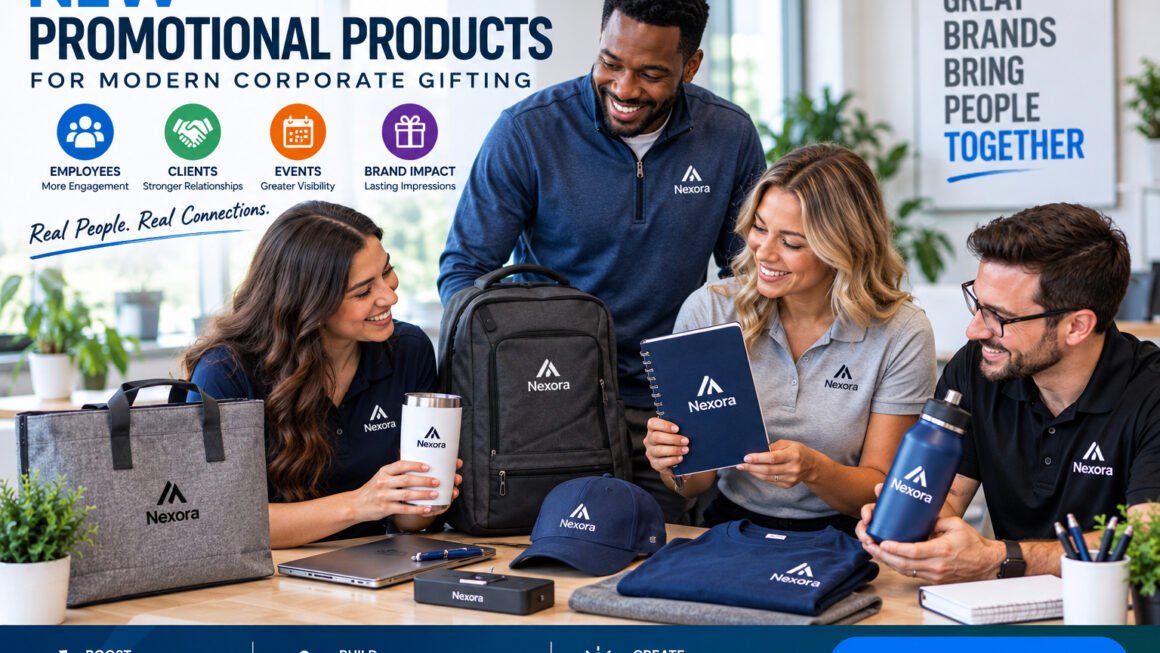
The category extends far beyond traditional pens and basic giveaways. Modern corporate merchandise programs can include performance apparel, premium outerwear, reusable drinkware, bags, desk accessories, technology products, event merchandise, recognition gifts, onboarding kits, and coordinated branded collections.
What makes a promotional product valuable is the interaction between the product and the recipient. An item that remains useful for months can create repeated brand exposure, while a poorly selected product may be discarded before it creates meaningful marketing value.
Why Businesses Are Rethinking Corporate Giveaways
Promotional merchandise increasingly functions as part of the overall brand experience. Employees encounter it during onboarding. Prospects receive it at trade shows. Customers receive it after important milestones. Sales teams use it to strengthen relationships, and organizations use branded apparel to create a more consistent presence at meetings, conferences, community events, and field operations.
This changes how buyers should evaluate merchandise. Instead of asking, “What can we put our logo on?” a more productive question is, “What experience should this product create?”
A useful product can generate repeated exposure without requiring another media impression to be purchased each time it is used. That makes retention, usefulness, quality, and visual appeal important parts of promotional merchandise ROI.
New Corporate Giveaways That Fit Modern Business Programs
Short Answer: Effective new corporate giveaways tend to fall into several high-utility categories: apparel, drinkware, bags, technology accessories, workplace merchandise, travel products, wellness-oriented items, and curated gift kits. The best category depends on the recipient and the moment in which the merchandise is delivered.
- Branded apparel: Performance polos, jackets, quarter-zips, T-shirts, caps, uniforms, and event apparel can turn employees and participants into visible brand representatives.
- Drinkware: Tumblers, insulated bottles, travel mugs, and reusable bottles offer practical everyday utility and substantial decoration areas.
- Bags: Backpacks, totes, laptop bags, travel bags, and event bags combine functionality with repeated mobile brand exposure.
- Technology accessories: Charging accessories, cable organizers, device stands, and related workplace technology products can support hybrid and mobile professionals.
- Office and desk merchandise: Notebooks, writing instruments, organizers, and workspace accessories work well for onboarding, meetings, training, and client programs.
- Curated kits: Multiple complementary products packaged together can create a more intentional experience for employees, customers, speakers, executives, and event attendees.
Use Case Block: Where Promotional Products Create Business Value
Promotional merchandise performs best when the product is selected around a specific business moment. The same organization may need several merchandise strategies because a recruiting event, executive meeting, employee anniversary, and customer conference each have different audiences and expectations.
Employee Onboarding Kits
An onboarding kit can turn a routine administrative process into an early brand experience. A coordinated package might include a branded shirt or quarter-zip, drinkware, notebook, bag, and practical desk item.
The operational advantage comes from standardization. Once the merchandise assortment, artwork, sizes, packaging, and replenishment process are established, HR and procurement teams can reduce repeated sourcing decisions and create a more consistent experience for new employees.
Trade Show Giveaways
Trade show merchandise should support the actual event objective. High-volume booth traffic may justify a scalable giveaway, while pre-qualified prospects or scheduled meetings may warrant a more valuable item.
A company attending an industry conference with 2,000 potential attendees, for example, does not necessarily need 2,000 premium gifts. It might order 1,000 accessible giveaways for booth engagement and 100 higher-value products for qualified prospects, customers, speakers, or strategic meetings. That tiered approach can improve budget allocation without sacrificing reach.
Businesses preparing for conferences can explore branded merchandise at https://products.digitizedlogos.com/ and build selections around audience volume, event deadlines, decoration requirements, and desired perceived value.
Corporate Gifting
Corporate gifting is less about maximum logo size and more about perceived relevance. A premium product with tasteful branding can feel like a genuine gift while still keeping the organization visible.
This is especially important for executive gifts, customer appreciation programs, milestone celebrations, and account-based marketing campaigns where the recipient relationship is more valuable than the quantity distributed.
Employee Recognition and Internal Campaigns
Branded merchandise can support anniversaries, performance recognition, safety programs, company meetings, wellness initiatives, and internal launches. Apparel and merchandise can also help distributed teams share a consistent visual identity across multiple offices and regions.
A Step-by-Step Framework for Selecting Promotional Products
A structured buying process reduces wasted inventory, rushed production, inconsistent branding, and products that do not fit the audience.
- Define the business outcome. Decide whether the merchandise should create awareness, reward employees, generate booth traffic, support recruiting, strengthen customer relationships, or serve another measurable purpose.
- Identify the recipient. Consider role, environment, expected product usage, demographics where relevant, and whether recipients are employees, customers, prospects, partners, or event attendees.
- Set a realistic total budget. Include product cost, decoration, setup, packaging, freight, shipping to individual recipients, and potential rush costs rather than comparing unit prices alone.
- Select the product category. Match utility and perceived value to the campaign instead of choosing solely because an item is new or inexpensive.
- Choose the customization method. Evaluate logo size, colors, imprint location, garment construction, material, artwork complexity, and desired visual impact.
- Confirm quantities and deadlines. Minimum quantities, inventory availability, production schedules, transit time, and event dates should be validated before artwork approval.
- Plan distribution. Determine whether products will ship to one location, multiple offices, individual recipients, event venues, or an ongoing fulfillment program.
- Measure the outcome. Track distribution, recipient response, campaign participation, qualified leads, employee engagement, repeat usage, or another metric tied to the original objective.
Customization and Production Methods Matter
The same product can communicate very different levels of quality depending on how it is decorated. Decoration should therefore be considered during product selection, not after the merchandise has already been chosen.
Embroidery can create a dimensional, professional appearance on polos, jackets, caps, and other suitable apparel. Screen printing can work well for many larger-volume apparel applications. Full-color and dye-sublimation methods can support more complex visual treatments where the product and material are compatible. Other products may use digital printing, transfers, engraving, or specialized imprint processes.
Practical operational insight: The largest available imprint area is not automatically the best branding choice. A premium jacket or executive gift may benefit from restrained logo placement, while a trade show banner, performance jersey, or full-color event product may call for greater visual impact.
Artwork should also be evaluated against the production method. Fine lines, small text, gradients, multiple colors, fabric texture, seams, zippers, pockets, and curved surfaces can affect the final result.
Behind the Scenes: What Happens After You Choose a Product?
Product selection is only the visible part of a promotional merchandise project. Behind the scenes, a reliable program requires inventory verification, artwork preparation, decoration specifications, proof approval, production scheduling, quality control, packaging, freight coordination, and final distribution.
For apparel, sizing adds another operational layer. For multi-location or individual-recipient programs, address collection and shipment management can become as important as the merchandise itself.
Practical operational insight: Event deadlines should be treated as delivery deadlines, not production deadlines. Building additional time between expected delivery and the event provides room for receiving, counting, organizing, internal distribution, or addressing unexpected issues.
Buyer Considerations: What Should You Evaluate Before Ordering?
Business buyers should evaluate total program fit rather than comparing products on unit price alone. A lower-cost product can become expensive if it has poor retention, inconsistent decoration, high freight costs, or limited usefulness.
- Audience fit: Will recipients realistically use the item?
- Brand fit: Does the product reinforce the organization’s desired image?
- Decoration quality: Is the customization method appropriate for the material and artwork?
- Inventory: Are required quantities, colors, sizes, and variations available?
- Scalability: Can the product support future reorders or a larger program?
- Fulfillment: Will merchandise ship in bulk, to multiple offices, or directly to recipients?
- Timeline: Is there enough time for proofing, production, shipping, and contingency?
- Total cost: Have decoration, setup, freight, packaging, and fulfillment been considered?
Decision Support: Cost, ROI, Turnaround and Minimum Quantities
Short Answer: Promotional product pricing depends on the product, order volume, decoration method, number of imprint locations, packaging, freight, and fulfillment requirements. Buyers should compare total delivered program cost and expected business value rather than evaluating the blank product price alone.
How Should You Think About Cost?
Suppose a business has a $10,000 merchandise budget. One option is to distribute 2,000 items at an average total program cost of $5 each. Another is to distribute 500 more targeted gifts at $20 each. Both use the same budget, but they serve very different objectives.
If the goal is broad conference visibility, the higher-volume approach may make sense. If the recipients are 500 strategically important customers, employees, or qualified prospects, the higher-value product may create greater perceived value and retention.
How Should Promotional Product ROI Be Measured?
ROI should reflect the campaign objective. Event programs might measure qualified conversations, meetings booked, booth engagement, or cost per lead. Employee programs might consider participation, adoption, recognition, onboarding experience, or internal engagement. Corporate gifting may be evaluated through account engagement, retention, relationship development, or response rates.
A simple scenario illustrates the principle. If a $7,500 trade show merchandise program helps generate 75 qualified sales conversations, the merchandise component represents $100 per qualified conversation before considering other event expenses. If several conversations become valuable opportunities, evaluating the program solely by giveaway unit cost misses its commercial purpose.
What About Turnaround Times?
Turnaround varies according to product availability, decoration method, quantity, proof approval, production capacity, shipping destination, and seasonal demand. Products needed for fixed events should be sourced earlier than general inventory because there is little flexibility if the event date cannot move.
Are Minimum Quantities Always High?
No. Minimum quantities vary significantly across product categories and suppliers. Some products accommodate smaller orders, while specialized manufacturing, custom colors, complex packaging, or factory-direct production may require larger quantities.
Digitized Logos manages sourcing, customization, and fulfillment considerations so business buyers can evaluate products within the context of quantity, timing, branding, and distribution requirements. Buyers comparing options can review promotional products at https://products.digitizedlogos.com/ before finalizing a program.
New Promotional Products vs Traditional Giveaways
Traditional promotional products still have a place when they are useful, appropriate, and cost-effective. A quality pen, tote, notebook, or T-shirt does not become ineffective simply because the category has existed for years.
The difference is often execution. Newer corporate merchandise programs tend to place greater emphasis on product usefulness, retail-inspired styling, personalization, sustainability considerations, premium packaging, coordinated collections, and fulfillment flexibility.
Traditional giveaway strategy: Prioritizes broad distribution, low unit cost, simple branding, and high quantities.
Modern merchandise strategy: Prioritizes audience relevance, perceived value, brand experience, product retention, customization, and measurable campaign outcomes.
Many organizations benefit from using both. High-volume merchandise can support awareness while premium branded gifts are reserved for higher-value interactions.
Promotional Merchandise Trends Business Buyers Should Watch
The market is moving toward merchandise that feels less like advertising inventory and more like something recipients would voluntarily choose to own. This favors practical products, stronger materials, thoughtful design, wearable apparel, coordinated kits, and merchandise that fits modern work and travel routines.
Another important trend is program thinking. Instead of purchasing unrelated items from campaign to campaign, organizations are developing repeatable branded merchandise systems with approved products, artwork standards, apparel selections, event kits, onboarding merchandise, and replenishment processes.
For companies operating across Maryland, Virginia, Washington DC, and the broader United States, program consistency can be particularly useful when multiple offices, departments, events, and teams need branded merchandise while maintaining a recognizable identity.
Common Promotional Product Mistakes
One of the most common mistakes is starting with price instead of purpose. A low-cost item that recipients do not want can create little lasting value, regardless of how attractive the unit price initially appears.
Another mistake is waiting until an event is close before beginning sourcing. Product inventory can change, popular colors may sell out, proofs require approval, and production and freight need time.
Businesses should also avoid treating every recipient the same. A conference attendee, long-term customer, executive stakeholder, new employee, and field team member have different needs. Segmenting merchandise by audience often produces a stronger program without necessarily increasing the overall budget.
How to Scale a Corporate Merchandise Program
Scalability becomes important when merchandise moves from occasional purchasing to an ongoing business function. A company may initially order products for one conference, then discover that HR, sales, marketing, recruiting, customer success, and leadership all have recurring merchandise needs.
A scalable approach establishes approved products, brand standards, artwork files, ordering procedures, budget expectations, inventory practices, and fulfillment rules. This reduces duplicated sourcing work and helps protect quality consistency across departments.
For example, a regional organization with offices in Maryland, Virginia, and Washington DC could establish a core collection of approved branded apparel, drinkware, bags, and event products. Individual departments could then select from the approved assortment rather than independently sourcing unrelated merchandise for every campaign.
How to Choose a Promotional Products Vendor
Short Answer: Choose a promotional products partner based on sourcing capability, decoration knowledge, quality control, communication, deadline management, customization flexibility, and fulfillment support, not simply access to a large catalog.
A strong vendor should help identify what is operationally realistic before an order reaches production. That includes discussing inventory, minimum quantities, artwork limitations, imprint methods, shipping requirements, deadlines, and potential alternatives when the original request is not the best fit.
Digitized Logos provides branded apparel and promotional product solutions and manages sourcing, customization, and fulfillment. The company is an MDOT, DDOT, and VA SWaM Certified Small, Minority, Female-Owned Business, supporting organizations seeking branded merchandise solutions in Maryland, Virginia, Washington DC, and across the United States.
Key Takeaways
- Start with the business objective: Product selection should follow the audience, campaign, desired outcome, budget, and distribution plan.
- Measure total value: Consider usefulness, retention, perceived quality, customization, fulfillment, and campaign outcomes rather than unit price alone.
- Plan operationally: Inventory, proofs, production, packaging, shipping, apparel sizing, and event deadlines can determine whether a program succeeds.
- Segment when appropriate: Different merchandise tiers can serve high-volume awareness and higher-value customer, employee, or prospect interactions within the same campaign.
- Build for scalability: Approved products and repeatable merchandise processes can improve consistency as programs expand across teams, locations, and events.
Frequently Asked Questions About New Corporate Giveaways
What promotional products are best for corporate events?
The best event products are useful, portable, easy to distribute, and appropriate for the attendee profile. Drinkware, bags, branded apparel, notebooks, technology accessories, and compact practical giveaways can work well. Product value should reflect whether the goal is broad booth traffic, qualified lead engagement, customer appreciation, or VIP gifting.
How far in advance should businesses order promotional products?
Ordering early provides more flexibility for inventory, artwork approval, production, and shipping. Exact timing varies by product and customization method, but fixed-date events deserve additional contingency time. Buyers should work backward from the required delivery date rather than treating the event date as the target arrival date.
How much should a company spend on corporate giveaways?
There is no universal amount. Spending should reflect recipient value, campaign objective, quantity, expected business outcome, and total program budget. High-volume awareness campaigns may prioritize economical items, while executive gifting, employee recognition, and strategic customer programs can justify higher per-recipient spending for greater perceived value.
Can promotional products be customized beyond adding a logo?
Yes. Depending on the product and production method, customization can include multiple imprint locations, full-color artwork, embroidery, personalized names, coordinated brand colors, custom packaging, and product-specific decoration. The best approach balances visual impact with material, production limitations, budget, quantity, and intended recipient experience.
Can new corporate giveaways be shipped to multiple locations?
Many merchandise programs can be designed around bulk shipping, multi-location distribution, or individual recipient fulfillment. Requirements should be discussed before production because packaging, address management, freight, kitting, and shipping costs affect the program. Planning fulfillment early is especially important for distributed teams, onboarding programs, and nationwide campaigns.
Turn Promotional Products Into a Stronger Brand Experience
The best new promotional products do more than carry a company logo. They give employees, customers, prospects, and event attendees a useful physical connection to the brand while supporting objectives such as awareness, engagement, recognition, recruiting, relationship development, and event readiness.
Digitized Logos can help businesses evaluate branded apparel, corporate merchandise, and new corporate giveaways around practical factors such as customization, quantities, deadlines, fulfillment, and brand consistency. The result is a merchandise program designed around business outcomes rather than simply filling an order.
For support building your next corporate merchandise program, call 301-963-3553 or visit https://products.digitizedlogos.com/. Explore options early to improve product availability, protect event timelines, maintain merchandise consistency, and create more flexibility for customization and fulfillment.
#NewPromotionalProducts #CorporateGiveaways #PromotionalProducts #CorporateSwag #BrandedMerchandise #BrandedApparel #CorporateGifting #TradeShowGiveaways #EmployeeOnboarding #DigitizedLogos