Personalized Staff Appreciation Gifts That Employees Actually Value
Personalized staff appreciation gifts give organizations a practical way to recognize employees while strengthening culture, engagement, and brand connection. The most effective gifts combine usefulness, thoughtful customization, dependable quality, and an experience that feels intentional rather than like generic corporate swag.
For employers planning recognition programs, onboarding initiatives, company events, milestone celebrations, or year-round gifting, Digitized Logos provides branded apparel, promotional products, and corporate merchandise solutions designed for real business requirements. Companies can explore corporate gifting and branded merchandise options through :contentReference[oaicite:0]{index=0}.
Quick Answer: What Are the Best Personalized Staff Appreciation Gifts?
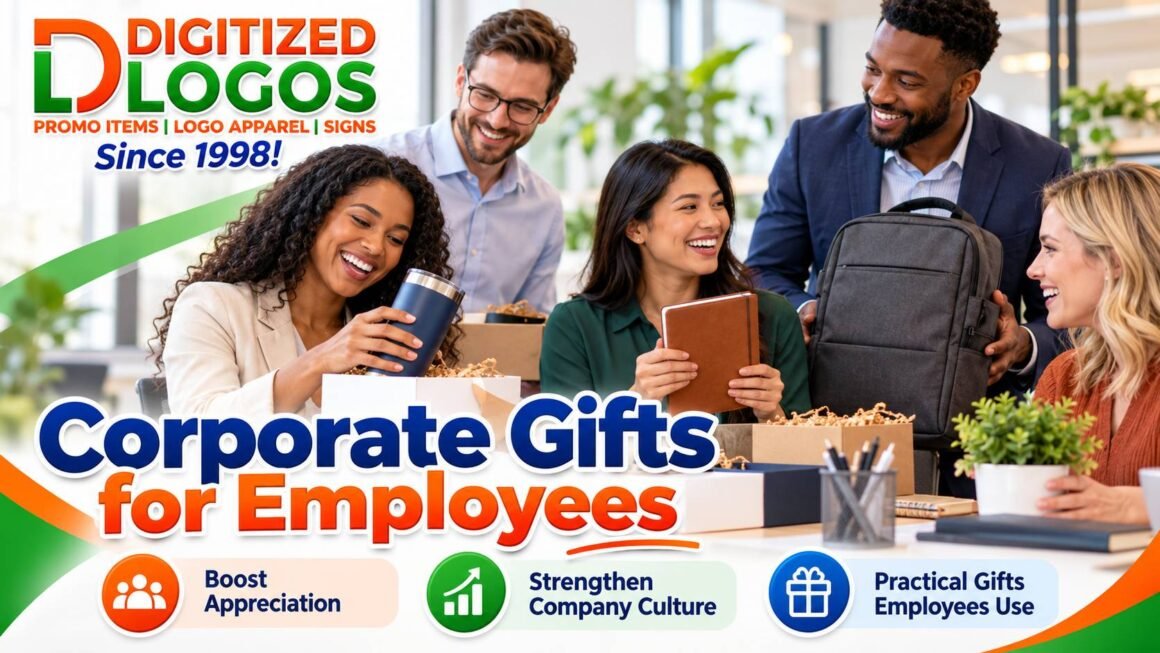
Short Answer: The best personalized staff appreciation gifts are useful, relevant to the recipient, aligned with company culture, and customized professionally. Popular presenting gift ideas include premium drinkware, embroidered apparel, backpacks, tech accessories, desk products, wellness gifts, travel items, recognition kits, and curated merchandise packages.
For business buyers, the product itself is only part of the decision. Decoration quality, packaging, inventory availability, production timelines, shipping, employee distribution, and consistency across multiple orders can determine whether an appreciation program succeeds.
What Are Personalized Staff Appreciation Gifts?
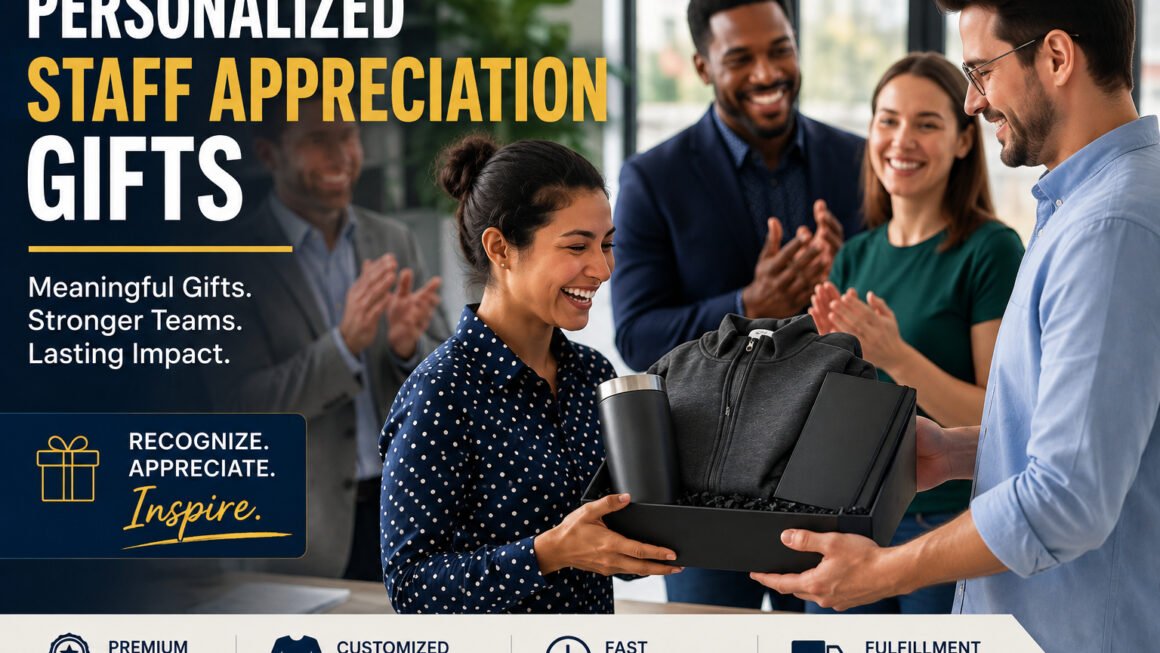
Definition: Personalized staff appreciation gifts are products selected and customized to recognize employees for their contributions, achievements, milestones, loyalty, or participation. Personalization may include an employee name, company logo, department identity, event theme, anniversary date, custom message, or a combination of these elements.
They differ from ordinary promotional giveaways because the primary objective is recognition. A trade show giveaway is typically designed for broad brand exposure, while an employee appreciation gift should make the recipient feel specifically valued.
That distinction affects everything from product quality and decoration to packaging and presentation. A thoughtfully embroidered quarter-zip presented for a five-year anniversary creates a different experience from an inexpensive giveaway distributed indiscriminately.
Why Staff Appreciation Gifts Matter to Businesses
Employee recognition is often discussed as a human resources initiative, but it also has operational and brand implications. Employees influence customer experiences, workplace culture, recruiting, retention, internal communication, and the way an organization is represented outside the office.
A useful branded gift can continue creating value long after the recognition moment. A premium backpack may travel between home and work for years. An insulated tumbler can appear on an employee’s desk every day. A well-designed jacket can turn an employee into a natural brand ambassador without making the product feel like advertising.
This is why the practical ROI of employee gifting should not be measured exclusively as immediate revenue generated per gift. Its value can include employee goodwill, participation, brand visibility, culture reinforcement, retention support, and reduced purchasing fragmentation.
Presenting Gift Ideas: What Should Companies Give Employees?
There is no single product that works for every workforce. Strong presenting gift ideas start with the recipient, occasion, working environment, budget, and desired experience.
- Premium branded apparel: Polos, jackets, hoodies, quarter-zips, performance shirts, hats, and other wearable merchandise can combine recognition with long-term brand visibility.
- Drinkware: Tumblers, insulated bottles, mugs, and travel drinkware are practical for office, hybrid, field, and remote employees.
- Bags and backpacks: Laptop backpacks, totes, duffels, travel bags, and drawstring bags provide substantial branding space and everyday utility.
- Technology accessories: Chargers, power banks, wireless accessories, cable organizers, and related products work particularly well for technology-dependent teams.
- Desk and office merchandise: Notebooks, writing instruments, organizers, portfolios, and desk accessories can support professional recognition programs.
- Wellness merchandise: Fitness accessories, outdoor products, relaxation items, and wellness-oriented kits can complement broader employee wellbeing initiatives.
- Recognition kits: Combining several coordinated products in one package can make an anniversary, achievement, or company milestone feel substantially more important.
- Travel merchandise: Luggage accessories, travel organizers, bags, bottles, and portable technology products are useful for sales teams, executives, field employees, and frequent travelers.
The goal should not be to put a logo on as many objects as possible. The goal is to select merchandise employees will willingly keep, wear, carry, or use.
Common Use Cases for Employee Appreciation Merchandise
Use Case: Personalized employee gifts work best when they are connected to a recognizable moment in the employee experience. This creates context for the gift and makes recognition feel deliberate rather than random.
Companies commonly use branded gifts for employee anniversaries, Employee Appreciation Day, annual meetings, performance recognition, sales achievements, holiday programs, project completions, promotions, retirements, safety milestones, company anniversaries, onboarding, leadership conferences, and team events.
The same sourcing infrastructure can support related corporate merchandise requirements. An organization may use premium kits for employee recognition, coordinated branded apparel for an annual meeting, onboarding merchandise for new hires, and promotional products for trade shows while maintaining consistent brand standards across each program.
Businesses evaluating a broader merchandise strategy can begin with :contentReference[oaicite:1]{index=1} to coordinate promotional products, corporate gifts, and apparel within a more unified purchasing process.
A Step-by-Step Framework for Building a Staff Appreciation Program
- Define the recognition moment. Determine whether the program celebrates service anniversaries, performance, onboarding, holidays, company milestones, event participation, or another specific achievement.
- Establish the recipient profile. Consider office employees, remote workers, executives, field personnel, technicians, sales teams, hospitality employees, healthcare teams, or mixed workforces. Their daily routines should influence product selection.
- Set a realistic per-recipient budget. Include the product, customization, packaging, freight, individual shipping, setup costs, and any fulfillment requirements rather than evaluating only the blank product price.
- Select merchandise for utility and perceived value. Prioritize products employees are likely to keep. A smaller number of better products frequently creates a stronger experience than a box filled with low-value merchandise.
- Choose the customization method. Match embroidery, screen printing, full-color printing, dye sublimation, engraving, transfer methods, or other decoration techniques to the product and creative requirements.
- Approve proofs and samples carefully. Review logo proportions, colors, placement, personalization, spelling, sizing, and product specifications before production.
- Plan fulfillment before production begins. Determine whether products will ship to one corporate location, multiple offices, event venues, or individual employee addresses.
- Measure participation and feedback. Track employee response, product usage, reorder demand, distribution accuracy, and internal feedback to improve future programs.
Customization: Logo Branding Versus True Personalization
Customization and personalization are related but not identical. A company logo makes an item branded. Adding the recipient’s name, achievement, anniversary year, department, or individual message makes the experience more personal.
Businesses should decide how far personalization needs to go before requesting pricing because variable personalization can affect production workflow. Producing 500 identical embroidered jackets is operationally different from producing 500 jackets containing individual employee names.
That distinction can affect setup, data management, proofing, production time, sorting, and fulfillment. Providing a clean employee data file with standardized spelling, sizes, shipping information, and personalization fields can reduce errors substantially.
Which Production Method Is Best?
Short Answer: The best customization technique depends on the product material, artwork, quantity, desired appearance, durability requirements, and budget. Embroidery often works well for premium apparel, while full-color decoration and dye sublimation can support more complex creative applications.
Embroidery creates a dimensional, professional appearance and is particularly effective on polos, jackets, caps, bags, and uniforms. Printing methods can be preferable when artwork contains gradients, multiple colors, large graphics, or detailed visual elements.
Full-color dye sublimation is especially valuable when the design needs to become part of the apparel rather than simply occupy a small decoration area. It can support bold patterns, edge-to-edge visual concepts, complex graphics, and highly customized branded apparel.
What Does a Successful Program Cost?
There is no universal price for personalized staff appreciation gifts because cost depends on product category, brand, quantity, decoration technique, number of decoration locations, personalization, packaging, freight, and fulfillment complexity.
Consider a company recognizing 200 employees with a hypothetical all-in merchandise budget of $60 per recipient. That represents a $12,000 program before any special distribution requirements. Rather than dividing that budget among numerous inexpensive products, the buyer might invest in one premium wearable and one practical accessory to increase perceived value and usage.
A second organization might have 1,000 employees across multiple locations with a $35 merchandise target. The purchasing strategy becomes different: inventory availability, decoration efficiency, carton sorting, location-specific quantities, shipping schedules, and consistency become much more important at that scale.
How Should Businesses Think About ROI?
Short Answer: Employee appreciation gift ROI should be evaluated through a combination of employee response, product usage, participation, brand exposure, program efficiency, and retention-related value rather than direct sales alone.
For example, suppose a company spends $50 each on 300 appreciation gifts, creating a $15,000 merchandise investment. If employees use those products repeatedly for a year, the cost per meaningful interaction can become very low compared with a disposable recognition item that is forgotten immediately.
There is also an operational ROI. Centralizing recurring branded merchandise can reduce the time managers spend independently finding vendors, obtaining proofs, reconciling inconsistent logos, managing quality problems, and coordinating shipments.
Behind the Scenes: What Happens After You Approve a Gift?
Business buyers often see a product image and a logo proof, but production involves several additional steps. Depending on the merchandise, the process can include product sourcing, inventory verification, artwork preparation, decoration setup, pre-production approval, manufacturing or decoration, quality checks, sorting, packaging, and shipment coordination.
Personalization adds another control layer. If 250 employee names are being applied to 250 garments, production data needs to match the correct product, size, spelling, and recipient. For individually shipped programs, those finished products must then be matched to the appropriate destination.
This is one reason experienced merchandise coordination matters. A successful gifting program is partly a creative project and partly a logistics project.
Two Realistic Employee Appreciation Program Examples
Example 1: A 150-Person Professional Services Company
A professional services organization wants to recognize employees at its annual meeting. Instead of distributing another inexpensive giveaway, it selects premium quarter-zips customized with the corporate identity and packages them with insulated drinkware.
Sizes are collected several weeks before the event, artwork is approved in advance, and the merchandise is sorted for distribution. The result is a coordinated recognition experience that also gives employees apparel they can wear during client meetings, travel, and company events.
Example 2: A Multi-Location Company With 800 Employees
A regional employer needs to recognize 800 employees working across Maryland, Virginia, Washington DC, and additional United States locations. Shipping everything to headquarters would create an unnecessary redistribution problem.
A better approach is to establish quantities by location before production and build fulfillment requirements into the program from the beginning. Products can then be packed according to location or another defined distribution structure, reducing internal handling and helping gifts reach employees more efficiently.
Practical Operational Insights Buyers Often Overlook
Operational Insight 1: Confirm inventory before announcing the gift internally. Apparel sizes, popular colors, and specific product models can become unavailable, particularly when large quantities are required. Substituting products after employees have already seen them creates unnecessary disappointment and approval work.
Operational Insight 2: Build shipping into the original budget. A $40 gift is not necessarily a $40-per-employee program when products require custom packaging and individual residential delivery. Understanding landed program cost makes vendor comparisons more meaningful.
Buyer Considerations: What Should You Evaluate Before Ordering?
Corporate buyers should evaluate the complete program rather than selecting merchandise solely by unit price. The cheapest quote can become expensive if it results in inconsistent decoration, missed event dates, replacement orders, excessive internal handling, or products employees do not want.
- Product quality: Will employees perceive the item as something worth keeping?
- Brand consistency: Can logos, colors, placement, and decoration remain consistent across multiple products?
- Inventory: Are the required colors, sizes, and quantities realistically available?
- Customization flexibility: Can the supplier accommodate names, departments, multiple artwork versions, or special packaging?
- Production capacity: Can the order be completed within the required schedule?
- Fulfillment: Can merchandise be sorted or distributed according to the organization’s needs?
- Scalability: Can the program expand from 100 recipients to 1,000 without requiring an entirely new process?
- Reordering: Can successful products be reordered while maintaining reasonable consistency?
Decision Support: Cost, Minimums, Turnaround and Fulfillment
How Much Should We Spend?
Start with the importance of the recognition moment and expected recipient experience. A routine participation gift may justify a modest budget, while a major service anniversary, executive recognition, or milestone award may require a higher-value product.
Are Minimum Quantities Required?
Minimum order quantities vary by product and customization method. Some merchandise is practical in relatively small quantities, while custom-manufactured or highly specialized products may require larger production runs. Buyers should confirm minimums early rather than building a program around a product that does not fit the required quantity.
How Long Does Production Take?
Turnaround depends on inventory, decoration, quantity, proof approval, personalization, manufacturing requirements, and shipping destination. Event-driven orders should include buffer time for proof revisions and logistics rather than treating the event date as the production completion date.
How Flexible Is Customization?
Customization can range from a single logo to complex full-color graphics, multiple decoration locations, employee names, department versions, event branding, and custom packaging. Greater customization can produce a more distinctive experience but may also introduce additional production steps.
Can Merchandise Go to Multiple Locations?
Fulfillment requirements should be discussed before ordering. Distribution to one headquarters is operationally different from shipping to regional offices or individual employees. Digitized Logos manages sourcing, customization, and fulfillment, helping business buyers coordinate the merchandise program rather than treating each stage as a separate project. Learn more through :contentReference[oaicite:2]{index=2}.
Generic Gifts Versus Personalized Employee Gifts
Generic merchandise can be appropriate for large events where speed, reach, and unit economics matter most. Personalized gifts are better suited to recognition moments where emotional relevance and perceived value are important.
A basic logo item says, “This is from our company.” A thoughtfully selected item personalized for an employee can say, “This recognition was prepared for you.” That difference matters when the objective is appreciation rather than simply merchandise distribution.
Employee Appreciation Gifts Versus Corporate Swag
Corporate swag generally supports broad brand awareness, events, recruiting, marketing, and community engagement. Employee appreciation merchandise has a more specific recognition objective, even though the same product categories may overlap.
A branded backpack handed out at a trade show functions as a promotional product. A premium backpack presented to an employee after a major achievement functions as a recognition gift. The context, presentation, quality expectations, and desired business outcome change the meaning of the product.
Connecting Appreciation Gifts to a Larger Merchandise Program
Employee recognition becomes more efficient when it is considered alongside other branded merchandise requirements. Companies frequently purchase onboarding kits, corporate apparel, trade show giveaways, customer gifts, event merchandise, uniforms, and employee recognition products through separate departments.
That fragmentation can create inconsistent logos, duplicate products, uneven quality, unnecessary setup costs, and limited purchasing visibility. A coordinated merchandise program can establish clearer product standards, approved artwork, repeatable decoration specifications, and purchasing processes.
For example, an approved premium polo can serve onboarding, conferences, sales meetings, and employee recognition programs. The objective is not to make every program identical, but to create enough standardization that buyers are not rebuilding their merchandise strategy with every order.
Employee Onboarding Is Another Important Recognition Opportunity
Recognition should not begin after an employee has worked for the company for five years. An onboarding kit creates one of the earliest physical interactions a new employee has with the organization’s culture.
A coordinated welcome package might combine apparel, drinkware, a notebook, technology accessories, and a welcome message. For remote employees, delivering the package before or during the first week can help create a tangible connection to the organization even when the employee is not entering a physical office.
Current Trends in Corporate Gifting and Branded Merchandise
Corporate gifting is moving away from simply maximizing the number of items in a package. Business buyers increasingly prioritize usefulness, product quality, personalization, presentation, sustainability considerations, premium apparel, flexible fulfillment, and merchandise that fits hybrid working environments.
Another important trend is visual customization. Companies increasingly want branded apparel and merchandise that feels designed rather than simply decorated. Full-color production, custom patterns, creative packaging, coordinated kits, and more sophisticated brand applications can make employee merchandise feel closer to retail-quality products.
Common Mistakes When Choosing Personalized Staff Appreciation Gifts
- Choosing by price alone: Low-cost merchandise delivers little value when employees do not use it.
- Ordering too late: Tight timelines reduce product choices and create unnecessary production risk.
- Ignoring recipient demographics: The same product is not equally useful to office, remote, warehouse, field, and executive teams.
- Over-branding the merchandise: Employees are more likely to use products that look attractive independently of the corporate logo.
- Forgetting fulfillment costs: Individual shipping, packaging, and sorting can materially change total program cost.
- Skipping artwork controls: Inconsistent logos, incorrect colors, and poor placement weaken the professional impression.
- Failing to plan reorders: A successful program should be designed with future employees and recurring milestones in mind.
How to Select a Corporate Gifting Vendor
Short Answer: Select a corporate gifting partner based on sourcing capability, decoration expertise, quality control, customization flexibility, communication, production reliability, fulfillment support, and ability to scale, not simply the lowest unit price.
A strong vendor should understand how merchandise moves from product selection to finished delivery. Buyers should ask how artwork is handled, how inventory is confirmed, what happens when products become unavailable, how personalization data is managed, and how multi-location orders are sorted.
Digitized Logos provides branded apparel and promotional product solutions for organizations seeking coordinated corporate merchandise programs. The company manages sourcing, customization, and fulfillment and is an MDOT, DDOT, and VA SWaM Certified Small, Minority, Female-Owned Business.
This combination is relevant for businesses, associations, institutions, government-related buyers, and organizations throughout Maryland, Virginia, Washington DC, and across the United States that need branded merchandise backed by structured purchasing and fulfillment support.
How to Scale From Occasional Gifts to a Merchandise Program
A business does not need thousands of employees to benefit from a more structured merchandise strategy. Scalability begins by documenting what works.
Maintain approved artwork, decoration specifications, product information, employee sizing processes, packaging requirements, shipping procedures, and reorder history. When the next onboarding class, employee anniversary, conference, or trade show arrives, the organization has a repeatable foundation rather than starting over.
At larger scale, companies can also establish product tiers. Everyday recognition might use one merchandise level, milestone anniversaries another, and executive or major achievement awards a premium tier. This makes spending more predictable while preserving the significance of different recognition moments.
Key Takeaways
- Useful products create more value. Prioritize merchandise employees will genuinely wear, carry, display, or use.
- Plan the complete cost. Evaluate products, decoration, personalization, packaging, freight, and fulfillment together.
- Start early. Additional planning time improves product choice and reduces inventory and production risk.
- Build for scalability. Approved products, artwork, specifications, and fulfillment processes make recurring programs easier to manage.
- Think beyond the gift. Personalized employee merchandise can support recognition, culture, brand visibility, onboarding, events, and broader corporate merchandise strategies.
Frequently Asked Questions About Personalized Staff Appreciation Gifts
What are good personalized staff appreciation gifts for employees?
Good personalized staff appreciation gifts include premium apparel, insulated drinkware, backpacks, technology accessories, travel merchandise, notebooks, wellness products, and curated gift kits. The strongest choice depends on employee preferences, workplace environment, budget, recognition occasion, and how frequently the recipient is likely to use the product.
How far in advance should companies order employee appreciation gifts?
Companies should begin planning as early as practical, especially for large quantities, personalized products, custom manufacturing, or event-specific deadlines. Production schedules vary by product and decoration method. Additional time should also be allowed for artwork approval, inventory changes, packaging, sorting, freight, and multi-location fulfillment.
Can employee gifts include individual names as well as a company logo?
Yes. Many personalized gifts can combine corporate branding with employee names, departments, milestones, or other variable information. Feasibility depends on the product and decoration method. Buyers should provide accurate personalization data early because individually customized products require additional production controls, proofing, sorting, and quality assurance.
Are there minimum quantities for customized employee gifts?
Minimum quantities vary by product, supplier, decoration method, and level of customization. Some promotional products and branded apparel can support relatively small programs, while fully custom manufactured merchandise may require higher quantities. Confirming recipient count and budget before product selection helps identify practical options quickly.
How do businesses choose between one premium gift and a gift box?
Choose based on the recognition moment and recipient experience. One premium product can deliver greater long-term utility, while a curated kit creates a stronger unboxing and presentation experience. Businesses should compare total cost, perceived value, shipping requirements, product usefulness, and whether multiple items genuinely improve the recognition experience.
Build a Staff Appreciation Program Employees Will Remember
The best personalized staff appreciation gifts do more than place a corporate logo on a product. They connect useful merchandise with meaningful recognition while giving organizations a scalable way to reinforce culture, improve brand visibility, support employee engagement, and create a more consistent merchandise experience.
Digitized Logos helps businesses coordinate branded apparel, promotional products, corporate merchandise, customization, and fulfillment for employee programs, onboarding, events, trade shows, and other branded merchandise initiatives. Whether you need presenting gift ideas for a small team or a scalable program serving employees across multiple locations, thoughtful planning can reduce purchasing friction while improving the recipient experience.
Ready to plan your next employee appreciation program? Call 301-963-3553 or visit DigitizedLogos.com to explore options for flexible ordering, customization support, merchandise consistency, event readiness, brand visibility, and dependable turnaround.
#PersonalizedStaffAppreciationGifts #EmployeeAppreciation #CorporateGifts #BrandedMerchandise #PromotionalProducts #CorporateSwag #BrandedApparel #EmployeeGifts #CorporateMerchandise