
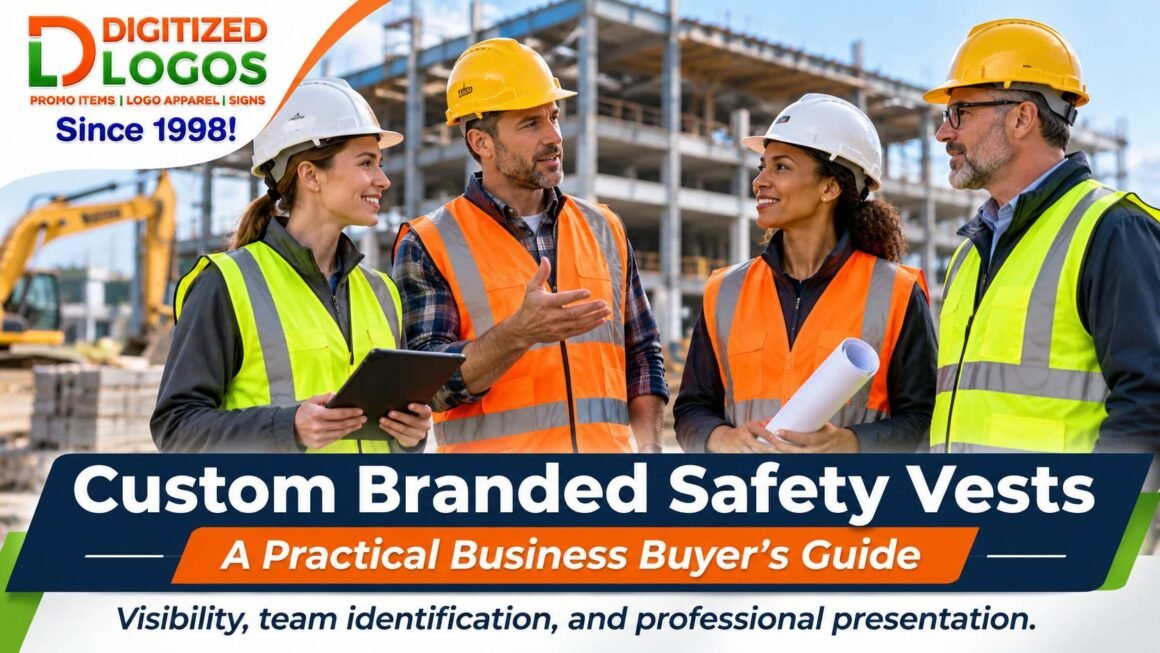
Workplace visibility is a practical concern for businesses operating around vehicles, machinery, loading areas, and active job sites. Employees need to be recognizable, appropriately equipped, and easy to identify in environments where several teams may be working simultaneously.
Custom branded safety vests combine high-visibility workwear with company identification. By adding an approved business logo to suitable safety apparel, organizations can support team recognition and a consistent professional appearance without overlooking the garment’s primary visibility function.
For construction companies, warehouse operators, facility managers, contractors, and event organizers, choosing the right vest involves more than selecting a fluorescent color. Visibility requirements, garment construction, customization methods, sizing, and ordering procedures all influence the purchasing decision.
What Are Custom Branded Safety Vests?
Custom branded safety vests are high-visibility garments personalized with a company logo, business name, department identification, or other approved artwork. They are commonly worn in workplaces where employee visibility and identification are operational priorities.
These garments typically use fluorescent background materials, reflective components, or both, depending on their design and intended application. A safety vest’s visibility performance and compliance depend on its complete construction, not simply its color or the presence of reflective tape.
Brand customization adds an identification function. Employees can be more easily associated with a particular contractor, company, department, or operational team.
Why Businesses Choose Custom Branded Safety Vests
High-visibility apparel serves an important workplace purpose, while company identification can help businesses coordinate people and maintain a recognizable appearance across locations.
1. Supporting Worker Visibility
Appropriately selected high-visibility clothing helps workers stand out against surrounding environments. Fluorescent materials support daytime visibility, while retroreflective materials return light toward its source, helping improve visibility under suitable artificial lighting conditions.
Vest selection should reflect actual workplace hazards. Company branding does not replace a safety assessment or establish that a garment meets a particular protective standard.
2. Identifying Employees and Contractors
Company logos help supervisors, site managers, and other personnel distinguish employees or contractors working in shared environments.
This can be useful at construction sites, distribution centers, industrial facilities, and large events where employees from several organizations operate in the same area.
3. Maintaining a Consistent Professional Appearance
Coordinated workwear can reinforce organizational identity. Using consistent logo artwork, garment colors, and approved decoration placements helps businesses maintain a recognizable appearance across teams.
For multi-location organizations, documented garment specifications can also make future purchasing and replacement orders more consistent.
Common Business Applications
Different industries use high-visibility vests for different operational reasons. The work environment should determine the required garment type and performance before branding decisions are made.
- Construction and contracting: Identifying workers, subcontractors, site supervisors, and visiting personnel around active work areas.
- Warehousing and logistics: Supporting employee recognition in loading zones, distribution centers, and locations with moving equipment.
- Road maintenance: Equipping personnel with appropriately classified visibility apparel for applicable roadway conditions.
- Facilities management: Distinguishing maintenance personnel, contractors, and operational teams across commercial properties.
- Event management: Identifying parking attendants, setup crews, logistics staff, and designated event personnel.
- Utilities and field services: Providing recognizable workwear for crews performing authorized field operations.
In each application, businesses should determine whether a particular safety standard, site policy, or regulatory requirement applies before choosing a garment.
How to Choose the Right Custom Branded Safety Vests
Choosing custom branded safety vests starts with matching the garment to the working environment. Buyers should establish required visibility performance and functional features before evaluating logo decoration or appearance.
Understand ANSI/ISEA High-Visibility Apparel Requirements
ANSI/ISEA 107 is a recognized American standard addressing the design, materials, performance, and labeling of high-visibility safety apparel. It categorizes qualifying garments by type and performance class.
The type relates to the intended work environment, while the performance class reflects requirements involving visible materials and garment design.
- Type O: Intended for occupational off-road environments where workers are not exposed to public roadway traffic.
- Type R: Intended for occupational roadway environments involving exposure to traffic and related work hazards.
- Type P: Intended for qualifying public safety applications, including certain emergency response activities.
Performance classes establish different minimum garment visibility requirements. Class 2 and Class 3 are particularly relevant to many roadway applications, but the correct selection depends on the applicable rules and workplace conditions.
Important: A fluorescent vest is not automatically ANSI/ISEA compliant. Buyers should verify the applicable standard edition, garment labeling, type, performance class, and supporting product documentation. Customization must not compromise required visible material areas or garment performance.
Select Suitable Materials
Vest construction affects comfort, durability, and suitability for the task. Common choices include polyester mesh and solid polyester fabrics.
Mesh garments can provide airflow in warm working environments, while solid fabrics may be preferable for certain applications requiring a different construction or surface for decoration.
Buyers should consider:
- Expected working temperatures and ventilation needs
- Garment durability for repeated workplace use
- Visibility requirements and reflective material placement
- Fit over uniforms, jackets, or seasonal workwear
- Maintenance and laundering instructions
- Compatibility with the intended decoration process
For applications involving flame, electrical arc, or other specialized hazards, additional protective characteristics may be required. High visibility alone does not establish flame resistance or protection from those hazards.
Evaluate Practical Vest Features
Closures, pockets, garment length, and fit can affect everyday usability. Some workers need access to identification badges, radios, notebooks, or small tools, while other roles benefit from a simpler garment design.
Extra features should be evaluated against the actual job. Pockets and accessories must not interfere with required protective equipment or the intended visibility performance.
High Visibility Safety Vests With Company Logo: Customization Considerations
Businesses exploring high visibility safety vests with company logo should evaluate branding methods and placement carefully. The goal is to create clear company identification while preserving the visibility characteristics of the selected garment.
Logo Placement
Common proposed decoration areas include the chest and back, subject to the garment’s construction and the manufacturer’s approved customization locations.
A chest logo can identify employees during face-to-face interactions. A back logo may be useful when workers face away from supervisors, visitors, or other personnel.
However, large prints, dark graphics, or incorrectly positioned artwork may cover fluorescent background materials or interfere with reflective elements. Branding should never obscure required reflective tape, safety labels, or mandatory visible areas.
Choosing a Decoration Method
Screen printing and heat transfer are commonly considered for customized safety apparel. The appropriate method depends on the fabric, garment construction, artwork, intended use, and manufacturer’s decoration guidance.
- Screen printing: May be suitable for repeat logo designs when the garment and production process support the application.
- Heat transfer: Can accommodate certain detailed designs, subject to compatibility with the garment material and performance requirements.
- Other decoration methods: Should be evaluated individually for their potential effect on fabric, reflective components, garment weight, and compliance.
Businesses should not assume that every standard apparel decoration process is appropriate for safety garments.
Why Artwork Preparation Matters
One commonly overlooked production issue is the relationship between artwork size and the garment’s available decoration area.
A company may submit a wide horizontal logo that looks clear on a computer screen but does not fit between the vest’s reflective strips. Reducing the logo may affect readability, while enlarging it may interfere with required visible material.
A practical preproduction review should compare logo dimensions, garment size, tape placement, color contrast, and the approved print area.
Vector artwork is generally useful for producing clean, scalable graphics. Buyers should also confirm the final decoration size, placement, and color treatment through an artwork proof before production.
Custom Safety Vest Purchasing: A Step-by-Step Process
A structured purchasing process helps businesses reduce artwork errors, sizing problems, and inconsistent reorders.
- Define the work environment. Identify relevant workplace hazards, site policies, and required garment classifications.
- Establish product specifications. Determine material preferences, sizing, colors, closures, pockets, and other necessary features.
- Prepare the artwork. Supply the company logo in a suitable file format and identify preferred branding locations.
- Review decoration compatibility. Confirm that the proposed printing process and placement are appropriate for the selected garment.
- Request an artwork proof. Check logo dimensions, spelling, color, and placement before approving production.
- Confirm commercial terms. Review quantity requirements, setup charges, production schedules, shipping arrangements, and replacement ordering procedures.
- Document approved specifications. Retain product information and artwork approvals to support future reorders.
Companies purchasing for several departments or locations may benefit from consolidating approved specifications rather than allowing individual teams to choose different garments independently.
What Affects the Cost of Custom Safety Vests?
The cost of customized high-visibility apparel depends on the selected garment and the requirements of the purchasing program. Businesses should compare complete project costs rather than focusing only on an advertised unit price.
Important variables include:
- Garment type, performance class, and construction
- Material and functional features
- Quantity and available size assortment
- Number and complexity of logo decorations
- Decoration method and setup requirements
- Artwork preparation or revision needs
- Production scheduling and delivery arrangements
- Shipping to one location or multiple destinations
Minimum order quantities and pricing structures vary by product and supplier. Buyers should confirm these details for the selected item rather than assuming every customized vest follows the same purchasing requirements.
For recurring programs, replacement frequency, garment durability, and administration time can also influence overall purchasing costs.
Realistic Business Examples
Example 1: Construction Contractor With Multiple Job Sites
Consider a hypothetical construction contractor managing several active projects. Workers need suitable high-visibility apparel, and supervisors want to distinguish company personnel from subcontractors.
The contractor could establish an approved vest specification based on the relevant work conditions, standardize logo artwork, and maintain a sizing record for employees.
With an agreed product specification and an approved decoration layout, purchasing staff would have a consistent reference for replacement orders across job sites.
Example 2: Distribution Center Preparing for Seasonal Staffing
Imagine a hypothetical distribution center adding temporary personnel during a busy operating period. Managers need clearly identifiable workers in designated areas where moving equipment is present.
The business could coordinate appropriately selected safety apparel with consistent company or team identification, confirm the required size range, and establish a distribution process before employees begin work.
This approach supports operational organization. It does not replace equipment training, traffic controls, pedestrian separation, or other workplace safety measures.
Common Mistakes When Ordering Branded Safety Vests
Purchasing problems often originate before production begins. Several issues deserve attention:
- Choosing by appearance alone: A bright color does not confirm that a garment meets the applicable visibility requirements.
- Ignoring decoration restrictions: Unapproved artwork placement can interfere with reflective materials or required visible surface areas.
- Ordering without checking fit: A vest that fits over a light shirt may not fit comfortably over cold-weather workwear.
- Submitting unsuitable artwork: Low-resolution files or unclear artwork instructions can lead to additional proof revisions.
- Overlooking replacement needs: Damaged, heavily soiled, faded, or deteriorated garments may no longer provide their intended visibility performance.
- Failing to retain approved specifications: Reorders may vary when product references, logo dimensions, and decoration details are not documented.
Businesses can address many of these issues through clearer purchasing requirements, documented approvals, and regular review of workwear conditions.
Managing Branded Safety Vests Across Multiple Locations
Multi-location businesses may need to provide consistent apparel to employees working at different facilities, projects, or regional offices.
A standardized merchandise program can organize approved garment models, company artwork, available sizes, and reorder instructions. However, product standardization should not override location-specific safety requirements.
For example, a warehouse employee and a roadway worker may need different high-visibility apparel even when both work for the same organization.
Purchasing teams should document the applicable garment specifications for each role or environment and coordinate distribution accordingly.
Frequently Asked Questions About Custom Branded Safety Vests
Can businesses print their logos on high-visibility safety vests?
Yes, many high-visibility garments can be customized with company artwork. However, the approved printing area, decoration method, and logo dimensions depend on the vest. Businesses should confirm that branding will not obstruct reflective materials, required visible areas, or garment labels and will not compromise applicable performance requirements.
Are custom branded safety vests OSHA compliant?
A company logo does not establish OSHA compliance. Compliance depends on the workplace, applicable regulations, identified hazards, and selected garment. Businesses should verify the relevant ANSI/ISEA classification where required and confirm that the final customized garment remains suitable for its intended use. Workplace safety personnel should review applicable requirements.
What is the difference between fluorescent and reflective safety vest materials?
Fluorescent materials help improve visual contrast in daylight and certain other lighting conditions. Retroreflective materials return incoming light toward its source, making them useful when illuminated by vehicle headlights or other suitable lighting. Many high-visibility garments combine both material types to address different visibility conditions.
Can companies purchase different sizes and add the same logo?
Businesses can generally request consistent company identification across a size assortment when suitable customizable garments are available. Decoration placement may need adjustment because vest dimensions and reflective layouts can vary. Buyers should confirm the available sizes, approved print areas, and ordering requirements before approving production.
How should businesses prepare for a bulk safety vest order?
Begin by confirming the work environment, required garment specifications, employee sizes, and total quantity. Prepare approved logo artwork and review the proposed decoration layout. Before production, verify the supplier’s quantity requirements, proof approval process, production schedule, shipping arrangements, and procedures for future replacement orders.
Key Takeaways for Business Buyers
- Choose high-visibility apparel according to workplace requirements before considering logo customization.
- Confirm applicable garment classifications and ensure decoration does not compromise visibility performance.
- Evaluate materials, fit, closures, and functional features based on actual employee needs.
- Review artwork proofs, total project costs, minimum quantities, and delivery arrangements before production.
- Maintain approved specifications to support consistent purchasing and reordering across teams or locations.
Explore Custom Branded Safety Vests With Digitized Logos
Branded safety apparel requires careful coordination between workplace needs, garment selection, and company identification. Businesses should select products that meet their operational requirements while ensuring the final decoration is compatible with the intended use.
Digitized Logos provides branded apparel and promotional product solutions for business customers. Organizations exploring custom branded safety vests can use the product platform as a starting point for discussing garment choices, artwork requirements, customization, and purchasing considerations.
Before placing an order, communicate your intended application, required visibility classification, estimated quantity, logo requirements, and delivery location so the available options can be evaluated appropriately.
Contact Digitized Logos
Phone: 301-963-3553
Email: Info@DigitizedLogos.com
Clear specifications and carefully reviewed customization help businesses make more informed workwear purchasing decisions while supporting consistent company identification.