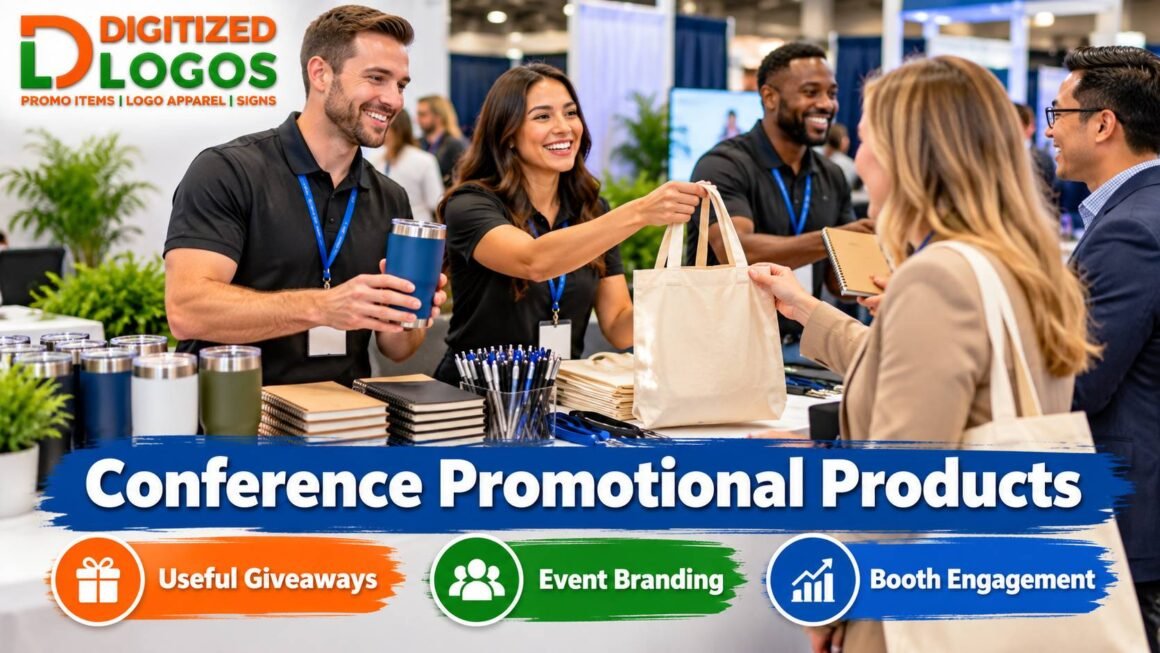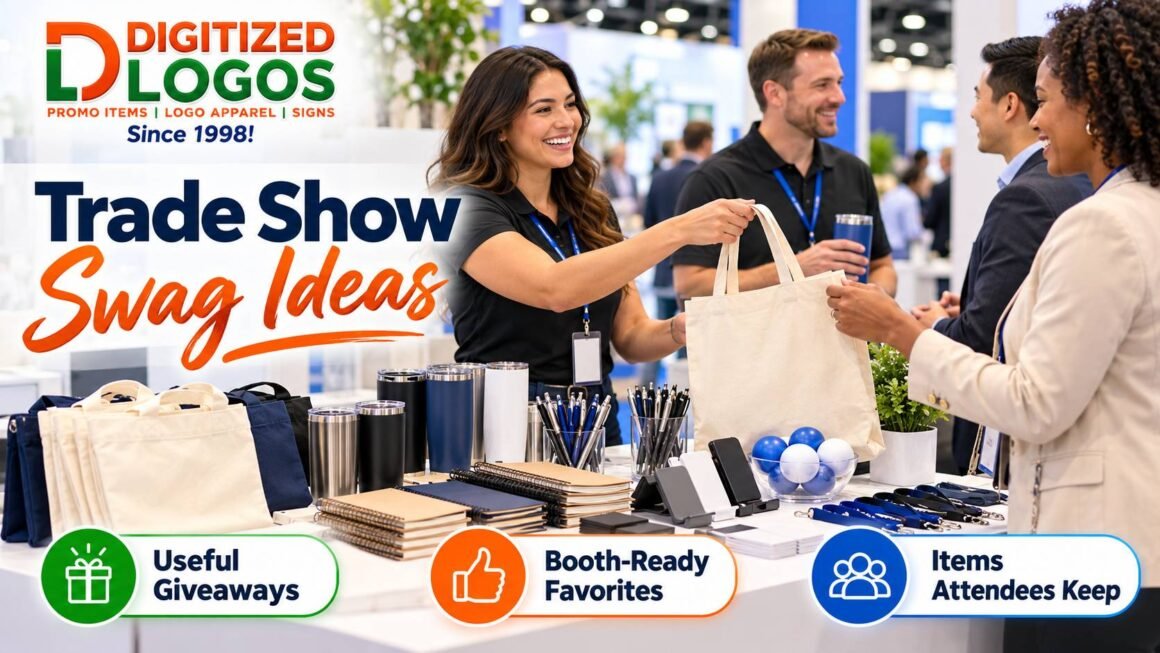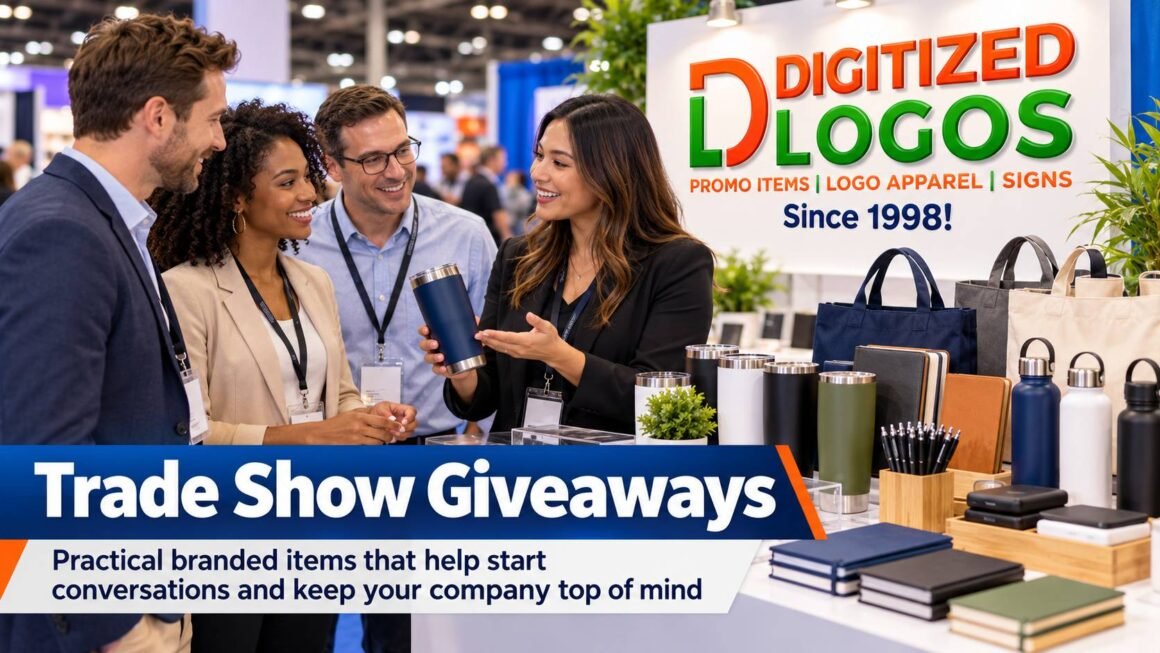
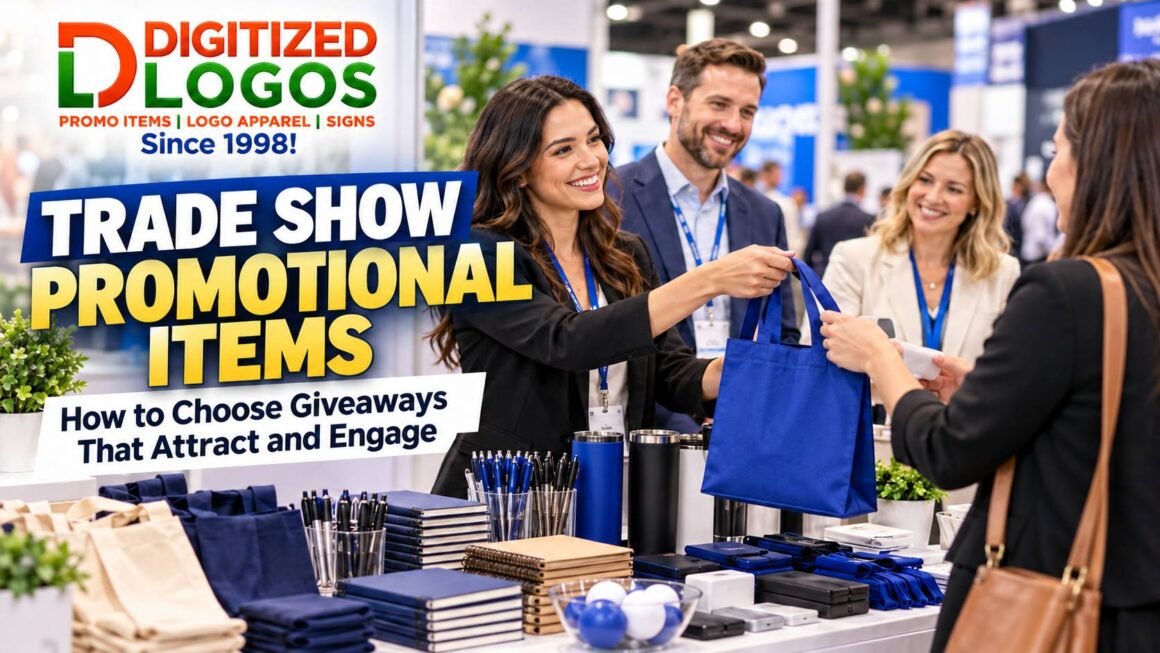
A successful trade show booth needs more than an attractive display. Exhibitors must give attendees a reason to stop, start a conversation, and remember their business after the event. Well-chosen trade show promotional items can support all three goals when they complement a clear event marketing strategy.
From custom tote bags and branded notebooks to reusable drinkware and promotional apparel, the right giveaway creates a useful connection between your company and the people you want to reach. However, ordering thousands of inexpensive products without considering your audience, budget, or event objectives can lead to unnecessary spending.
This guide explains how to select trade show giveaways, compare customization methods, plan quantities, and build a practical promotional merchandise strategy that supports meaningful business interactions.
What Are Trade Show Promotional Items?
Trade show promotional items are branded products that businesses distribute to attendees, prospective customers, employees, and business partners during exhibitions, conferences, conventions, and networking events.
These products typically feature a company logo, brand colors, slogan, or campaign message. Their purpose is to create a physical reminder of the exhibiting business while providing something useful or relevant to the recipient.
Common examples include:
- Custom tote bags for carrying event materials.
- Branded pens, notebooks, and stationery.
- Reusable water bottles and insulated tumblers.
- Promotional T-shirts, polo shirts, and caps.
- Charging cables and practical technology accessories.
- Lanyards, badge holders, and conference accessories.
- Desk accessories and office organization products.
- Premium corporate gifts for qualified prospects and business partners.
The most appropriate giveaway depends on the people attending the event, the impression your business wants to create, and the action you hope recipients will take afterward.
Quick Answer: What Are the Best Trade Show Giveaways?
The best trade show giveaways are useful, appropriate for the target audience, easy to carry, and consistent with the exhibitor’s brand. Tote bags, pens, notebooks, reusable drinkware, and technology accessories are practical options for general audiences. Higher-value gifts may be more appropriate for qualified business prospects or scheduled meetings.
There is no single promotional product that works best at every event. A technology conference, healthcare exhibition, property management convention, and hospitality trade show may attract buyers with very different needs.
Rather than choosing merchandise solely by its unit price, businesses should evaluate whether attendees are likely to use the product and associate it with a positive interaction.
10 Trade Show Promotional Items Worth Considering
1. Custom Tote Bags
Branded tote bags are particularly practical at conventions where attendees collect brochures, samples, notebooks, and promotional materials from multiple exhibitors.
Cotton, canvas, polyester, and nonwoven tote bags offer different combinations of appearance, durability, weight, and cost. Larger printable areas can accommodate logos, campaign graphics, and event messaging.
When selecting tote bags, consider handle strength, bag dimensions, material quality, and whether the design remains readable from a distance.
2. Branded Pens and Writing Instruments
Promotional pens remain a straightforward option for companies that need relatively simple, compact giveaways. They are easy to distribute and may be useful during conference sessions, meetings, and everyday office work.
Plastic pens can suit broad distribution, while metal pens and gift-boxed writing instruments may be appropriate for executive meetings or selected prospects.
Test writing performance before approving a large order. A smooth-writing pen with a legible logo creates a better experience than one selected purely because it is inexpensive.
3. Custom Notebooks and Journals
Notebooks are especially relevant for professional conferences, educational events, training sessions, and business exhibitions.
Businesses can select pocket notebooks, spiral-bound pads, hardcover journals, or notebook-and-pen sets depending on their intended recipients.
Consider paper quality, binding strength, cover durability, and the placement of your logo. A restrained design often works well for corporate audiences because recipients can use the notebook in different professional settings.
4. Reusable Water Bottles
Reusable bottles are practical promotional products for audiences who commute, travel, exercise, or spend extended periods away from their desks.
Available options may include plastic, aluminum, stainless steel, and insulated designs. Features such as leak-resistant lids, comfortable carrying handles, and suitable capacities can influence usability.
Buyers should also review material specifications, cleaning instructions, and any applicable product safety documentation rather than assuming all bottles offer the same performance.
5. Custom Tumblers and Travel Mugs
Branded tumblers and travel mugs can be appropriate for business professionals who regularly carry coffee, tea, or other beverages.
Insulated designs may be particularly appealing for employees, sales teams, business travelers, and corporate gift recipients.
Before ordering, compare lid construction, insulation specifications, capacity, decoration durability, and packaging requirements. Laser engraving and printing can create different visual effects depending on the product material.
6. Promotional T-Shirts
Custom T-shirts can serve as attendee giveaways, contest prizes, employee uniforms, or limited-edition event merchandise.
They offer a larger decoration area than many small promotional accessories, making them suitable for designs featuring logos, illustrations, or event-specific artwork.
However, apparel requires additional planning. Size distribution, fabric weight, fit, printing method, and inventory management can all affect the total cost and recipient experience.
For complex, colorful designs, dye sublimation may be appropriate on compatible polyester fabrics. Screen printing and heat-transfer methods may be better suited to other designs, quantities, and materials.
7. Branded Lanyards and Badge Holders
Lanyards and badge holders can be particularly useful at exhibitions where attendees must display identification throughout the event.
These accessories provide a functional way to incorporate company branding into something recipients may use during the conference.
Check whether event organizers impose rules on badge accessories or provide official lanyards before ordering. Also review attachment styles, available safety breakaways, printing methods, and comfort.
8. Technology Accessories
Technology-related giveaways can work well for IT conferences, professional associations, corporate events, and business audiences that frequently use mobile devices.
Possible options include charging cables, device stands, webcam covers, cable organizers, and power banks.
Technology accessories require careful specification checks. Compatibility, electrical safety, product certifications where applicable, packaging, and shipping requirements can be more involved than those for basic stationery.
A product that does not work reliably with the recipient’s devices is unlikely to provide the intended brand experience.
9. Custom Polo Shirts and Branded Apparel
Branded polo shirts, performance shirts, and lightweight jackets can serve a dual purpose at trade shows. They can help booth personnel maintain a coordinated appearance while also functioning as premium merchandise for customers or business partners.
Custom full-color dye sublimation apparel is worth evaluating when the design calls for detailed graphics, strong color coverage, or an integrated all-over appearance on compatible fabrics.
Businesses should coordinate garment construction, artwork placement, front-and-back consistency, fabric selection, and size availability before production.
10. Premium Executive Gifts
Not every giveaway needs to be distributed to every attendee. Some products are better reserved for scheduled appointments, purchasing managers, qualified prospects, or established business partners.
Examples may include premium notebooks, executive pens, insulated drinkware, curated merchandise kits, and higher-quality travel accessories.
Selective distribution allows businesses to differentiate between general visitor engagement and relationship-building opportunities without treating every booth interaction as equally likely to produce a sale.
How to Choose Trade Show Promotional Items for Your Audience
Choosing the right trade show promotional items starts with understanding the business purpose behind the order.
An exhibitor introducing a new company may prioritize visibility and broad distribution. A business meeting a small group of procurement professionals may prefer fewer products with better perceived value.
Use the following selection process before placing an order.
- Define the event objective. Decide whether the goal is brand awareness, booth traffic, qualified conversations, scheduled meetings, or customer appreciation.
- Identify the target audience. Consider attendees’ industries, job responsibilities, professional interests, and likely product preferences.
- Establish the complete budget. Account for merchandise, customization, setup charges, shipping, packaging, and applicable taxes.
- Evaluate usefulness. Prioritize products that recipients have a reasonable opportunity to use after the exhibition.
- Review portability. Consider how easily attendees can carry the product through the venue and transport it home.
- Select the decoration method. Match the logo, artwork, material, and desired appearance with an appropriate customization process.
- Confirm production requirements. Review artwork approval, quantity requirements, delivery deadlines, and shipping arrangements before authorizing production.
This process helps prevent a common purchasing mistake: selecting an attractive product before confirming whether it is suitable for the event.
Choosing Branded Trade Show Giveaways by Budget and Purpose
A useful promotional merchandise strategy often includes more than one product category. Instead of distributing the same item to everyone, exhibitors can match giveaways to different levels of engagement.
General Booth Visitors
Low-cost, easy-to-carry products can support broad distribution. Pens, small notebooks, stickers, and selected everyday accessories may be appropriate when attendance is high and individual interactions are brief.
Engaged Prospects
For visitors who participate in product demonstrations or have meaningful conversations with the sales team, consider more substantial merchandise such as tote bags, drinkware, or carefully selected office accessories.
Qualified Buyers and Scheduled Meetings
Higher-value products may be appropriate for purchasing decision-makers, existing customers, or prospects involved in a defined business opportunity.
These might include premium drinkware, executive gift sets, or branded apparel, depending on the recipient and the organization’s gift policies.
When evaluating branded trade show giveaways, consider the total cost of distribution rather than focusing exclusively on the price printed in a product catalog.
How Many Promotional Items Should You Order for a Trade Show?
The right order quantity depends on expected booth visitors, event duration, staffing capacity, distribution criteria, and the number of products available from previous events.
Total event registration should not automatically become your merchandise order quantity. Not every attendee will visit your booth, and not every visitor needs to receive the same giveaway.
A practical planning approach is to estimate expected booth interactions, determine what proportion should receive merchandise, and add a reasonable contingency for unexpected demand.
Hypothetical Quantity Planning Example
Suppose a business expects 400 booth visitors and plans to provide a general giveaway to approximately 60% of them.
That would mean 240 giveaways before accounting for contingency stock. With an additional 10% planning allowance, the company would prepare approximately 264 items.
This is an illustrative calculation, not an industry benchmark. Actual quantities should reflect the event’s attendance profile and the exhibitor’s distribution plan.
For premium gifts, maintain a separate quantity estimate based on scheduled appointments or identified opportunities.
Customization Methods: How to Match Artwork With Products
A promotional product’s appearance depends partly on the decoration process used to apply the artwork. Different materials, shapes, and print areas require different methods.
Screen Printing
Screen printing is commonly used for apparel and selected fabric promotional products. It can be suitable for designs with defined colors and relatively straightforward artwork.
Production suitability depends on the garment, number of ink colors, print location, and quantity.
Embroidery
Embroidery uses thread to create a stitched design on compatible fabric products. It is commonly considered for polo shirts, jackets, caps, and other corporate apparel.
Small lettering and highly detailed artwork may need simplification to remain readable after stitching.
Dye Sublimation
Dye sublimation uses heat to transfer dye into compatible materials, most commonly polyester-based fabrics and specially coated products.
It is particularly useful for detailed, full-color graphics and can support extensive printed designs on suitable apparel.
However, standard sublimation is not equally effective on every fabric or product. Material compatibility, base color, construction, and printing specifications must be reviewed before production.
Laser Engraving
Laser engraving removes or alters the surface of compatible materials to create a permanent-looking decorative mark. It is frequently considered for metal drinkware, writing instruments, and selected accessories.
The finished contrast and appearance vary depending on the material and coating.
Digital Printing and Heat Transfers
Digital printing and heat-transfer processes may accommodate complex artwork or multiple colors. Their suitability depends on the product surface, production quantity, required durability, and intended appearance.
Production insight: A logo that looks sharp on a computer screen may not reproduce correctly on a small pen barrel, embroidered cap, or textured fabric. Suppliers often need vector artwork, appropriate line thickness, sufficient contrast, and a design adapted to the actual decoration area.
Ask for a digital proof and confirm critical placement details before production. For complex or high-value orders, a physical sample may also be worth considering when available.
Realistic Business Examples: Matching Giveaways to Event Goals
Example 1: A Property Management Company at an Industry Expo
Consider a hypothetical property management services company exhibiting at a regional real estate conference.
Its target audience includes property managers, building operators, purchasing professionals, and commercial property owners.
Rather than distributing unrelated novelty items, the company might choose branded notebooks for general visitors, reusable drinkware for engaged prospects, and coordinated polo shirts for booth employees.
This approach connects the merchandise to the event’s professional setting while supporting a consistent company presentation.
Example 2: A Technology Provider at a B2B Conference
Imagine a software provider attending a conference to introduce a new business platform.
The company might use compact cable organizers or desktop accessories for booth visitors, while reserving premium notebooks or technology-themed gift sets for scheduled product demonstrations.
Each giveaway could include a concise campaign message or a properly tested QR code directing recipients to a relevant landing page.
These examples illustrate possible strategies and do not represent documented Digitized Logos customer projects.
Common Trade Show Giveaway Mistakes to Avoid
Even professionally designed merchandise can create problems when procurement decisions are rushed or poorly coordinated.
- Ordering without a distribution strategy: Purchasing quantities without defining recipient groups can create shortages or excess inventory.
- Choosing products solely by price: An inexpensive item may offer little value if recipients do not use it.
- Ignoring decoration limitations: Detailed artwork may become unreadable when reduced to a small print area.
- Approving artwork without checking placement: A logo may appear off-center or conflict with seams, handles, lids, or product construction.
- Forgetting packaging and shipping: Bulky or heavy giveaways may increase transport and storage requirements.
- Ordering apparel without a size plan: Incorrect size distributions can leave exhibitors with merchandise they cannot effectively distribute.
- Leaving production decisions too late: Artwork revisions, product sourcing, and shipping can affect event readiness.
- Failing to connect merchandise with follow-up: A giveaway alone does not replace a useful sales conversation or an organized lead-management process.
How to Plan Trade Show Merchandise Production and Delivery
Event deadlines are fixed, which makes production planning especially important. A supplier needs enough information to determine whether the chosen products, customization requirements, and requested delivery schedule are feasible.
Before approving a purchase, confirm the following:
- Exact product model, material, color, and available decoration area.
- Artwork format, logo colors, and required placement.
- Quantity, size breakdowns, and any product variations.
- Proof approval requirements and revision procedures.
- Production schedule and supplier cutoff dates.
- Shipping destination, receiving hours, and delivery instructions.
- Applicable setup charges and additional services.
- Procedures for reporting damaged, missing, or incorrectly decorated items.
If merchandise will ship directly to an exhibition venue, verify the organizer’s freight and receiving rules. Some events require advance warehouse delivery, special labeling, material-handling arrangements, or delivery within designated receiving windows.
For multi-day events, exhibitors should also plan how stock will be stored, replenished, and distributed at the booth.
Are Trade Show Promotional Products Worth the Investment?
Trade show promotional products can be worthwhile when they contribute to a defined business objective and are purchased within a realistic event budget. Their value should be evaluated alongside booth costs, staffing, marketing activities, and sales follow-up.
Businesses should avoid treating the number of giveaways distributed as proof of marketing success.
More useful performance measures may include qualified conversations, booked meetings, relevant follow-up opportunities, landing-page visits, and eventual sales attributable to the event.
How to Evaluate Giveaway Cost
For a practical cost analysis, calculate the full merchandise expense, including product costs, decoration, setup fees, shipping, and applicable additional charges.
Then compare that expense with the number of meaningful business interactions the merchandise strategy helped support.
For example, suppose an exhibitor spends an assumed $1,200 on promotional merchandise and records 60 qualified conversations during the event. The merchandise expense equals $20 per qualified conversation.
That figure is only a cost-allocation measure. It does not establish that the giveaways caused the conversations, nor does it represent customer acquisition cost or return on investment.
To evaluate financial return, the company would also need reliable information about resulting sales, gross profit, attribution, and other relevant event expenses.
Working With Digitized Logos for Trade Show Promotional Products
Digitized Logos provides promotional product and branded apparel solutions for business customers. Companies preparing for exhibitions can explore merchandise options based on their branding requirements, intended recipients, and event objectives.
For purchasing teams, a well-organized supplier discussion should begin with the intended products, required quantities, artwork, budget, and delivery location.
Digitized Logos can be contacted to discuss sourcing and customization requirements for promotional merchandise, including options relevant to corporate events and trade shows. Product availability, minimum order quantities, decoration compatibility, pricing, and production schedules should be confirmed for the specific order.
Businesses can explore available trade show promotional items and compare products suited to general booth distribution, customer engagement, and higher-value business gifting.
Frequently Asked Questions About Trade Show Giveaways
What are the most practical giveaways for trade shows?
Tote bags, notebooks, pens, reusable drinkware, and selected technology accessories are practical options for many professional events. The right choice depends on attendee preferences, budget, portability, and product quality. Businesses should prioritize items that recipients can use beyond the exhibition rather than selecting merchandise based only on novelty.
How far in advance should businesses order trade show promotional products?
Businesses should begin planning as early as practical, especially when orders involve custom apparel, complex artwork, multiple product types, or direct delivery to an event venue. Production times vary by item, quantity, customization method, and supplier capacity. Always confirm a feasible delivery schedule before placing the order.
Are expensive promotional giveaways better than inexpensive ones?
Not necessarily. Lower-cost merchandise can be appropriate for broad event distribution, while premium gifts may fit targeted meetings with qualified buyers. An item’s relevance, usability, and presentation matter more than price alone. A thoughtful distribution strategy can make better use of a limited budget than offering expensive products indiscriminately.
Can businesses order promotional items with full-color logos?
Many promotional products support full-color decoration, but capabilities vary by material, product construction, and printing method. Digital printing, compatible heat transfers, and dye sublimation can accommodate detailed artwork in suitable applications. Buyers should review the available decoration area, artwork requirements, and supplier proof before production.
Should companies include QR codes on trade show giveaways?
QR codes can provide a convenient connection between physical merchandise and digital information when the selected product offers adequate space and printing clarity. Link to a relevant page rather than a generic destination. Test the code at its actual printed size and consider whether the surface shape or material could affect scanning.
Key Takeaways
- Choose promotional giveaways based on your audience, event objectives, and realistic distribution needs.
- Useful products such as tote bags, drinkware, notebooks, and apparel can provide a practical connection to your brand.
- Match decoration methods with product materials, logo complexity, and the desired appearance.
- Include production, freight, setup fees, and handling requirements when building your event merchandise budget.
- Measure event results through meaningful business interactions and follow-up opportunities rather than giveaway quantities alone.
Make Your Next Trade Show Giveaway Strategy More Effective
Trade show promotional items work best when they are treated as part of a broader event marketing strategy, not as an afterthought. A useful product, clear branding, thoughtful distribution, and reliable production planning can help your business create a more professional experience for event attendees.
Whether you are preparing for a regional business expo, an industry conference, or a larger corporate exhibition, selecting the right merchandise starts with understanding who will receive it and how it supports your business objectives.
Explore promotional merchandise with Digitized Logos. Discuss product options, customization requirements, quantities, and event delivery considerations before making your purchasing decision.
Call: 301-963-3553
Email: info@DigitizedLogos.com
Browse promotional products: https://products.digitizedlogos.com/