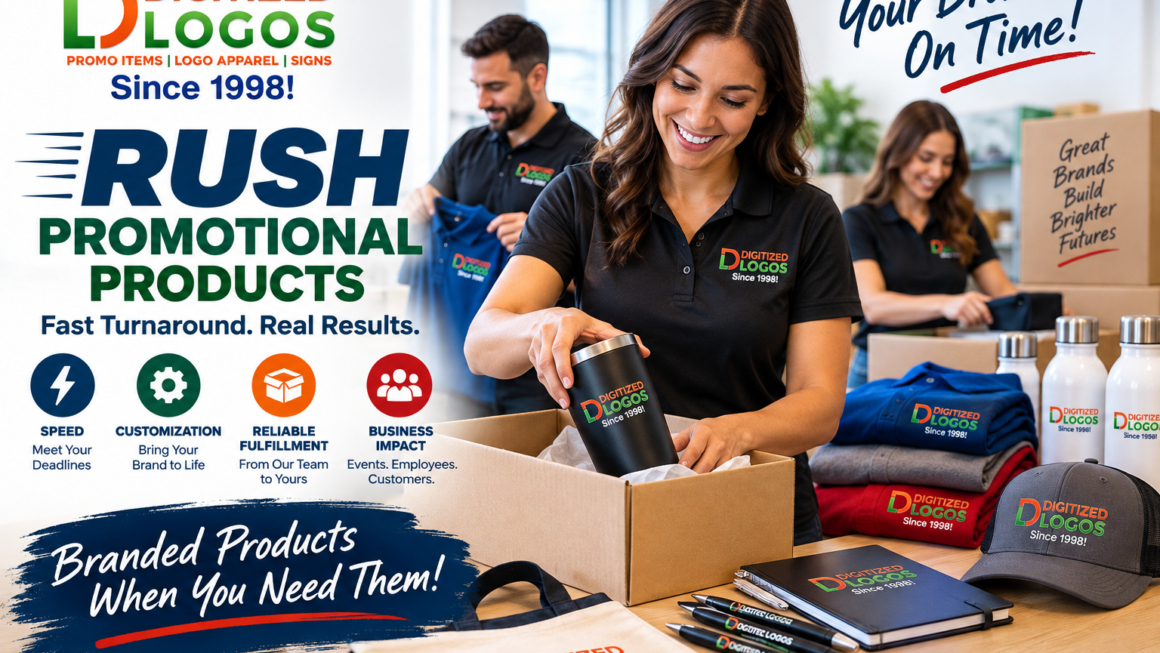
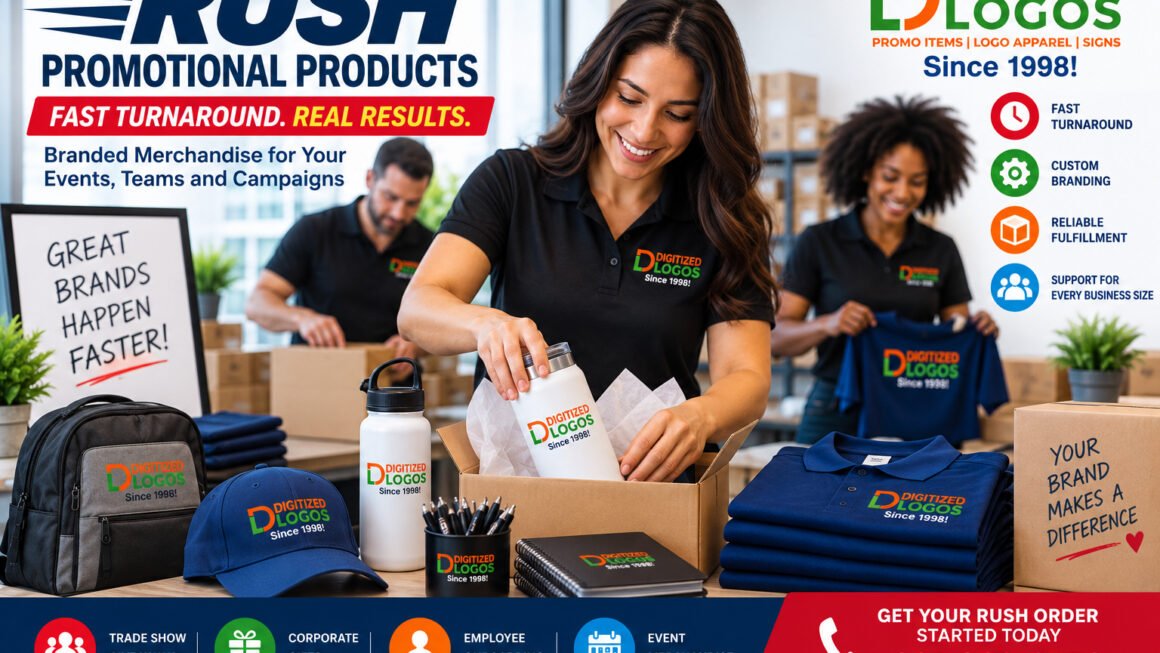
Rush Promotional Products for Fast Business Needs
When an event date moves up, a new employee starts sooner than expected, or a campaign needs branded merchandise immediately, waiting weeks for production is not always an option. Rush promotional products give businesses a practical way to put professionally branded merchandise in people’s hands while working within compressed production and delivery schedules.
Digitized Logos provides branded apparel and promotional product solutions for organizations that need speed without losing sight of presentation, consistency, or business objectives. Companies can explore promotional products with rush service through the Digitized Logos promotional products catalog and identify options suited to their quantity, customization requirements, destination, and deadline.
Quick Answer: What Are Rush Promotional Products?
Short Answer: Rush promotional products are customizable branded items selected and produced specifically for shorter-than-standard turnaround requirements. They can include drinkware, bags, apparel, office accessories, event giveaways, employee gifts, technology accessories, and other corporate merchandise, depending on product availability and the required decoration method.
The fastest option is not necessarily the product with the shortest advertised production time. A successful rush order must account for inventory, artwork approval, decoration, quantity, packaging, destination, carrier transit time, and the actual date the merchandise needs to be in hand.
Why Businesses Need Rush Promotional Products
Most organizations do not intentionally leave branded merchandise until the last minute. Rush requirements often emerge because business timelines change faster than procurement and marketing plans.
A sales team may secure a booth at an industry conference with two weeks of notice. Human resources may need onboarding kits after a hiring class expands unexpectedly. A corporate event may require another 150 attendee gifts after registrations exceed projections.
Common applications include:
- Trade show and conference giveaways
- Employee onboarding kits and new-hire merchandise
- Customer appreciation gifts
- Sales meetings and executive events
- Corporate swag for internal campaigns
- Branded apparel for teams and field personnel
- Grand openings and community events
- Recognition programs and employee celebrations
- Last-minute campaign and sponsorship requirements
In each situation, speed matters, but the real business objective is event readiness. Merchandise arriving two days after an event has considerably less value than a simpler product that arrives on time and looks professional.
Promotional Products With Rush Service: What Actually Determines Turnaround?
Short Answer: Rush turnaround depends on more than printing speed. Product inventory, artwork readiness, decoration method, order quantity, proof approval, packaging requirements, destination, and shipping method collectively determine whether a deadline is realistic.
This distinction matters because buyers often see a short production estimate and assume it represents the complete order timeline. Production time and delivery time are separate parts of the schedule.
Product Availability
An item cannot move into decoration if the required quantity, color, or configuration is unavailable. For urgent projects, choosing an in-stock alternative can save considerably more time than trying to preserve a specific product choice.
Artwork Readiness
Clean, production-ready artwork helps prevent avoidable delays. Low-resolution graphics, missing fonts, unclear brand colors, or repeated artwork revisions can consume valuable time before production begins.
Decoration Method
Screen printing, embroidery, digital printing, dye sublimation, laser engraving, pad printing, and other decoration methods have different workflows. The best method depends on the product, artwork, desired appearance, quantity, and available production window.
Quantity
A 100-piece giveaway order and a 5,000-piece merchandise program create different sourcing and production requirements. Larger quantities can still be achievable under tight timelines, but capacity should be confirmed before committing to the delivery date.
Shipping Destination
Transit is part of the deadline. Businesses in Maryland, Virginia, Washington DC, and elsewhere across the United States should evaluate the complete timeline from order approval through final delivery, not production alone.
How to Order Rush Promotional Products: A 7-Step Framework
Urgent orders become easier to manage when buyers start with operational constraints rather than browsing hundreds of products. The following framework helps reduce uncertainty.
- Define the in-hand date. Specify when the merchandise must physically arrive, not simply the event date.
- Confirm the quantity. Establish a realistic quantity and include a reasonable buffer for additional attendees or employees where appropriate.
- Set the budget. Consider product cost, decoration, setup requirements, packaging, and expedited freight as part of the total project cost.
- Identify the business purpose. Determine whether the merchandise is for lead generation, employee engagement, customer gifting, event visibility, onboarding, or another objective.
- Shortlist production-compatible products. Prioritize merchandise that is in stock and compatible with the available customization window.
- Prepare and approve artwork quickly. Provide usable logo files, brand colors, imprint instructions, and authorized approvals without unnecessary revision cycles.
- Confirm production and logistics. Validate the production schedule, shipping destination, delivery method, and required arrival date before finalizing the order.
Use Case: Last-Minute Trade Show Merchandise
A regional technology company learns 12 days before a conference that its booth sponsorship includes an additional networking event. The team wants 500 branded giveaways but originally planned on a specialty item with a longer production schedule.
Instead of forcing the original selection into an unrealistic timeline, the buyer chooses an in-stock product with a faster decoration workflow. Artwork is approved immediately, production begins without additional revisions, and expedited delivery creates a buffer before booth setup.
The lesson is straightforward: deadline-compatible merchandise often creates more business value than the theoretically perfect product that cannot arrive on time. Buyers facing similar event requirements can use Digitized Logos’ promotional product selection to identify merchandise aligned with the audience, campaign, and available timeline.
Use Case: Employee Onboarding Kits for an Expanding Hiring Class
Consider an HR team that planned onboarding merchandise for 80 new employees but receives approval to expand the hiring class to 120. Forty additional kits are suddenly required within a short window.
The team could attempt to reproduce every component of the original kit, but one specialty item may delay the entire project. A better operational decision can be to preserve the most visible brand elements, such as a branded shirt, tumbler, notebook, and bag, while replacing the slow component with an available alternative.
If an onboarding kit costs $45 per employee, 40 additional kits represent a $1,800 merchandise investment before freight or special packaging. Evaluating that expenditure against employee experience, brand consistency, and readiness for day one provides a more meaningful ROI framework than evaluating the lowest unit price alone.
Choosing the Right Product for a Rush Order
Short Answer: For urgent orders, prioritize availability, dependable decoration, audience relevance, usable life, and shipping efficiency. Product selection should begin with the deadline and business objective, then narrow to merchandise that can realistically satisfy both.
A $3 giveaway that reaches 1,000 qualified conference attendees can be more useful than a premium $20 gift intended for the same audience if the premium product exceeds the budget or cannot meet the event date. Conversely, higher-value merchandise can make more sense for executives, employees, strategic customers, or account-based marketing campaigns.
Trade Show Giveaways
Prioritize portability, visibility, useful products, and efficient distribution. Bags, drinkware, writing instruments, notebooks, accessories, and event-ready branded merchandise can support booth traffic and post-event brand recall.
Corporate Gifts
For clients and strategic partners, perceived quality matters more than maximizing unit count. Packaging, material quality, usefulness, and brand presentation should receive greater weight.
Employee Merchandise
Wearability and practical utility are critical. Branded apparel, drinkware, bags, desk products, and useful accessories can become part of everyday employee experience rather than disposable swag.
Onboarding Kits
Consistency matters because every new employee should receive a comparable brand experience. Buyers should consider whether products can be reordered later without creating obvious differences between onboarding groups.
Rush Service vs Standard Promotional Product Ordering
Standard ordering usually gives buyers more freedom to compare products, decoration techniques, colors, packaging, and pricing. Rush ordering shifts the priority toward products and processes capable of meeting a fixed deadline.
Standard orders are generally better when buyers have flexible schedules, complex customization, specialty packaging, very large quantities, or extensive product comparisons. Rush orders are better suited to fixed event dates, unexpected inventory shortages, accelerated hiring, campaign launches, sponsorship opportunities, and other time-sensitive requirements.
Neither approach is inherently better. The correct choice depends on which constraint carries the greatest business risk.
Buyer Considerations Before Approving a Rush Order
Cost
Rush orders may carry additional costs because accelerated production or expedited freight can be required. Buyers should compare the total project cost with the cost of missing the business opportunity.
For example, suppose a company spends $2,500 on 500 branded event items, or $5 per attendee. If the merchandise contributes to stronger booth engagement and helps generate five additional qualified opportunities, the meaningful question is not whether $5 per item was the cheapest option. It is whether the campaign supported enough pipeline value to justify the $2,500 investment.
Minimum Quantities
Minimum order quantities vary by product and production process. Buyers needing smaller quantities should identify that constraint early so time is not wasted reviewing products that cannot support the required order size.
Customization Flexibility
Complex customization usually creates more production variables. Multiple imprint locations, individual personalization, specialty packaging, unusual color matching, or highly detailed decoration can affect the available timeline.
Quality Consistency
Fast should not mean careless. Logos should remain legible, imprint placement should be appropriate for the product, brand colors should be handled consistently, and merchandise should reflect the organization professionally.
Fulfillment Logistics
Determine whether everything is shipping to one office, an event venue, multiple branches, or individual recipients. Multi-destination fulfillment can add operational complexity and should be discussed early in the project.
Behind the Scenes: What Happens After a Rush Order Is Submitted?
Rush fulfillment works best when several operational steps happen in the correct sequence. The supplier verifies inventory, evaluates artwork, confirms the decoration process, schedules production, manages approvals, coordinates packaging, and plans outbound logistics.
One important behind-the-scenes reality is that artwork approval can become the critical path. Saving a day in production has little value if two days are lost waiting for internal stakeholders to approve a proof. Businesses with hard deadlines should identify an authorized approver before submitting the order.
A second operational insight involves shipping buffers. Scheduling delivery for the morning an event begins creates unnecessary risk. When possible, the requested in-hand date should include time for receiving, inspection, internal distribution, venue handling, or unexpected carrier disruption.
How to Evaluate Vendors for Rush Promotional Products
Short Answer: Choose a rush promotional products partner based on operational reliability, not merely the shortest advertised turnaround. The vendor should be able to connect product sourcing, customization, production, approval, and fulfillment into one realistic schedule.
Ask prospective suppliers:
- Is the required inventory available now?
- When does production begin after artwork approval?
- Which decoration methods fit the deadline?
- What minimum quantities apply?
- Are rush or expedited charges involved?
- What shipping method is required?
- Can the order ship to multiple destinations if necessary?
- How are proofs and approvals handled?
- What happens if the preferred product becomes unavailable?
Digitized Logos provides branded apparel and promotional product solutions while managing sourcing, customization, and fulfillment. For organizations evaluating a vendor for urgent requirements, that coordinated approach reduces the number of separate production and logistics decisions the buyer must manage.
Decision Support: Balancing Speed, Cost, Quality, and ROI
Rush purchasing is usually a tradeoff among four factors: deadline, product choice, customization complexity, and budget. Fixing all four without flexibility can create unnecessary risk.
If the deadline cannot move, consider allowing flexibility in the product or decoration method. If brand presentation cannot change, budget flexibility may be required for faster production or transportation. If the budget is fixed, a simpler in-stock item may produce a stronger outcome than forcing a premium selection into an unrealistic schedule.
Businesses should also think beyond the individual order. A recurring merchandise program can reduce future rush requirements by establishing approved products, artwork, reorder quantities, and inventory strategies before the next campaign occurs.
Rush Merchandise as Part of a Scalable Branded Merchandise Program
Organizations that regularly purchase corporate swag can use purchasing history to anticipate recurring demand. Annual conferences, employee anniversaries, recruiting seasons, sales kickoffs, community events, and holiday gifting often occur on predictable schedules.
A scalable program can establish a core group of approved products for planned purchasing while maintaining a smaller set of rush-compatible alternatives for unexpected needs. This creates more consistency across branded apparel, promotional products, corporate gifting, onboarding kits, and event merchandise.
For multi-location organizations, standardization can also reduce brand drift. Approved artwork, imprint specifications, product selections, and reorder processes help Maryland, Virginia, Washington DC, and nationwide teams present the same organization consistently.
Current Trends in Fast-Turn Branded Merchandise
Business buyers increasingly expect merchandise to do more than display a logo. Products need to feel useful, intentional, and appropriate to the recipient.
That is driving interest in practical drinkware, retail-inspired branded apparel, reusable bags, work accessories, technology-related products, curated employee kits, and merchandise that can serve multiple campaigns. Organizations are also becoming more selective about quantities because unused inventory creates storage costs and weakens promotional ROI.
Another important trend is treating merchandise as an operational program rather than a series of disconnected purchases. Procurement, marketing, HR, sales, and event teams can achieve greater consistency when they share approved products and branding standards.
Common Rush Ordering Mistakes
- Starting with the product instead of the deadline. Establish the in-hand date first.
- Confusing production time with delivery time. Freight and receiving must be included.
- Submitting incomplete artwork. Artwork corrections consume time that cannot always be recovered.
- Overcomplicating customization. Extra imprint locations or personalization may increase production requirements.
- Ordering exactly the expected quantity. Events and onboarding groups can grow unexpectedly.
- Waiting too long for proof approval. Internal approval delays can undermine an otherwise achievable schedule.
- Choosing purely on unit price. Arrival date, usefulness, quality, and campaign impact affect total value.
How Digitized Logos Supports Time-Sensitive Merchandise Projects
Digitized Logos provides branded apparel, promotional products, and corporate merchandise solutions for businesses, agencies, institutions, associations, government organizations, and other professional buyers. The company manages sourcing, customization, and fulfillment to help customers move from product selection to completed merchandise efficiently.
Digitized Logos is an MDOT, DDOT, and VA SWaM Certified Small, Minority, Female-Owned Business, providing additional relevance for organizations with supplier diversity and procurement objectives in Maryland, Virginia, Washington DC, and beyond.
For rush projects, the value of experienced support is practical: buyers can focus on the products that fit their actual deadline rather than spending critical time evaluating merchandise that cannot satisfy the production requirements.
FAQ: Rush Promotional Products
How quickly can rush promotional products be produced?
Turnaround varies by product, quantity, inventory, decoration method, artwork approval, and destination. Some products are designed for accelerated production, while others require longer schedules. The safest approach is to provide the required in-hand date first so sourcing and production decisions can be made around the actual deadline.
Do promotional products with rush service cost more?
They can. Additional costs may result from accelerated production, expedited freight, or other deadline-related requirements. However, the cheapest shipping or production option is not always the best business decision when merchandise supports a fixed event, employee start date, customer meeting, or revenue-generating campaign.
Can rush promotional products still be customized with our logo?
Yes. Many rush-compatible promotional products can be decorated with company logos or campaign artwork. Available customization depends on the product, decoration process, artwork, quantity, and schedule. Keeping artwork production-ready and limiting unnecessary revisions can make the approval and production process significantly more efficient.
Are minimum quantities required for rush promotional products?
Minimum quantities depend on the specific product and production method. Some merchandise supports relatively small orders, while other products are designed for higher-volume production. Sharing quantity, budget, deadline, and customization requirements at the beginning makes it easier to identify realistic options without delaying the project.
What are the best products for a last-minute corporate event?
The best choices are in-stock products that are useful, easy to distribute, appropriate for the audience, and compatible with fast decoration. Depending on availability, drinkware, bags, writing products, notebooks, apparel, and practical accessories can work well for conferences, trade shows, employee events, and customer programs.
Key Takeaways
- Successful rush ordering starts with the required in-hand date, quantity, destination, and business objective.
- Inventory, artwork approval, decoration, production, packaging, and shipping all affect actual turnaround.
- Product flexibility can reduce cost and delivery risk when a deadline cannot move.
- ROI should consider campaign outcomes, employee experience, event readiness, and brand visibility, not unit price alone.
- Standardized merchandise programs can reduce future emergencies while improving brand consistency and scalability.
Get Rush Promotional Products Ready for Your Next Deadline
When a conference, onboarding program, corporate event, customer campaign, or employee initiative is approaching quickly, the goal is not simply to order merchandise faster. The goal is to get the right rush promotional products produced, branded, and delivered in time to create business value.
Digitized Logos can help businesses evaluate product availability, customization requirements, ordering flexibility, turnaround expectations, and fulfillment needs while maintaining consistent brand presentation. Start exploring promotional products at https://products.digitizedlogos.com/ or call 301-963-3553 to discuss a time-sensitive project.
Better planning creates consistency. When the deadline is already close, experienced sourcing and fulfillment support can help create a clearer path to event readiness, brand visibility, and professionally executed merchandise.
#RushPromotionalProducts #PromotionalProducts #CorporateSwag #BrandedMerchandise #BrandedApparel #TradeShowGiveaways #CorporateGifts #EmployeeOnboarding #DigitizedLogos