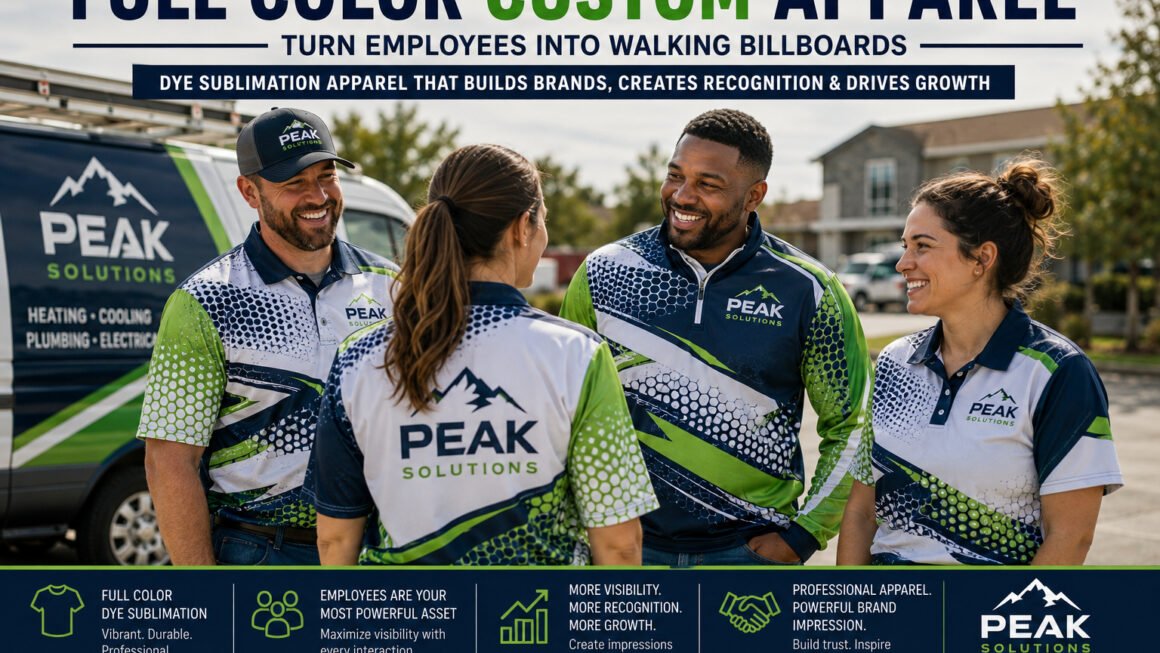
Full Color Custom Apparel: Turn Employees Into Walking Billboards
Employees are one of the most underutilized marketing assets in any organization. Businesses invest heavily in digital campaigns, signage, direct mail, sponsorships, and paid media while overlooking a marketing channel that already interacts with customers every day: their workforce. Full Color Custom Apparel can turn those everyday interactions into consistent opportunities for brand visibility, recognition, and growth.
From custom performance jerseys worn by event teams to branded workwear used by technicians, sales representatives, restaurant employees, and customer-facing staff, company apparel can do more than create a professional appearance. When strategically designed, it becomes a mobile branding system that keeps a company visible wherever employees work, travel, meet customers, attend events, or interact with the community.
Quick Answer
Full Color Custom Apparel transforms employees and teams into mobile brand ambassadors by creating repeated visual exposure wherever they go. Dye sublimation apparel, including custom performance jerseys, can strengthen customer recognition, local awareness, brand recall, and professional consistency while continuing to generate impressions long after the initial purchase.
What Is Full Color Custom Apparel?
Full Color Custom Apparel is branded clothing designed with extensive color, graphics, patterns, logos, messaging, and other visual elements to create a distinctive company identity. With dye sublimation, designs can become an integrated part of the garment rather than functioning only as a small decorative logo placed on top of it.
For businesses, the strategic value is not simply having a more colorful shirt. It is having more visual real estate available to communicate a recognizable brand identity.
Custom uniforms, polos, shirts, jackets, branded workwear, promotional apparel, and custom performance jerseys can all become part of a coordinated workforce branding program. Employees then reinforce the same visual identity customers encounter on company vehicles, websites, storefronts, trade show displays, advertising, and sales materials.
This consistency matters because recognition is rarely created through a single exposure. Brands become familiar when customers encounter recognizable visual cues repeatedly.
The Walking Billboard Effect
Walking billboard marketing is the idea that branded clothing creates mobile advertising impressions whenever it is worn in public or around customers. Unlike a stationary sign, employee apparel moves through workplaces, neighborhoods, restaurants, stores, job sites, events, hotels, parking areas, conferences, and community spaces.
Are employees walking billboards? They can be. When employees consistently wear recognizable company apparel, ordinary customer and community interactions become recurring brand impressions.
Consider a service technician wearing a professionally designed uniform while arriving at a residential property. Neighbors may see the employee approaching the home. Customers see the brand throughout the service appointment. The technician may stop for fuel or lunch afterward. Each interaction creates another opportunity for the company identity to be noticed.
That exposure compounds across a workforce.
How many impressions can employee apparel generate? There is no universal number because impressions depend on workforce size, where employees work, how frequently garments are worn, and how many people employees encounter. The more employees wearing recognizable apparel in high-traffic or customer-facing environments, the greater the potential cumulative exposure.
The important business advantage is longevity. A digital advertisement disappears when a campaign ends. A radio spot ends within seconds. A piece of direct mail may be discarded quickly. Well-made branded apparel can continue producing visual impressions every time employees wear it.
A garment purchased once may therefore create exposure over weeks, months, events, shifts, customer visits, and community interactions.
Why Employees Are One of the Most Powerful Marketing Channels
Employees are one of the most underutilized marketing assets in any organization because they already participate in the environments businesses are trying to reach.
A restaurant employee interacts with diners. An HVAC technician travels through neighborhoods. A dealership representative meets prospective buyers. A retail employee assists shoppers. A hospitality team interacts with guests. A solar installation crew may spend hours working in highly visible residential areas.
These interactions already exist. Employee branding adds a recognizable visual identity to them.
That makes workforce branding different from many paid advertising channels. Instead of purchasing access to an audience and hoping someone notices an advertisement, a business can reinforce its identity during actual service delivery and human interaction.
Why does branded apparel improve brand recognition? Branded apparel repeatedly presents consistent visual cues such as logos, colors, patterns, and company identity during real-world interactions. Repetition can make the business easier for customers to recognize and remember later.
Employee apparel can also contribute to trust. Customers arriving at a restaurant, dealership, retail store, hotel, or service appointment can quickly identify who represents the organization. That clarity can make an operation appear more organized and professional.
In this sense, company apparel performs multiple jobs simultaneously: employee identification, brand reinforcement, customer recognition, cultural alignment, and marketing visibility.
Full Color Custom Apparel as a Brand Visibility Strategy
The greatest marketing opportunity comes from treating apparel as part of the brand system rather than as an isolated merchandise purchase.
Traditional uniform programs often begin with the question, “Where should we put the logo?” A stronger strategic question is, “How can employees become instantly recognizable representatives of the brand?”
Full-color dye sublimation expands the creative possibilities. Businesses can incorporate distinctive colors, patterns, visual themes, campaign graphics, sponsor elements, department identities, and other brand assets into apparel.
Custom performance jerseys are particularly useful for company events, tournaments, promotional teams, hospitality environments, outdoor activations, employee programs, and other situations where visibility and visual energy matter.
When the apparel is distinctive enough to be recognized at a distance, it can perform a role similar to mobile signage. Customers do not necessarily need to read every word. Strong colors, patterns, and consistent branding can establish recognition before someone consciously processes the entire design.
Understanding the ROI of Branded Apparel
What is the ROI of branded uniforms? ROI should be evaluated through more than immediate sales attribution. Branded uniforms can create value through repeated exposure, customer recognition, professional presentation, employee identification, brand consistency, and the long usable life of the garment.
One useful concept is cost per impression.
Suppose a business purchases apparel that employees repeatedly wear during customer interactions. The initial cost is fixed, but the number of potential impressions can continue increasing each time those garments are worn.
That creates a fundamentally different economic model from advertising channels where exposure stops when spending stops.
Digital advertising generally requires continued media spend to maintain reach. Radio requires additional airtime. Direct mail requires another print and distribution cycle. Outdoor advertising typically requires continuing placement costs.
Branded apparel requires an upfront investment but can continue delivering visibility throughout its useful life.
This does not mean apparel should replace paid advertising. Its strategic value is often strongest when it reinforces other marketing channels.
A customer might see a service vehicle, encounter an employee wearing branded workwear, notice a digital advertisement later, and eventually search for the business. Consistent branding across those touchpoints can make the company feel familiar.
Is custom apparel a marketing investment? Yes, when it is intentionally designed and consistently used to increase visibility, reinforce brand identity, improve recognition, and support customer-facing operations. The business case becomes stronger when garments are worn frequently and across a larger workforce.
Three Real-World Business Examples
1. HVAC Company: Turning Service Calls Into Neighborhood Visibility
Imagine an HVAC company with 20 field technicians serving communities across Maryland and Virginia. Each technician makes several customer visits per day.
Without consistent branded workwear, those technicians generate little visual connection to the company outside the service vehicle.
With recognizable custom uniforms, every arrival becomes another branding opportunity. Homeowners see the company identity. Neighbors may notice technicians working nearby. Property managers recognize the team during repeat visits.
The business outcome is broader neighborhood awareness and stronger customer recognition without purchasing an advertising impression for every individual interaction.
2. Restaurant: Making the Staff Part of the Brand Experience
A busy restaurant may serve hundreds of customers during a weekend. Employees interact directly with diners throughout that experience.
Distinctive Full Color Custom Apparel can make the workforce part of the restaurant’s visual identity. Instead of generic uniforms, staff apparel can reflect the restaurant’s colors, personality, atmosphere, and promotional themes.
The business outcome extends beyond appearance. Employees become easier to identify, the environment feels more coordinated, and customers repeatedly encounter the brand throughout their visit. Staff members wearing the apparel during off-site catering or community events can extend that visibility further.
3. Car Dealership: Creating Recognition Across Departments
A dealership may have sales representatives, service advisors, technicians, event staff, and customer-service employees interacting with buyers at different stages of ownership.
A coordinated apparel program can create consistency across those departments while allowing role-specific customization. Custom performance jerseys might be used for promotional events, while polished branded apparel supports everyday sales and service operations.
The business outcome is a more unified customer experience. Customers can recognize representatives more easily, while consistent visual branding reinforces the dealership identity throughout the property and at community events.
Branded Apparel vs. Traditional Advertising
Businesses evaluating marketing investments should consider not only how many people a channel can reach but also how long the exposure lasts, how frequently it repeats, and whether it reinforces actual customer experiences.
- Digital advertising: Highly targetable and measurable, but visibility generally depends on continued campaign spending.
- Direct mail: Can reach specific households or businesses, but exposure may be brief and requires new production and distribution for additional campaigns.
- Radio advertising: Can generate broad local awareness, but each individual message is temporary and requires repeated media purchases.
- Print advertising: Can support targeted audiences and credibility, but visibility depends on publication frequency and readership.
- Outdoor advertising: Provides strong geographic visibility, but placement is stationary and usually requires ongoing media costs.
- Branded apparel: Moves with employees, supports real customer interactions, can produce repeated exposure, and continues functioning throughout the garment’s usable life.
The strongest strategy is rarely choosing only one channel. Instead, businesses can use employee branding to reinforce the recognition created by advertising elsewhere.
When customers encounter the same visual identity online, on vehicles, at physical locations, and on employees, separate marketing activities begin working together as one recognizable brand system.
How Employee Branding Supports Business Growth
How does employee branding support business growth? It increases the number of places where customers can encounter and recognize a company’s identity while reinforcing professionalism during actual customer interactions.
Growth depends partly on becoming memorable enough to enter the customer’s consideration set when a need arises.
For local businesses, this can be particularly important. A homeowner may not need an HVAC contractor today, but repeatedly seeing a recognizable company throughout the community can contribute to familiarity when the air conditioner eventually fails.
A customer may not be shopping for a vehicle this week but may recognize a dealership months later. A hotel guest may remember a hospitality brand after seeing consistent employee presentation throughout a stay.
This is why brand visibility should not be measured only through immediate conversions. Familiarity accumulates.
Employee apparel creates another opportunity for that accumulation to occur.
How Small Businesses Can Increase Visibility Without Large Advertising Budgets
How can small businesses increase visibility without large advertising budgets? They can make greater use of marketing assets they already control, including employees, vehicles, locations, packaging, customer communications, and company apparel.
For small businesses in Maryland, Virginia, Washington DC, and communities throughout the United States, workforce branding can be particularly efficient because employees frequently operate within the exact geographic markets the business wants to reach.
Instead of paying exclusively for additional reach, the company improves the visibility of everyday operations.
A five-person service company does not need hundreds of employees for this strategy to matter. If those five employees regularly interact with customers and move throughout the local market, professional branded apparel can make each interaction more identifiable.
The goal is not to manufacture artificial exposure. It is to capture more branding value from activity that is already happening.
Company Culture and Employee Engagement Matter Too
Workforce branding is outward-facing, but it also has an internal dimension.
Well-designed company apparel can reinforce team identity and help employees feel connected to a recognizable organization. This becomes especially relevant during conferences, company meetings, community events, trade shows, charity activities, sales events, and team-building programs.
Employee adoption matters, however. Apparel only creates sustained marketing value when people actually want to wear it.
That means businesses should consider comfort, role requirements, visual appeal, garment selection, workplace environment, and employee feedback alongside branding objectives.
A shirt that looks impressive but stays in an employee’s closet produces no impressions. A thoughtfully designed garment that employees repeatedly choose to wear can become a recurring brand asset.
Decision Support: Building a Practical Apparel Program
Budget
Start with the employees and situations that generate the most customer visibility. Customer-facing teams, field employees, sales representatives, event staff, hospitality workers, and service technicians may provide the strongest initial opportunities.
ROI
Evaluate more than direct sales. Consider garment lifespan, frequency of use, customer interactions, employee visibility, brand consistency, replacement cycles, and potential impressions. The more frequently apparel is worn, the more opportunities the original investment has to create value.
Implementation
Define the purpose before selecting garments. Determine whether the program is intended for daily uniforms, events, promotional teams, sales staff, field crews, customer-facing employees, or multiple use cases.
Employee Adoption
Choose apparel appropriate for the actual working environment. Employees are more likely to support a workforce branding program when garments are comfortable, practical, visually appealing, and suitable for their roles.
Customization Flexibility
Dye sublimation apparel provides extensive design flexibility for organizations that want more than a standard logo placement. Full-color graphics, patterns, department variations, campaign themes, and custom performance jerseys can be developed while maintaining an overarching brand identity.
Ordering Logistics
Centralizing sourcing, customization, production, and fulfillment can reduce the administrative burden of managing multiple vendors. Establishing approved artwork and garment standards also helps prevent inconsistent branding between departments or locations.
Scalability
Design the program so it can expand. A company might begin with a customer-facing team and later add field employees, event apparel, seasonal garments, promotional apparel, and additional locations.
Why a Coordinated Apparel Partner Matters
Effective employee branding requires more than printing a logo on a shirt. Businesses must coordinate garment sourcing, artwork, customization, sizing, production, quality expectations, delivery, replenishment, and sometimes distribution across multiple locations.
Digitized Logos provides branded apparel and promotional product solutions and manages sourcing, customization, production, and fulfillment. This coordinated approach can help organizations create more consistent company apparel programs while reducing the complexity of working across disconnected suppliers.
Digitized Logos is also an MDOT, DDOT, and VA SWaM Certified Small, Minority, Female-Owned Business, serving organizations seeking branded solutions for workforce programs, events, promotions, and customer-facing operations.
For organizations exploring visually distinctive workforce branding, dye sublimation apparel offers the flexibility to move beyond basic uniform decoration and create clothing that functions as part of the broader marketing system.
Frequently Asked Questions
Are employees really walking billboards for a business?
Yes, employees can function as walking billboards when they consistently wear recognizable branded apparel. Every customer interaction, service call, event, commute, or community encounter can create additional visual exposure for the company.
What is the ROI of branded employee uniforms?
The ROI comes from repeated use and multiple business benefits, including brand visibility, customer recognition, professional presentation, employee identification, and long-term exposure. ROI tends to improve when apparel is worn frequently and remains in service for an extended period.
Are custom performance jerseys suitable for corporate branding?
Yes. Custom performance jerseys can be effective for corporate events, promotional teams, tournaments, outdoor activities, hospitality programs, employee initiatives, and other high-visibility environments where businesses want distinctive full-color branding.
Why choose dye sublimation for Full Color Custom Apparel?
Dye sublimation enables extensive full-color customization, making it possible to integrate patterns, graphics, brand colors, and visual themes across apparel. This gives organizations greater creative flexibility when building recognizable employee branding programs.
Can branded apparel help a small local business compete with larger companies?
Yes. Branded apparel helps smaller businesses increase visibility by turning normal employee activity into recurring brand exposure. It can complement digital and traditional advertising without requiring businesses to purchase every individual impression.
Key Takeaways
- Visibility: Employees can generate recurring brand impressions during customer interactions and everyday activity.
- Branding: Consistent company apparel can strengthen recognition, professionalism, customer familiarity, and workforce branding.
- Marketing value: Apparel can continue creating exposure long after its initial purchase, making it a durable complement to paid advertising.
- ROI: Evaluate branded apparel through frequency of wear, longevity, customer exposure, operational value, and cost per potential impression rather than immediate sales alone.
- Implementation: Successful programs combine strong design with practical garments, employee adoption, consistent production, straightforward ordering, and scalability.
Turn Your Workforce Into a More Visible Brand
Employees are one of the most underutilized marketing assets in any organization. Every shift, customer meeting, service visit, event, and community interaction represents an opportunity to make the business more recognizable.
Full Color Custom Apparel helps businesses capture that opportunity. From branded workwear and custom uniforms to custom performance jerseys and promotional apparel, the right program can transform clothing from an operating expense into a long-term brand visibility investment.
Digitized Logos can help organizations develop consistent employee branding with flexible customization, coordinated sourcing, production and fulfillment, and fast-turnaround solutions designed around real business needs.
For businesses ready to make their employees, teams, and customer-facing operations more visible, call 301-963-3553 or visit Digitizedlogos.com to explore dye sublimation apparel options.
Your employees are already representing your business every day. The opportunity is to make every one of those interactions work harder for brand visibility, customer recognition, and business growth.